Showing posts with label keynes. Show all posts

Wednesday, March 17, 2021

Keynes vs Marx on Idealism and Materialism


The NZ Labour Party hanging onto the coat-tails of dying capitalism will end up in the same graveyard of “progressive hopes”. Fortunately, before that happens workers will reach peak idealism and awaken to dialectical materialism. But such is its hold on our minds, idealism is not spontaneously replaced by the materialist world view we need to make the transition from capitalism to socialism. 

Without a class conscious revolutionary leadership to warn them and point the way, workers will fall for anti-scientific conspiracy theories of power elites manipulating their lives. Without the antidote to idealism, workers fall prey to demagogues of left and right instead of uniting and organizing to fight for survival socialism.

Idealism is the doctrine that thought creates being, rather than as Marx put it, that being determines consciousness. Being is our material, biological and productive life. Life begins with material needs not the ideas we use to measure it. 

So if our basic needs (jobs, health, housing, education etc) are not met and we face poverty, racism, sexism etc., the bourgeoisie blames this on ‘human nature’ the source of all ideas next to God. 

Keynes, master of distributional economics based on the ‘animal spirits’ of capitalists, was an arch idealist. On the face of it he was a practical economist. But for him capitalism was motivated by ideas. When capitalists failed to invest because they calculated they would not get a sufficient profit, Keynes had a bright idea; use the state to boost wages and demand (the multiplier) and stimulate  capitalists to invest in supplying that demand.

Yet this idea fell flat because despite increased demand, the capitalists hoarded their money rather than invest in production, or gambled on existing values, and the result was inflation as the increased money supply chased too few goods and services. Marxists at the time explained why this happened. Capitalism was subject to the Law of the Tendency of the Rate of Profit to Fall (LTRPF) and that required the supply side (inputs of labour and raw materials) to be cut in price to restore an average rate of profit.

In other words all attempts to tweek the markets will fail if the conditions necessary to restore profits are not satisfied. All neo-Keynesian ideas like Modern Monetary Theory and Donut Economics suffer from the same defect as Keynes basic idea. If the costs of inputs are not cut sufficiently to return a profit, capitalism will stagnate and enter a slump.

So, state ‘interference’ in the market is idealist because the material conditions required for the production of profits demand greater state attacks on workers living standards, and on nature to drive down costs the of production.

In Aotearoa today, peak idealism will be reached when workers no longer believe that the Labour government (or any capitalist government) can rescue society and humanity from the destruction of nature. The last hopes of a system reboot to avoid its self-destruction will be overtaken by the looming apocalypse of climate change, pandemics, economic crash and political tyranny.

Yet what is the response to the failure of such defunct ideas? Mostly a shift to supposedly 'new' or 'better' ideas that still remain trapped in idealism. The failure of the system is still seen as the failure of ideas, usually the ideas of influential individuals who create social movements dedicated to the delusion that a radical rebooting of capitalism will save us all.

That is why we are served up a mad menu of vulgar theories and conspiracies, invoking the ideas of self promoting gurus and their corporate backers who resist peak idealism with even more extreme post-modern forms that deny the biological and sociological reality of the material world. Scientific truth as a collective struggle for knowledge becomes a relativism where the free individual can escape external forces and realise his or her or their personal truth.

Bourgeois fetishism now escapes the normal institutions of academia, journalism, history and law, and become hypomanic denials of reality such as QAnon where elites rape children, antivaxxers in denial of coronovirus, or trans ideology that reduces biological sex to idealist feelings about being ‘born in the wrong body’.   

Once ideas become detached from material reality, notions of growth and personality become detached from biology, science and nature. Debates exist in an otherworldly vacuum of religious belief without roots to the earth. It’s one thing to reject these as false, it’s another to know what causes them. The critique of such forms of idealism today has to start at the beginning by grasping Marx’s critique of idealism.

Even before class society emerged (before there was sufficient surplus to enable it) social production was the result of material need not ideas. Ideas served only to organise the collective struggle for biological and social reproduction. The kinship group had a classless relation to production developing the tools to harness nature's human and non-human energy.

Once that development produced a surplus, ideas then turned to conserving the labour time of the few at the expense of the many. The ruling class had the ruling ideas about labour time. Work and die. The shaman and warlord was born to impose those ruling ideas within the class system.

After this gigantic leap, class societies went from exploiting the labour of slaves, to that of peasants and then wage workers, articulating all three! The ruling minority imposed its ideas on the working majority. Those who became the rulers justified their wealth in the name of gods, projecting their class power onto the gods in interest of the community.

The capitalist system is not an aberration, it follows this historic law - the ruling ideas are the ideas of the ruling class. The capitalist ruling class has the advantage over previous ones in that it doesn't need gods. Capitalism itself produces its own ideology in the very process of production where the act of exploitation of labour-power to produce surplus-labour and profit appears to be ‘natural’ and ‘just’. If we are all individuals buying and selling commodities, including labour-power, at their value then the worker who sells his/her labour power at its value is no different to the capitalist who buys it.

For Marx the ideology of capital is the idealist fetish of value created by market exchange rather than production. As a result we are alienated from production and trapped in the fetishism of exchange.

The production of labour value is separated from the ‘being’ of wage-labour and magically becomes the 'ideal' effect of supply and demand. Therefore, the failure of the market to create equal and free individuals appears to be caused by unequal exchange of commodities rather than the exploitative relations of production.

Unequal exchange results from monopoly power forcing down the price of the commodity below its value. Naturally capitalists always blame workers for this disruption. Marx demolished this illusion,  proving that labour-power was the only commodity that produced more value than its own value - hence the secret of profit extracted at the point of production, not its fetish in the market.

If the ruling idea of capitalism is the ideology that the system is natural and perfect, and this breaks down when the market malfunctions, it still leads to  attempts to reform the market from Proudhon to Piketty, and every shade of Labourism and Democratic Socialism.

So, Marx's discovery of the commodity labour-power (a child's discovery said Marx) proves that capitalism as a system never was intended to benefit all, but to justify in the name of all, poverty for the producers and wealth for the ruling class.

Once he made that discovery Marx had the key to unravel the apparent complexity of capitalism as a living reality determined by laws of motion that would lead necessarily to its eventual demise as it destroyed its material base in nature. 

But there is no need to surrender to fatalism. Knowledge provides an escape route from the alienated fetishism of life under capitalism which sucks us into futile identity politics. No longer are we isolated individuals but part of a social class where our collective knowledge becomes that basis of our capacity to act and change society.

The understanding of Marx’s scientific method creates the opportunity for workers to become class conscious and organise the power of the producers to end the long history of class society and embark on building the classless society - communism.


Thursday, June 23, 2016

Aotearoa/NZ: The Fudget Fiddles while Capitalism Burns

Screen Shot 2016-05-24 at 9.48.29 am
Bill English, New Zealand's Minister of Finance
"The NACTS budget is really a fudget for trying to hide the growing weakness of NZ’s neo-colonial economy behind a veil of spin. The Key regime hopes to promote business confidence in a climate of falling profits by ‘tax cuts’ made possible by cuts to public spending on the ‘social wage’ and by ‘dividends’ created by privatising state assets and plundering public resources such as water and fisheries."

http://thedailyblog.co.nz/2016/06/16/guest-blog-comrade-dave-brownz-the-fudget-fiddles-while-capitalism-burns/

Sunday, June 19, 2016

Corbyn and Sanders: Reformism and Social Imperialism


We don’t suppose Jeremy Corbyn had to pay much of a political price for the flap caused by former London mayor Ken Livingstone, but it does highlight the creepy racist thinking of British ruling class circles that even the Labour Party “left” has entered into.  Along with the anti-Jewish sentiments one finds under their carpet, the dirty open secret is how they support imperialist wars maintaining the “special relationship” between Britain and the U.S.A.  Many reformists in the U.S. point to the rise of Corbyn and liken this to the mass support for the Democrat Bernie Sanders. 

We think there is more identity here between these two than the Sanders supporters would want to acknowledge. These two are social imperialists.  What we mean by that is the generation of an illusion of championing a socialist “political revolution” by means of bourgeois electoral contests, while in fact supporting imperialist military, investment and political projects aimed expressly at crushing anti-imperialist revolts by workers and peasants overseas. We will discuss some of the economic theory supporting this political identity further below.

While the vanguard of the Mexican-American population, overwhelmingly working class, blocks and disrupts  Donald Trump’s ‘know-nothing’ rallies, the true “Carlton Cliquers” of the SWP seek to recruit Trump supporters, hawking their press and Pathfinder literature with ‘tables’ at Trump events. One variety of Barnesites-without-Barnes rallies to the reformist North Star e-magazine.  In its latest number, Louis Proyect retails a reformist wet-dream where Bernie Sanders can form an independent third party that runs for offices and presumably president in 2020 to effect their “political revolution.”[1] 

We can assume this means that Bernie’s politics will get a branding as “progressive” for some supporters and “socialist” for others. For unrepentant Barnesite-of-old Proyect, such a party would be all about defense of his own “middle class.”  Proyect dreams of the social imperialist past, the 1932-72 era spanning the New Deal to the end of the Bretton Woods Agreement.  We in the labor movement have had to deal with the pro-imperialist bureaucracy of the AFL-CIO and Change to Win federations from the Meany era down to the Trumka-Hillary crowd we are saddled with today.

They have uninterruptedly handed us the idealized vision of rising living standards without connection to the real world situation where U.S. imperialism is in decline and confronted with new rivals, economic and military, in the form of the China-Russia alliance, the Shanghai Cooperation Organization (SCO), the BRICS project, and the Asian Infrastructure Investment Bank (AIIB.)  These counters don’t weigh for Proyect, who is dreaming.  What matters is the belief in reform.  We say that lasting reforms cannot be won from imperialism in decline.  Not in Britain and not in the U.S.A.

Ranked alongside Proyect’s dream are the more serious offenders, the reformist economists who know what Marx said and wrote and still peddle a patch-up for capitalism or a socialism arrived at by parliamentary cleverness, legislative stealth or triangulations.  We see Richard Wolff saying the answer to capitalism’s ills are to be found in the Basque Mondragon experiment, in ESOP (Employee Stock Ownership Programs), worker cooperatives and smoking a lot of pot on Fridays.

Wolff idealizes the New Deal.  Wolff does not tell you that the New Deal hid behind the wall of Smoot-Hawley tariffs and sold “recovery” until the real recovery came along with the war clouds and employment at producing “the Arsenal of Democracy”. But what Wolff does tell you is just as nationalist.  He calls for municipalities to invoke eminent domain against runaway employers who seek cheaper wages overseas. Lest you think this “Marxist” is suggesting seizing the means of production, a joke among Bernie supporters, Wolff supports burdening the tax-payers with buying out the fleeing bosses with ‘fair compensation.’[2]  We say thanks for nothing, Wolff.

Likewise, Professor Jack Rasmus of St. Mary’s College in Moraga, CA, wants to sell us reformed capitalism, contending just like the New Dealers that the cause of economic crisis is not the Law of Tendency of the Rate of Profit to Fall (TRPTF), but insufficient consumption by the masses.  We wonder what world is responsible for such an ivory-tower view, because all the masses we know spend everything they get and borrow every dollar they can to try to hold the line of their living standard at some level where they can reproduce themselves and house, clothe and feed their offspring.  The masses are consuming all they can and should their children wish to be educated for 21st Century employment, they have to incur colossal debt to pay for it.  Therefore the underconsumptionist view embraces an idealist picture where a $15 minimum wage will be a panacea if only it were adopted.

The Bernie crowd almost universally endorses the “Fight for $15” campaign.  We declare that a Living Wage is determined by the area standards of the labor movement in its struggle with Capital.  The “Fight for $15” is only the latest version of the Democrat Party promise to the ruling class to exclude many millions of U.S. workers from the American Dream with a new, revised, sub-living minimum wage.  Labor lieutenants of Capital, like the Trumka AFL-CIO bureaucracy, endorse the “Fight for $15” and underconsumptionism out of one side of their mouth, even while admitting that this is a sub-living wage, they admonish class struggle militant rank-and-filers that more is not achievable. 

This last part is what makes them valuable to the ruling class.  They support the “Fight for $15” exactly to forestall or prevent a fight for jobs for all at union wages. They lamely answer Marxist critics saying the proof of the impossibility of delivering more in the pay envelope is the existence of what are in fact ‘sweetheart’ contracts where union members make less than $15 per hour.  The union bureaucrats cynically pose as the heroes of these most oppressed workers; they will get them a big bump up to $15.  When?  Someday.[3]

The real record of reformism is a collapse into the Democratic Party leaderships’ arms every four years. The real record shows the “Fight for $15” takes no account of inflation during the years it will take to win and gain this wage and they have been calling for $15 since 2012 (in some places, before then.)  Furthermore, the bureaucracy is urging you with no subtlety to vote for the Democrat office-seekers who say they will give you the $15 in 2020 or 2022! 

Where union representation has been one of the demands of this movement, this has turned into a separate fight to no one but the reformists’ surprise, and where the workers have won a cost-of-living allowance, this was also won after another battle. No automatic applications of COLA’s to contracts appear in the Democrats’ national plans and no mention of any is to be found in the Administration’s new overtime law. We recall all the ‘Obama is our best bet’ verbiage of bureaucrats and reformists at the January, 2009 Workers Emergency Recovery Conference, and we have to ask, “How is that working out for you?  Do you think everybody has amnesia?”

You can be sure that the bureaucrats’ idealized vision of the 1930’s includes a big rise in dues checkoff dollars, but what this vision absolutely excludes is the truly mass organizing drives, general strikes and sit-down strikes and factory occupations which were the true history of the 1930’s.  The economic emancipation of the oppressed black and brown populations is not in fact on their agenda even as they promote black and brown “pro-labor” operatives of the Democratic Party. These will be future minions of a new Clinton administration that promises to be more aggressively imperialist.

Professor David Harvey gives Capital classes at New York University and is the darling of self-styled Marxists in and around the Occupy Wall Street movement.  Professor Harvey is the sophisticates’ underconsumptionist.  He uses Marx against Marx and derates the centrality of the Law of the TRPTF from Marx’s explanation of capitalist crises in Volume III of Capital.  Harvey doesn’t care if you become a Marxist, he says.  He just wants you to know what Marx wrote (i.e., according to him.)  The Law of the TRPTF has a fundamental existence irrespective of these self-styled opponents of Wall Street and in fact was the cause of the rise of the hedge funds that were the mechanism the capitalist bourgeoisie used to tank the U.S. and world economy for private profit in 2008.  Profit we may add from looting banks that were deemed by them and their political operatives to be “too big to fail.”  This put the public and in particular the tax-paying working people on the hook for debts upwards of $60 trillion. 

To expect lasting reforms that ameliorate the living conditions of the working class or even of Proyect’s beloved “middle class” from the political institutions who legalized this staggering robbery is certifiable self-delusion.  But that is the hope-for-the-best mantra of Bernie-ism which does nothing to acknowledge, never mind resist the slide toward inter-imperialist world war. Inter-imperialist world war and not consumer spending is the capitalists’ last resort for restoring the rate of profit.  World wars destroy capital, solving for a time the problem of non-productive capital, both fixed and variable, which is to say destruction of factories and people.  We should point out that inter-imperialist world war and the permanent arms economy were the signature events of the heyday they are pining for.

[1] The North Star,“Bernie Sanders announces plans for a new left party”, Louis Proyect
http://www.thenorthstar.info/?p=12557
[2] Economic Update, “Economic Update: Worker Coops: Why and How”, Richard Wolff
http://www.democracyatwork.info/eu_worker_coops_why_and_how
[3] “A Workers Fight for a Living Wage? vs. a $15/hr Poverty Sub-Living Wage!”, Communist Workers Group – US
http://www.cwgusa.org/wp-content/uploads/2015/07/2013-0403-LEAF-CWG-LaborNotes.pdf

Reblogged from CWG-USA http://www.cwgusa.org/?p=1636 

Saturday, February 21, 2015

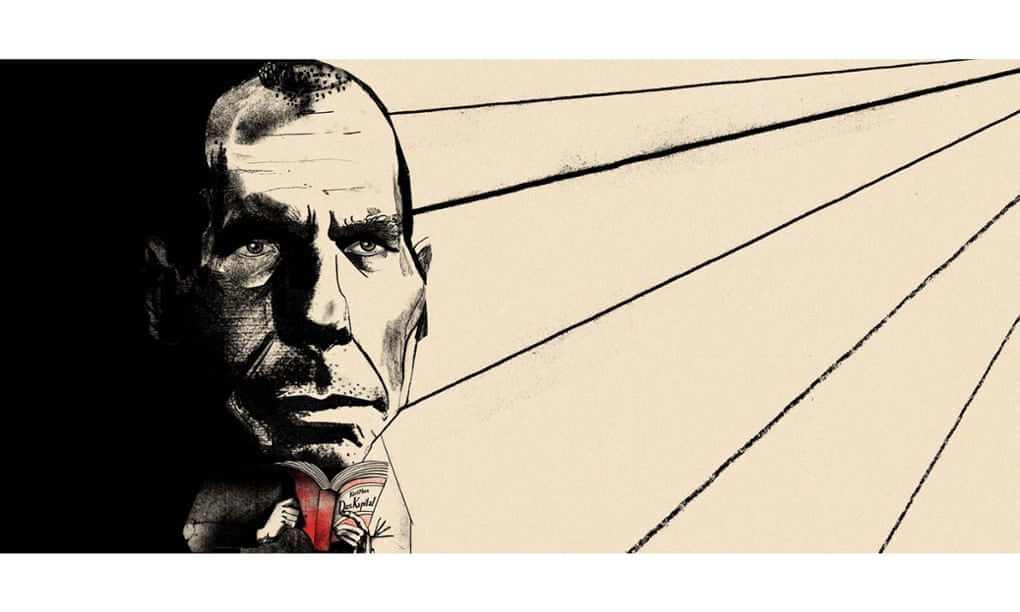
Yanis Varoufakis, fake Marxist saving European capitalism


 Yanis Varoufakis
In several articles and an interview Varoufakis claims to be an erratic Marxist. Michael Roberts comments that Varoufakis is more about burying Marx and keeping Keynes alive. Unlike Piketty, Varoufakis at least has read Marx even if he got stuck on the maths in Capital Volume 2.  He cannot forgive Marx’s basic errors that led to dogmatism and authoritarianism. He was “dogmatic” and produced a “closed system” based on his exposition of capitalism on his Volume 2 ‘reproduction schemas’. Keynes, however, was genius because...


“It was this determination to “have the ‘complete’, ‘closed’ story, or model, the ‘final word’, is something I cannot forgive Marx for. It proved, after all, responsible for a great deal of error and, more significantly, of authoritarianism. Errors and authoritarianism that are largely responsible for the Left’s current impotence as a force of good and as a check on the abuses of reason and liberty that the neoliberal crew are overseeing today.”

Robert’s continues: “This erratic Marxist, now negotiating with the neo-liberal Euro leaders aims “to save European capitalism from itself” so as to “minimise the unnecessary human toll from this crisis; the countless lives whose prospects will be further crushed without any benefit whatsoever for the future generations of Europeans.” Apparently socialism cannot do this. YV says “we are just not ready to plug the chasm that a collapsing European capitalism will open up with a functioning socialist system”.

“Instead, according to YV, “a Marxist analysis of both European capitalism and of the Left’s current condition compels us to work towards a broad coalition, even with right-wingers, the purpose of which ought to be the resolution of the Eurozone crisis and the stabilisation of the European Union… Ironically, those of us who loathe the Eurozone have a moral obligation to save it!” Thus YV has campaigned for his Modest Proposal for Europe with “the likes of Bloomberg and New York Times journalists, of Tory members of Parliament, of financiers who are concerned with Europe’s parlous state.”

Let’s see what the Greek people think of this attempt to “save European capitalism from itself.” 


Wednesday, August 03, 2011

Moralilty and Statistics: The Spirit Level Debate

From Left to Right:  Adam Smith, Karl Marx, Fred Hayek, Lord Keynes

The bland morality and statistics approach of The Spirit Level approach to inequality is already at least a half-century behind events. The 1960s in NZ marked the end of the post-war boom and the return of ‘social classes’ once thought to have been banished by the first Labour Government. A number of analyses of the causes of inequality began to be published from that time and continue to this day. Most operated at the same level of analysis as The Spirit Level i.e. measuring the distribution of income and of wealth and tracing its social effects.

By the 1970s Marxist critiques of this sort of distributional analysis were appearing. For example critiques of the Alternative Economic Strategies published regularly by the FOL and CTU slammed the reformist illusions in regulating and pacifying capitalism. The basic cause of inequality was argued to be the capitalist system itself and its developmental processes. Aotearoa was no less driven by capitalist laws of motion as any other country. The idea that NZ was more equal than others was a myth based on a few aberrant upturns, in particular the Postwar Boom. 

Equally, the possibility of making capitalism equal was also a myth. So the solution to capitalist inequality was the overthrow of capitalism itself. The Keynesian centre fell into disfavour and the battle was now between the far left Marx and far right Hayek. Fast forward 40 years and Hayek has been pushed aside by the right who have appropriated Keynes to bail out the banks. But in the process the market has exposed its hand: it was always handy to have a state to manipulate the market. Now Marx’s books are a booming commodity.

But capitalism will not fall down by itself. As we see countries will be bailed out so long as they have governments that will mortgage future generations of workers to pay back the debt plus compounding interest. And so long as workers let them get away with murder.

The real problem is that capitalism is no longer a progressive force for change but a destructive force. It was progressive so long as it destroyed feudalism and other pre-capitalist modes of production and gave us the industrial revolution. But since start of the 20th century, capitalism has become a top heavy, destructive juggernaut that grinds the masses under it wheels. It survives only by wars and counter-revolutions that smash the masses rebelling against its rule. Its productive capacity is on a long decline punctuated by depressions and wars that only kick start upturns by the sheer destruction of physical and social capital.

The current so-called ‘great recession’ is a deep cyclic recession among a series of such cycles since the end of the post-war boom, itself no more than a long-upturn brought about by the destruction of physical and social capital by the Great Depression and WW2. If there is another cyclic upturn following this recession it will be weak and rapidly swing downwards again. The reason for this is not overpopulation, underconsumption, or the bubble banking system, which are no more than surface symptoms of capitalism in terminal decline.

The underlying cause of capitalist crisis is that it can no longer as a global system extract sufficient surplus from human labour power to produce profits on the total capital accumulated. Since profit is the driving force of capitalist production the motivation to invest stops. Keynes’ ‘solution’ to prime the pump by paying workers to consume to leads to stagflation that only delays the decision as to when bosses stop investing. That is why the only real productive growth is now in East Asia and the other BRICS [Brazil, Russia, India, China, South Africa] where the conditions of early capitalism, low wages, and technical innovation allows labour to be exploited profitably for the moment. And yet even this productive burst will lead to stagflation which will produce a real test of state capitalist systems to survive.

In the rest of the world where capitalism has been long established, despite falling wages and new technology, productivity is lagging. Hence, surplus capital that is not shipped off to China etc. must be diverted into speculation in existing commodities. This is a giant Ponzi scheme to try to delay the inevitable devaluation of money that is not invested productively. No new value is added to these commodities, and their rising prices represent ‘fictitious’ value or capital. Hence when these fictional bubbles burst, the accumulated surplus money is devalued massively. It is a consequence not cause of the current crisis.

The only thing keeping capitalism alive at the moment is the capacity of the ruling capitalist classes to use THEIR state to siphon the wages and taxes of workers to pay for the bad debts run up by speculation. Bailing out private capital debt, turning it into sovereign debt, shifts the burden of repaying the debt onto the working class its total effects now referred to as ‘austerity’. But this trick of making the working class pay for the huge costs of capital’s survival is reaching its limit.

The contradiction of workers both producing the wealth, and then propping up a system that destroys it, has dawned when ‘austerity’ drives the masses of workers into poverty and misery. The ability of capitalism to mask this ‘destruction’ of society and nature as ‘natural’ and ‘necessary’ no longer works. Capitalism is losing its clothes. The unions and social democratic parties that have long kept the lid on workers struggles are as bankrupt as capitalism. Spanish and Greek workers have lost their faith in this political class. The corrupt power of the system of bosses, bankers, media barons and the armies of bureaucrats who keep the lid on popular discontent is being blown apart.

But as the melodrama of media magnate Murdoch in the dock shows, the bosses still have a lot of power to spray bullshit over the most damaging revelations. They pretend not to be naked and a lot of people refuse to open their eyes. Capitalism will stagger from one crisis to the next so long as we let it. Capitalism won’t die until we bury it alive and drive a stake through its heart.

We will see bigger rebellions, general strikes, and working class struggles against fascist movements to keep capitalism alive in the next years. For workers to win they have to pull off the scales that capitalism places over their eyes and open their eyes to the nature of the enemy so as to be able to defeat it. This includes rejecting the superficial analysis that ‘The Spirit Level’ represents. This applies even more to the superficial analysis of its rightwing opponents.

That is why the Marxist critique of Capital is as essential today is it was when it was first written some 150 years ago. We have to replace The Spirit Level with a Chain Saw.


Friday, November 14, 2008

Debate: Is Key a Keynesian?


There is confusion around that the National Party is no different from Labour because it also adopts a Keynesian economic policy. The Workers Party propagates this confusion because it suits them to claim that National and Labour are essentially no different and that social democracy is dead. Most of the so-called 'left' in NZ cannot relate to reformist workers other than by demanding they reject Labour and 'spoil their vote" (IBT) or vote for tiny, left reformist parties (RAM, Alliance). The Workers Party position equates John Key's use of the state to subsidise capitalists' profits directly with Michael Cullen's use of the state to subsidise workers wages directly in order to subsidise profits indirectly. While ultimately both serve the ruling class, the way they do this is not a matter of indifference to the working class.

Keynes claim to fame

Keynes claim to fame was to substitute for the failure of bosses to invest in production (when their profits were falling) state spending on consumption that would see increased demand create supply by stimulating bosses to invest in production. That is, the market failed when bosses failed to invest capital in production, slump followed.

Public employment and paying wages was the main point of public works, and not the actual infrastructure itself. Of course public works on infrastructure was and is welcomed by the bosses because it WAS and IS a subsidy to their profits in the form of cheap roads, rail, bridges, ports, schools, hospitals etc all of which lowered the value of labour power (cheapened wages).

For example public schools and hospitals maintain the skills and health of workers for exploitation more cheaply than private schools and hospitals. Public roads or rail shorten distances and travel time and therefore require less labour power to transport goods to market than clapped out private roads and railways.

So state investment in infrastructure from a Keynesian standpoint is a way of indirectly creating value by employing wage labour to stimulate demand and hence boost capitalist investment. Labourite social democrats turned Keynesian state intervention into a doctrine of reforming capitalism by smoothing out the business cycle and preventing the crisis of falling profits and the resulting depressions endemic to capitalism.

Keys claim to infamy


From a Keysian standpoint however, infrastructure is not at all a matter of creating demand to encourage investment. Investment is encouraged directly by cutting wages and cutting taxes to bosses. This means cutting state spending not increasing it. This is supply side economics. Profits are restored by cutting costs of the supply of inputs, not increasing demand for outputs.

Infrastructure investment is a way of directly subsidising profits by cutting wage costs and offering private participation in Public Private Partnerships (PPPs). In many cases infrastructure costs are so massive and so long run that the private sector does not want to take the risk. So where possible they want the main investment to be guaranteed by the national debt as a charge on taxpayers (preferably a flat tax that makes workers pay the biggest share) that will also guarantee a private profit flow

So Keysian economics has nothing to do with the state creating jobs and paying wages to increase demand to encourage profits, it simply relies on the market to cut wages and taxes to increase profits.

Some details of the Keysian plans

National wants to cut state spending on wages and state jobs, and state subsidies to workers savings, but wants to increase state investment. But it does not want to pay for this investment out of bosses taxes which it proposes to cut further. It will pay for it out of workers savings, Kiwisaver and the Cullen Fund, to bankroll private PPPs. This is creeping privatization of state assets by using them to subsidise profits. Moreover it wants the PPPs to go through without RMA delays as this reduces the profits from these investments. The Maori Party will be contracted to provide PPPs in Maori health, education and development.

We can add here the state guarantees to bank depositors and overseas creditors that both parties have advocated. Labour has, however, agreed to Reserve Bank loans to meet some of the needs of the banks in exchange for securities in the form of the bank’s mortgages. This means that if the banks go bust and the value of those mortgages is written down, these assets remain in state hands. Labour has also introduced a wholesale guarantee with high premiums to try to make the Australian parent banks provide funds to their NZ subsidiaries. Of course this cannot stop the Australian banks from charging high interest rates to their subsidiaries. Those who borrow from the banks for mortgages etc will ultimately pay these added costs in the form of increased bank charges. Another way in which the crisis is paid for by the workers.

All of these measures cut workers past, current and future wages and savings (and taxes such as go into the Cullen fund) and divert them into current and future profits of international banks and corporates.

Nationals PPPs will employ more workers to build the infrastructure, but they plan to involve private corporations like Fletchers who will profit from the surplus value they expropriate from their workers. And to cut private sector labour costs, National has a labour relations policy and ACC reforms lined up. Workers can be hired and rotated every 90 days if necessary. Unions can be kept offsite or company unions formed. ACC costs can be cheapened and the health and safety of workers compromised by introducing competition. Workfare will be introduced as benefits are cut, extra support for unemployed limited to a 16 weeks 'handup', keeping a large reserve army of unemployed ready to compete for jobs and drive down wages.

Some detail of the Keynesian plan

Contrast these Keysian anti-worker policies with Labour's Keynesian plan to counter the crisis. Labour is no less concerned with maintaining and boosting profits, but without the pain of the business cycle which brings massive deflation and unemployment and huge destruction of value - itself the product of past social labour.

Facing the prospect of a worsening crisis Labour was proposing to introduce the basics of a Keynesian deficit spending package to stimulate consumption and hence investment - creating jobs in public works, paying wages, raising the minimum wage, paying for job training etc. Its job
rescue plan added to existing benefit entitlements a 13 week benefit for those on WFF losing a second wage to maintain family consumption.

While this is far short of socialism by any definition, Labour's plan is objectively better for protecting workers jobs and living standards. It reveals its commitment to bosses profits by not going further and ending GST and replacing it with taxes on the rich. It also refused to consider nationalising NZ banks in the even they needed bailing out and stuck to finance capitals demand that it guarantee them with the future taxes of workers. Making workers pay on the trickle up.

Make them pay for their crisis!

But insofar as Labour was spending to reflate the economy by increasing the budget deficit, it
was not taking this cost out of workers wages and savings, rather charging this debt to future taxes. Like all sovereign debts, whoever pays for this is a matter of class struggle. What proportion will be deducted from profits and what proportion deducted from wages?

This is a question that can only be decided by class struggle. National is representing the current dominance of the bosses and is cashing in workers wages and savings for profits now. Labour was
proposing to manage capitalism as a class 'partnership' using the government's credit card, opening up the possibility of workers repudiating the public debt in the future.

The difference between Keynesian and Keysian economics then is in the opportunity the bosses crisis offers to workers. Under Keysian economics, the crisis is being solved at the expense of workers wages and savings now. We are being made to pay for the crisis today and tomorrow.

Under Labour the crisis would be countered (not solved) on credit so that the question of who pays for the crisis is something that is postponed and becomes a matter of which class is the stronger when the bill has to be paid tomorrow. Under the Keynesian regime, workers have the
opportunity to take advantage of deficit spending to organise their class power to make the bosses pay for their crisis, repudiating the public debt, cancelling obligations to bail out banks, nationalizing and socializing all banks and corporates and to democratically plan for a socialist society.