Showing posts with label alienation. Show all posts
Monday, March 05, 2018
Tuesday, February 13, 2018
Busting the Cannabis Madness Myth

The Green's Bill to extend access to Medical Cannabis came up for a vote to send it to Select Committee on 31st January. It was voted down 73 to 47. A majority for the Bill would have sent it to Select Committee - a relatively democratic forum to challenge the myths surrounding cannabis without the debate being dominated by the hysteria of the corporate media and the lobbyists for Big Pharma. It would have forced the health bureaucracy to defend their 'scientific evidence' about the 'harm' of cannabis against serious criticism. Its defeat proves that there is entrenched opposition in parliament to liberalising Medical Cannabis, especially the right to grow and supply outside of the control of Big Pharma.
Clearly the 'refer madness' myth hyped for decades remains the main barrier to reform. Our target has to be the pseudo scientific and bureaucratic devotion to the myths underlying prohibition that has stymied all genuine cannabis reform in NZ. The biggest lie is that cannabis causes psychosis.
Progress with cannabis law reform is cripplingly slow. Why? A century of stigmatisation and prohibition has embedded a reactionary ‘harm’ mythology from the days of ‘reefer madness’ to today’s ‘cannabis psychosis’ in the popular culture, health science and medical practice. The mythology claims that cannabis is addictive, leads to ‘harder’ drugs, makes you anti-social, dumbs you down, makes you fail in education, perform poorly at work, and in the end, it makes you mad. These are myths that conveniently blame individuals as ‘dope fiends’ rather than the victims of the alienating capitalist society into which they are born.
We won’t make any headway towards the liberalisation of cannabis and other drugs until we debunk these ‘harm’ myths, and understand the nature of capitalism and its effects, inequality, poverty, social breakdown etc, as the real cause of drug use, and that drug abuse is a consequence of a policy of prohibition. But let's skip the historical lecture and go straight to the misuse of science to bolster a hysterical prohibition culture.
NZ Misuse of Drugs Act and the myth of ‘harm’
The NZ Misuse of Drugs Act makes cannabis use a crime (unless waived by Ministerial approval) rather than a health need, on the grounds that it causes harm to health. Even if Cannabis were ‘decriminalised’ the assumption of ‘harm’ requires a ‘least harm’ approach to law reform by the Ministry of Health (MOH) which considers that cannabis ‘contributes’ to 32 deaths per year in NZ.
The NZ Drug Foundation (NZDF) rejects the MOH method of arriving at 32 deaths. It adopts a more moderate approach; that harm does not arise from “toxic overdoses”, but the “long-term effects” of use.
Cannabis does cause harm, but the harm comes from heavy long-term use and is mostly linked to mental health – lasting physical harm is unlikely, while poisoning or death is unheard of.So, the NZDF proposes ‘decriminalisation’ of cannabis use by 2020 combined with heavy state regulation and licensing to minimise ‘harm’. It seems that the Drug Foundation is trying to steer the public debate for law reform down the path of least resistance. Yet that resistance seems to be coming mainly from the Government and Health bureaucracy rather than in the general population.
This conflict between ‘harm’ and ‘health’ is evident in the Drug Foundation itself. On the one hand, the NZDF Executive Director Ross Bell argues that the District of Columbia (US) legalisation of use, but not trade, might be best for NZ:
Mr Bell looks to the District of Columbia which changed its approach towards marijuana as recently as last year. It legalised its use, but not the trade in it, so under a new law, people can grow it, use it and give it away, but they can't sell it. This is most closely in line with how Kiwis use it, Mr Bell said, suggesting it could be a starting point for discussion here. “If you think of the way Kiwis use cannabis, often they're not getting it from the tinny house. It might be the first thing we allow is for people to grow and give.”However, the Drug Foundation’s official new reform proposal repeats the ‘cannabis causes harm’ mantra.
We know that the majority of people use cannabis without serious harm.However, a small proportion experience negative impacts such as anxiety, depression, memory loss and mood swings. Those who use cannabis long term may face health risks such as respiratory disease (if smoked) and mental illnesses such as schizophrenia, at least for those who may be predisposed.Cannabis impairs driving, especially when combined with alcohol. It also carries the risk of dependency in around one in 10 users. Heavy use by young people has been linked to poorer outcomes in education and employment as well as a reduction in IQ points, though the research on this is mixed.Our verdict? Cannabis can be harmful, so our law should focus on minimising harm, especially to young people. The best way to minimise harm is to tightly regulate use.”The evidence for and against ‘harm’
The evidence contests the ‘harm’ myth. It shows that the “negative effects” attributed to cannabis such as anxiety and depression, mood swings and even memory loss are are widely experienced in society by many who don’t use cannabis, and when they occur among the few users who 'overdose', this like any drug overdose, is largely the result of prohibition which works against safe and controlled conditions for drug use.
Dependency is another word for addiction and this claim is widely disputed, notably by Carl Hart, not only for cannabis, but for other ‘hard’ drugs as well (to his own surprise). He finds that when offered choices between drugs and money his experimental subjects will often reject drugs and take the money proving that drug addiction is learned behaviour in situations where you don’t get to choose money.
And the familiar story that cannabis ‘abuse’ by youth harms their schooling, college prospects and can lead to suicide, and so on, is probably the effect of prohibition. When kids who are expelled from school, denied financial support and criminalised explains much of the risk of suicide.
But the biggest driver of the 'minimal harm' orthodoxy in the NZDF model reform relies on the Canterbury Study led by David Fergusson. Take the link between smoking cannabis and the risk of lung cancer. A US study using a large sample, done by Tashkin, showed that the 'normal, moderate’ level of cannabis smoking had no measurable link to lung cancer. Not only that, cannabis smoking was better than non-smoking for some people! This study, however, was contradicted by the NZ study which did find a ‘correlation’ between heavy smoking and lung damage.
Tashkin says,
The largest epidemiologic (case-control) study of the association between marijuana use and lung cancer failed to demonstrate that marijuana increases the risk of developing lung (or, for that matter, upper airway) cancer.” He notes that a much smaller, recent study from New Zealand did claim to find a link, but only in very heavy users. He says, “The authors’ interpretation of their data can be faulted because of the small numbers of their subjects exhibiting such heavy use, which rendered their estimates of risk imprecise." [My emphasis]The Scientific American, however, is more precise:
… looking at residents of Los Angeles County, the scientists found that even those who smoked more than 20,000 joints in their life did not have an increased risk of lung cancer. [my emphasis]Tashkin is saying that the Canterbury study cannot claim to have found that heavy smoking of cannabis causes lung damage. His Los Angeles sample of heavy users found no significant correlation. The NZ sample of heavy smokers was too small to exclude all other factors that may explain the correlation between cannabis and lung damage. Therefore, the positive correlation in the NZ study between cannabis use and lung damage may be a consequence of lung damage caused by some other unmeasured cause.
While very heavy smoking of cannabis causing lung damage may be ‘common sense’, Tashkin's large study was able to control for confounding factors and did not find any correlation, or causal link. If there are doubts about the Canterbury project’s results on lung damage, perhaps the NZDF concern about a studies 'suggesting' a causal link between cannabis use and ‘psychosis’ in adolescents should be also be re-examined.
Cannabis and Psychosis: Search for a causal link…
One of the reviews of studies (7, one of which was the Christchurch study) into this link by Le Bec PY et. al. (2009) found that “cannabis may be an independent risk factor” for psychosis:
Together, the seven studies were all prospective cohorts and represented 50,275 human subjects. There were three European studies (from Sweden, Holland and Germany), one from New Zealand and one from Australia. Only one study of the seven did not show a significant association between cannabis consumption and increase of the risk of developing a psychosis. However, this study had some bias, such as low level of cannabis use and the lack of evaluation of cannabis use after inclusion. For the six other studies, data show the existence of a significant association between cannabis use and psychotic disorders (with an increased risk between 1.2 and 2.8 in Zammit et al.'s study), particularly among vulnerable individuals (that is with a pre-psychotic state at the time of inclusion). Therefore, all the studies that assessed a dose-effect relationship showed this link between cannabis use and the emergence of psychosis or psychotic symptoms. The fact that all causal criteria were present in the studies suggests that cannabis use may be an independent risk factor for the development of psychosis. Results seem to be more consistent for vulnerable individuals with the hypothesis that cannabis use may precipitate psychosis, notably among vulnerable subjects. In particular, early onset of cannabis use during adolescence should be an environmental stressor that interacts with a genetic predisposition to induce a psychotic disorder. https://www.ncbi.nlm.nih.gov/pubmed/19748375 [my emphasis]Note that the closest that this review comes to finding that cannabis may be a cause of psychosis, is that, “…cannabis use may be an independent risk factor for the development of psychosis.” The strength of that suggestion comes down to what are referred to as “all causal criteria” being controlled as potential confounders, that is, alternative causes. So, what is the strength of this claim in the Christchurch study? In their 2004 paper Fergusson et. al. addressed the problem of testing ‘causal linkages’ to eliminate other explanations. I will summarise their paper.
Fergusson et. al. (2004) describe how their statistical method allowed them to control for ‘confounders” (i.e. other possible causes) both, “fixed” influences, such as age, gender etc that did not change over the time-frame of the data, and “time-dynamic” influences, such as education, employment etc., that did change over the time-frame and could ‘confound’ the association between cannabis use and psychosis. By testing the association among all confounders, against cannabis use, and against psychiatric symptoms, the study concludes that there is still a residual association between cannabis use and psychosis, ‘independent’ (with its own causal effect) of the influence of all confounders, that justifies treating cannabis as a contributory cause.
The second important conclusion was that the study was able to compare the subjects scores on all the relevant variables over a time frame between 18, 21 and 25 years of age, and data collected at those three points showed that the “direction of cause” was from cannabis to psychosis, rather than the reverse.
How does one include all possible alternative causes in a longitudinal cohort study with a relatively small sample size, so that cannabis stands out as the ‘independent’ cause? Note that for the sake of the argument about 'cause' I am not challenging the validity and reliability of the data such as 'psychiatric symptoms' at this point. Nor am I competent to assess the statistical methods used to perform these ‘tests’ in the Christchurch study. However, an assessment of such statistical methods was included in the review of the field by Ksir and Hart in 2016. They reviewed the evidence in support of two competing theories (hypotheses) between cannabis and psychosis; the “contributing cause” view held by the Christchurch study, and the “shared vulnerability” view held by the review authors.
Cannabis and Psychosis: Critical Overview of the Relationship.
According to Ksir and Hart (2016)
Interest in the relationship between cannabis use and psychosis has increased dramatically in recent years, in part because of concerns related to the growing availability of cannabis and potential risks to health and human functioning. There now exists a plethora of scientific articles addressing this issue, but few provide a clear verdict about the causal nature of the cannabis-psychosis association. Here, we review recent research reports on cannabis and psychosis, giving particular attention to how each report provides evidence relating to two hypotheses: (1) cannabis as a contributing cause and (2) shared vulnerability. Two primary kinds of data are brought to bear on this issue: studies done with schizophrenic patients and studies of first-episode psychosis. Evidence reviewed here suggests that cannabis does not in itself cause a psychosis disorder. Rather, the evidence leads us to conclude that both early use and heavy use of cannabis are more likely in individuals with a vulnerability to psychosis. The role of early and heavy cannabis use as a prodromal [symptomatic of an attack or disease] sign merits further examination, along with a variety of other problem behaviors (e.g., early or heavy use of cigarettes or alcohol and poor school performance). Future research studies that focus exclusively on the cannabis-psychosis association will therefore be of little value in our quest to better understand psychosis and how and why it occurs. [my emphasis]In other words, the authors conclude that cannabis cannot be shown to be a cause of psychosis, and the best interpretation of the limited evidence is that it suggests that cannabis may be part of a “shared vulnerability” where those ‘vulnerable’ to psychosis may use cannabis along with other substances as a means of self-medication.
The policy conclusions that flow from this conclusion are to reject cannabis as a cause of psychosis on the basis of a weak claim of “contributory causation”, and to address the common social and genetic factors that cause this ‘shared vulnerability’ associated with cannabis use. This shifts the focus away from the prevailing model of “harm” towards a model of “preventative health”.
That this is a highly politicized area is attested to by the debate between Ksir and Hart and the authors of one of the studies they reviewed, over why a correlation cannot as a rule be a cause, and whether the the appropriate policy response is the legalization of cannabis and other drugs or continued prohibition.
The significance of these policy options is clear if the most obvious cause of ‘harm’ is prohibition itself rather than the ‘harm’ attributed to cannabis. For example, the US study referred to above claiming that cannabis use led to school dropouts, failure to attend college, and more suicide attempts, could easily be explained as the effects of prohibition. The author advocates that prohibition should be replaced by prevention.
Conclusion: Prohibition causes the harm attributed to cannabis
The reform debate therefore comes down to one of two approaches. First the ‘harm’ model. Modest and incremental change via decriminalisation leaves the growth, sale and consumption, regulated and licensed, redirecting drug policy from prohibition towards state control and regulation. This is the moderate road which makes the assumption of ‘harm’ an excuse to protect individuals from harming themselves. The question of what constitutes ‘harm’ is reviewed, and the myths that cannabis is a 'gateway drug', that overdoses are 'toxic' and can even cause death, are rejected. Nevertheless, cannabis is still held to cause ‘harm’ among youth, long-term heavy users and those genetically or socially at risk of mental illness. For that reason law reform must be gradual, based on ‘best science’ and guided by the medical model of ‘least harm’.
The second approach is that cannabis is a harmless natural plant, used as a preventative and palliative medicine over millennia. Cannabis and our endocannabinoid system have co-adapted over our history of evolution. It is not only ‘harmless’ it is ‘harm-killing’ with many (including as yet undiscovered) health benefits. These include pain relief replacing opioids, stopping spasms in MS, and seizures in epileptics and pain in advanced cancer etc. And coming over the horizon is the prevention and elimination of diseases including cancer, Alzheimer’s, schizophrenia, etc. In assessing these health benefits, we should combine all sources of evidence: anecdotal, medical, laboratory research, epidemiological, as well as the ‘gold standard’ clinical trials, to understand fully the important role of cannabis in our lives.
We conclude that the ‘harm’ associated with cannabis is mainly caused by the policy of prohibition that reflects the objectives of powerful groups and class interests in society, and is reproduced in research assumptions and media sensationalism. It is not an attribute of cannabis itself but of politically loaded economic and social policies. We can see this clearly in the benefits that have accrued in many nations such as Portugal and Paraguay, and in those US states where decriminalisation or legalisation has occurred. Medical Cannabis has now been approved by WHO. But we still have to overcome the fear of THC as the cause of ‘reefer madness’ and prove that in a safe, legal environment, CDB cannot be separated from THC and the other components of cannabis without losing the full health benefits of the herb.
We can make a start as capitalism goes into its terminal decline and fall, but only fully reap the benefits of cannabis as part of the socialisation of production for need and not profit in a socialist society that has returned to nature in time to avoid human extinction.
Friday, June 16, 2017
Suicide is about Alienation
Good
on Mike King for attacking the gutless, shamefaced, official line on suicide as
part of the problem not the solution. And cheers to The Daily Blog for acting
as a forum on suicide with activists like Dave Macpherson and Martyn Bradbury
exposing the failures of the health system. While we agree that we need to
change the official response to suicide, that should be based on what causes
suicide. We will argue that suicide is a desperate act of refusal against a
powerless, de-humanising, alienated life under capitalism. But so long as the
official line of taking the fight against suicide out of the hands of people
and keeping it as a function of the bureaucracy, judiciary and medical
profession remains, the epidemic of suicide will continue. Not until suicide is
properly debated and its causes fully understood can any real solutions be
found. An independent inquiry is a start in that process.
Competing
theories of suicide
To
reduce suicide to a personal choice, something wrong with the genes, or
neo-liberal social policy, is to mistake the symptoms
for the cause.
There is a long trail of bankrupt theories strewn along the painful history of
this subject. First, there is the history of the Church, especially the
Catholic church, of reducing suicide to a sin in the eyes of God. Who would
know? Then there is the mainline bourgeois culture of rampant Western
individualism that suicides are ‘failures’ who haven’t found ‘success’ in the
market. Both of these superstitions form the underbelly of attitudes toward
suicide today. Then there are attempts to find measurable causes that can be
traced back to impacts on the individuals of social relations which can then be
isolated and treated as ‘abnormal’ or ‘deviant’ by medicine or social policy.
Most notable
was Emile Durkheim the French sociologist who wrote ‘Suicide: a study in sociology’
in 1897. Durkheim was a ‘positivist’, someone who observed behaviour and looked
for correlations and patterns to infer causes. He found 4 types of suicide
based on supposed differences in causation. (1) Egoistic: caused by the excessive
individualism of modern (capitalist) society. (2) Anomic: the result of a lack of social
norms and institutions that support the individual. (3) Altruistic: due to a
lack of strong individual traits when facing authority. 4) Fatalistic: suicide
resulting from overwhelming social pressures. The two examples he used were
slaves and married women.
Durkheim
proposed social policies for each type. Egoistic
and Anomic
suicides could he prevented by creating new social institutions to recreate the
mechanical solidarity (eg extended family and village life) of pre-capitalist
society to support individuals. Altruistic
and Fatalistic
suicides were more problematic because they involved critiquing military and
family authority both of which Durkheim endorsed as necessary for capitalism to
function. In fact he supported the authority of husbands over wives and opposed
divorce. In any event, these tinkerings with social policy have failed to get
to the root causes of suicide in the century or more since. The sociology of
suicide has fixated on symptoms while the state bureaucracies and the medical
profession prescribe “good science” but continue to ignore the fundamental
causes.
The most
promising 19th century line of attack on suicide was that of Marx which began
50 years before Durkheim. It was not the social effects of capitalism that were
the causes but the social relations of capitalism itself. For Marx, the basic
cause of all social ills was the alienation of individuals from their labour
though this also affected those who lived off that labour – the bourgeoisie.
Marx never studied suicide as such, but in 1845 he commented
on the work of French statistician and police chief Peuchet, who found an
obvious correlation between three young bourgeois females subjected to extreme
family abuse (spousal abuse and public humiliation for sexual ‘deviancy’) and
their suicides by drowning in the river Seine.
Marx concluded
that the common cause was alienation from one’s labour, but more concretely in
these cases, alienation in the bourgeois family in which women were the
‘slaves’ of their husbands. Proletarians are alienated, but women are also
alienated from their husbands in the bourgeois family. And as the bourgeois
family was the model for the proletarian family, working class wives became the
“proletarians of the proletariat”. So, to clear the way for socialism the
bourgeois “family must be destroyed in theory and practice.”
Does
revolution stop suicide?
Before looking
as more recent attempts to apply “good science” to suicide, it is worth pausing
to consider the “theory and practice” of the Bolshevik revolution and its
impact on suicide. Marx’s theory predicts that the end of capitalism would
bring an end to alienation and the beginning of real humanism. The end of the
bourgeois family would empower women and liberate them from domestic slavery.
What is the evidence? First, the freedom from oppression was such that human
creativity blossomed in all walks of life. Workers’ control of the state and
industry empowered them to make their own lives free of the shackles of
capitalist social relations. The place of women became more equal. The
bourgeois institutions of marriage and the family underwent massive changes.
The result was
that among those who made the revolution and participated democratically in
building the new society, suicides were almost nil. Workers were no longer
alienated from their labour by capital. They controlled their labour
collectively by democratic decisions in the Soviets which planned production on
the basis of need. A new individual began to emerge, the proletarian
individual. The proletariat was within reach of creating ‘humanity’. Such
were the expectations of a new order that the reversal of these conditions
brought the inevitable downfall and with it, waves of suicides.
For Trotsky, the
degeneration of the revolution brought about a reversal of these new freedoms.
Underlying this reversal was the failure of the revolution in Europe and the
isolation of the Soviet Union. The ideals of the revolution came under
increasing challenge. In the attempt to negotiate a peace with Germany the vast
areas of the South were devastated. The civil war against imperialist invasion
required a war economy where the state took more central powers and reduced
those of the soviets. To feed the troops the peasantry had their product
requisitioned. This turned many peasants against the workers state, and in
particular the Bolsheviks. The Kronstadt rebellion was ruthlessly put down. The
New Economic Policy virtually restored capitalism in the countryside to feed
the industrial workers.
The growing
concentration of power in the state disillusioned many and the state responded by
clamping down on dissidents. Stalin and his apparatus ushered in bureaucratic
rule. At each point in this reversal of the revolution, and as the hopes in the
revolution were dashed, the rates of suicide went up. Suicide
in the Soviet Union therefore was a direct result of
the failure to break completely from capitalism, and the inevitable
degeneration of "socialism in one country" as the bureaucracy usurped power from the
workers. Most important, socialist equality was stillborn as workers control of
their labour was taken over by a state bureaucracy. Surplus labour was not
allocated to social needs on a democratic basis, but expropriated by the
bureaucracy. Alienation re-appeared in the unequal social relations of the
bureaucratic regime.
What to do?
We have argued
above that alienation is the fundamental cause of suicide. It cannot be
overcome unless there is an end to the unequal social relations that produce alienation.
The capitalist state is based upon alienation and designed to reproduce it by
legitimising unequal class relations. The state bureaucracy uses its power to
monopolize knowledge and prevent any challenge to capitalist rule in the name of "good science". In the post-capitalist states, a state
bureaucracy emerged to suppress the power of workers and to block the road to
socialism and take the road back to capitalism.
In Aotearoa/NZ, the
first task to stopping suicide is to challenge and expose the state agencies
and the Mental Health bureaucracy. An official inquiry will do nothing to
expose the bureaucracy, plenty of earlier ‘disasters’ such as the police
shooting of Steven Wallace and the Pike River tragedy proves. An independent inquiry is needed to allow
critics of the official line on suicide to be heard and their issues raised and
debated publicly.
But even so,
more urgent actions are needed along the lines of the self-organising of
workers and youth, especially Maori youth, to actively fight against the
official silence and apathy towards suicide. There are lessons that can be
learned from the story of Yellow Ribbon, that created student groups in many
schools to deal with those at risk of suicide and its closing down by the state
agencies. And many more public initiatives to organise the grass roots
communities to campaign against suicide are important developments. Focusing
on the immediate causes of suicide will wake people up to the underlying cause
of suicide – the alienation of individuals from their labour, from their
friends and family, and finally from themselves.
Monday, June 30, 2014
A Marxist review of Capitalism and Drug Use
In New Zealand recent news coverage has been a typical example of journalistic activism promoting a moral panic about an issue.. in this case psychoactive drugs. Headlines about psychoactive substances, (synthetic cannabinoids) raise the issue of the legal status of new drugs, and call into question the legal status of old drugs. Dramatic case studies have made headlines, while the huge numbers of people lining up outside one of the limited (to 250) stores was repeated, as if this showed a problem. Various local newspapers gave plenty of space for anti-synthetic drug campaigners, amounting to free support for the anti-drug campaign. These were frequently parents distressed by their son/daughters loss of potential as a consequence of getting into synthetic cannabinoids (“legal highs”). Moral anti-drug fundamentalism, often comes from people whose addiction is something else (religion, work, alcohol, sport, etc). NZ law makers had given up on the war on drugs approach. Legal highs were a step ahead of the banning laws. New psychoactive substances were always in the pipeline, chemically different – not banned as yet. So the lawmakers tried regulations.
War on
Drugs vs Regulation
For decades the approach to
drug use by the ruling class was to ban some drugs and regulate others. The
current conventional approach to drugs: is the US led “war on drugs” or
“narcotics”. This is contrasted with the right to sell other equally or more
damaging drugs such as alcohol and tobacco. The lessons of prohibition of
alcohol in many countries led to organised crime, and the same is true of the
prohibition on narcotics.
There is a growing
recognition that the social costs of prohibition of cannabis vastly outweigh
its benefits. This has seen a swing away
from prohibition towards the introduction of legalised and regulated synthetic
cannabis. After years of playing catch up with organised crime in drugs, NZ
Governments took the step to allow the sale of ‘legal highs’ that have been tested
for safety and under strict controls.
From being sold in
thousands of dairies & convenience stores and little control over the
distribution the Interim Agreement allowed no more than50 chemicals to be sold from
no more than 200 stores with R18 rules. (While they were being tested).
A new frontier of
capitalism was opened with this new set of commodities: production, packaging
and marketing companies for these chemicals taking home super-profits. The
newly synthesised psychoactive substances were capitalised – taxable,
profitable, cowboy capitalism. They fitted a market segment – cheaper than
cannabis, and thought to be a way to avoid workplace drug screening (and legal
anyway).
‘Legal highs’ were not tested on animals or
humans: It was a grand scale experiment with the NZ population. A few chemicals
failed the safety test by causing direct harm that was reported to the ministry
of health, and were removed from the ‘legal’ (regulated) regime. There are many
other things we don’t know about the impact of the availability of legal highs.
E.g. if alcohol sales were reduced by the intro of ‘legal highs’, or if
cannabis consumption reduced: if the corresponding legal or illegal markets
were under profit squeeze? We don’t know if drug (& alcohol) related
traffic crashes were reduced during the period of legality.
Capitalism has failed to measure the damage or risk of drugs. Instead drugs like alcohol
& tobacco which are profitable and taxed hugely and create massive damage;
cancers, etc, are legal. An illegal drug like cannabis creates less damage on
an active component comparison. When a technical expert such as (UK) Professor
David Nutt said this, the conservative government did not like his advice. He
was dumped from his role on an “independent” government advisory panel. He went
on to found an “independent scientific committee on drugs”. He complains
that illegal drugs are much more difficult to conduct research on since the
bureaucracy required to obtain the drug for research purposes creates a barrier
to research.
NZ Drug classifications
have followed the worldwide trend – US driven “war on drugs”. While other
addictive problems such as gambling was legalised (regulated and taxed),
alcohol remains legalised (loosely regulated), but those regulations are
clearly unable to stop the social problems related to alcohol. Tobacco
regulation has followed the Australian trend and introduced stricter controls
on advertising and marketing. Warning signs on packaging have grown from small
to bigger and more graphic.
Cannabis being illegal
left the door open to the new technology of synthetic cannabinoids – chemicals
not yet identified and banned by the governments, and not yet detectable in
standard drug screens.
Workplace Drug Testing
In the name of “health
& safety” the employers banned detectable psychoactive substances. Workplace “health & safety” has been an
excuse for drug testing. So a drug testing industry has developed in the last
15years. “Health & Safety” avoids addressing the real risk issues and labels
occasional substance users as risks in the workplace.
Workers (& soldiers)
have been trying the new chemicals “synthetic cannabis”, because it cannot be
detected in workplace drug testing. The ranks of the US military have been high
users of synthetic cannabis – exactly because they are not detectable in
standard tests. Synthetic Cannabinoids became another product to market to
avoid detection by those tests. Synthetics were a good option if workers wish
to avoid being sacked or dumped into unemployment.
But for what reason – if
cannabis detected in drug testing it may have been used a month ago and not affect
the worker at work. So the Capitalist reaction was an over–reaction, and made
some workers unemployed for no good reason.
Drug testing makes a mockery
of real concern for the health and safety of workers. The greater threat to the
health and safety of the working class is worker fatigue due to extreme long
hours of work – where a 6 day 10hr days (60hr) working week has now become common
in many NZ industries. Coal mines with malfunctioning gas testing equipment and
extreme long working hours are the failures of capitalism.
Only a united working
class can fight these employers and these employment practices. For fighting
democratic unions that campaign for a living wage is set by workers committees and achievable in
a 40hrs working week!
Capitalism puts profits
before people and this is true in drug law. Short term profits for the alcohol,
tobacco and gambling “industries” (capitalists) have been more important than the
damage done to people, their families and communities. The tax the government
takes from these commodities is more important to the government than the long
term human and health costs.
Government funding for
treatment is pitiful, and so treatment resources are pathetic, not at all near
the level of need. Really treatment consists of individual assessment and if
you are really motivated to change maybe some treatment. Talking therapy is a
poor substitute for lack of community; family/friends workmates – involvement
in what you really need.
A public health or
education model treats the population like farm animals: Keep enough people
alive enough to work, reproducing capitalist class relations.
The “illegal” drugs
provide excuses for police to criminalise the working class, with poor, Maori
and Pacific Islanders most likely to end up with drug convictions and rich and
white most likely to be let off with a slap on the wrist.
The NZ state now taxes
illegal drug profits through seizing assets under “proceeds of crime” laws. A
family caught with illegal drugs could lose their family home, i.e. be made
homeless, while the state auctions off this and pockets the money.
Regulate/ criminalise - decriminalise
Radical youth may call
for the legalisation of all psychoactive substances – perhaps in a reaction to
police state control. The “war on drugs” turns possession and use of some drugs
into criminal activities. Drug related
oppression across racial and class lines, is state oppression.
In a previous statement
on drugs Class Struggle called to
support legalisation, however this was mistaken. Marxists have no confidence in
any of capitalisms laws. The whole system is biased in favour of the rich while
the working class are controlled by the state forces = police, courts, prison
system, etc.
It is sowing illusions in the capitalist state to believe that legalisation would lessen the adverse effects of drug use. That is, the legalisation of drug use can lead to a wider misuse of drugs as the legal high experiment in NZ proves. There is no guarantee that the state can or would regulate drugs to make them harmless. Would legalisation really assist the strength and organisation of working class? No!
Calls to regulate,
decriminalise or to legalise drugs all rely on parliament to change laws. This
fails to increase the power of the working class. Instead diverts the struggle
for freedom from police oppression (the state) back into the capitalist state
at another level: - parliament and law making.
It limits the debate to legal status.
Many states have
legalised (e.g. Portugal) or decriminalised drugs. Cannabis is available in cafes in the
Netherlands. Now the UK and several states of Australia have decriminalised
possession of small amounts of cannabis. Western Australia runs a “Cannabis
infringement notice” system, which hits people caught with small amounts with
$100 fines. Several states of the US have decriminalised medicinal use of
cannabis. So legalising drugs is possible within capitalism. And does not
necessarily increase the power of the working class
Even a decriminalised
drug regime is unfair; the poor would clock up fines, that the rich could avoid
or easily pay off. The poor are more likely to fail to pay their fines and end
up under increased court pressure over this.
The Legal status of a
drug does not address the real driving forces behind consumption of drugs. Nor
does it necessarily allow the working class more organising potential like
democratic freedoms and union rights do.
A useful historic and
psychological perspective from Bruce
Alexander identifies a dislocation or “poverty of spirit” as the underlying
cause of addiction. He particularly blames the “free-market economy”.
Alexander’s definition
of free-market economy is one and the same as capitalism. He locates all
addiction problems as driven by individual doing their best to cope in this
“dislocating” society. Effectively his definition of dislocation is the same as
Marx’s alienation. But Alexander does not locate alienation at the point of
production, instead at the surface appearance of our relationship to things
(culture, place, people, etc). In spite of his limitations, Bruce Alexander
gets further down to the roots of the problems than others from the field of
psychology.
Alienation
Drawing the Marxist
lesson from Bruce Alexander’s research; capitalism is alienating and alienation
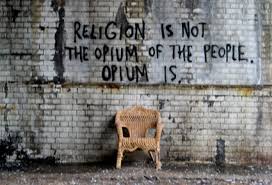
drives drug consumption and dangerous addictions more generally. “Religion is
the sigh of the oppressed creature, the heart of a heartless world, and the
soul of soulless conditions. It is the opium of the people.”
Marx put drug addiction on the same level as devotion to religion, and most
significant this is all in the context of experience of alienation (oppression,
heartlessness and soulless conditions).
Marx was commenting about addictive devotion and alienation.
To legalise drugs
disregards the alienating processes of work under capitalist production and
other harms of social abuse and exploitation within capitalist society all that
need to be changed. So legalising does not develop unity of working class in
common consciousness of the experience of alienation. Instead it distracts the
working class by offering more “legal” options for “self-medicating” (drug use)
to cope with life under capitalism. The drug regulation debate ignores the need
for revolutionary change.
Many societies have used
music (drumming chants), dance, and rituals to alter states of consciousness
and transition members or whole communities from child to adult, from season to
season, and in many societies psychoactive substances were used in these
ceremonies. Prior to capitalism there is little evidence from history of
problem drug use – except the final years of the Greek and Roman civilisations
(see Bruce Alexander).
Freedom from enslavement
by drugs will be more possible when alienation through capitalism is
overthrown.
Workers’ Control
We support working class
control over all drugs! Instead of a ‘no control’ situation of full
legalisation there needs to be some level of social control – but the power
should be held by the working class, not capitalist forces.
Working class control is
not possible under capitalism: the current example of alcohol regulation shows
this. In theory NZ “communities” have a say about alcohol premises / outlets,
however the capitalist alcohol lobby has alcohol wholesale outlets spread like
corner dairies in poor areas, and less wholesalers, more “on licence” premises
(restaurant / café / bars) in rich areas. The distribution of alcohol outlets
follows the typical pattern of most profitable to the capitalist; and most
dangerous or harmful to the poor.
When the working class
is in control of assessment of safety / damage of each drug then we may decide
the level of control needed. Medicinal use should be allowed – and production
could control quality (dose) and find safer ways to take some drugs (such as
cannabis). Legalising does not address harm related to substances, we know that
from tobacco and lung cancer, alcohol and liver cancer, caffeine and kidney
cancer.
The Russian revolution
was an important example of workers’ social control of drugs: The Bolsheviks
needed to throw out alcohol. In 1917–1918 the revolution was under attack from
the White army. Counter-revolutionaries had been supplying alcohol to soldiers
to create problems for the Bolsheviks. John Reed “Ten Days That Shook The World”
p244, on “Wine Pogroms”; counter-revolutionaries were promoting drunkenness and
rioting through raiding wine cellars to give freely to the soldiers. The
revolutionary council of people’s commissars appointed a “commissar for the
fight against drunkenness”. They blew up cellars and destroyed thousands of
bottles of wine.
Trotsky commented on
alcohol and drug problems after the revolution, in “the problems of everyday
life”. The theme following the revolution being the social control sitting with
the (workers) state, and as the state withers away, a corresponding increase in
more local - community control. While more meaningful activities replace those
alienating coping mechanisms.
For workers’ control over all drugs!
For workers’ control of health & safety in the
workplace!
Reduce the hours of the “fulltime” working week until there
is employment for all!
For workers committees to set living wages in a “fulltime”
(40hrs) week!
We make these calls in the knowledge that true workers
control will only be possible with the overthrow of capitalism. This shows that
the solution to capitalisms problems cannot be found within capitalism.
Subscribe to:
Posts (Atom)

