Showing posts with label labour party. Show all posts

Monday, March 25, 2019

Health Workers betrayed by "labour" Party


Another year of wage stagnation and dangerous conditions of continued deliberate underfunding of state provided health services. Residents Doctors Association and Midwifes continue to fight while the district health board bosses (DHB) deliberately drag out negotiations (longer than a year of negotiations). 

Members of the Resident Doctors' Association have held four 48-hour strikes so far this year. They are fighting against DHB bosses who want to dictate rosters and extreme shifts. The RDA wants to be able to reject unsafe rosters: Rosters like 10 days on and up to 4 nights in a row. Who would want to be assessed by a doctor in their past day 6 let alone the last hours of that sort of roster?

This government delivers tired doctors to the working people of NZ who need medical services. That is state deliberately funding second class health services to ordinary working class. While the ‘rich enough’ can dip into both public health services and when concerned or dissatisfied access the private specialists. Labour willingly stands by and runs down the public health service which as a by-product is fostering private health providers.

Nurses (NZNO) took repeated strike action and the rank and file repeatedly rejected offers of cost of living increases. However, their leadership sold them only barely repackaged deal, and promises of progress on gender pay equity that could be a decent pay rise. The PSA (Health) also gave in for an equivalent pay deal, below cost of living increases at < 3% per year. Health workforce has been sold pathetic deals by union bureaucracies that are too close to the Labour Party and so demobilise the workforce to stop pressure on a Labour Government.

The labour bureaucracy of the Council of Trade Unions (CTU) was exposed when it failed to support the RDA. Teachers (NZEI & PPTA) and state sector public service association (PSA) voted against basic solidarity. The PSA was even caught out helping the formation of a scab doctor union “SToNZs”, who negotiated a side deal which gave away safe rostering. PSA and NZNO also refuse any deviation from the leaders/bureaucrats who are anti-MERAS. Yes, they compete for members in the health sector, but to also refuse solidarity with workers in struggle such as the Midwives union, is against the wider class interests. That pays into the government and employers’ hands, continuing to underfund health while health sector unions lack solidarity and can be picked off one at a time.

The Labour led government idly sits by and keeps the DHB Budget under screws sticking to a “fiscal cap” – Labour’s self-imposed budget parameters for its efficient running of the capitalist regime. This means all the DHBs have to ration health services and screw down wage bills. There are not enough resources and waitlists are referred back to their GPs to avoid being a real waitlist. Patients in pain or seriously mentally unwell, are more likely to assault health workers. But protection of our health workforce would come with effective treatment and good prevention.

The Labour Party has in effect, abandoned working people and sticks to the capitalists’ limits, now obviously within their own budget responsibility rules, in other words putting profits before working people. It treats the DHBs as private corporations. The government is effectively encouraging DHBs in their anti-worker rostering. We hear DHBs are not employing experienced nurses who are on top RN pay grades if they can get nurses on lower pay grades and save some money. That means less experience on the floor – fewer specialised nurses. Forever training up relatively new nurses is not the rational way to provide good health services.

Health workers also need to treat DHBs as private corporations and demand a living wage by taking strike action building support in the unions and wider working class until they get their demands. Labour will either respond to the pressure by conceding apparent reforms (increasing funding for DHBs) or it will come out as an openly capitalist party doing the bidding of finance capital and sending the army in to replace health workers. (As it did do in the last nurses strikes). And continue subsidising private health providers (many public dollars go to private health operators and profits.  

Either way, it is a united organised working class that is needed to defeat the parties who defend this capitalist regime and to socialise health under workers’ control.


For Fighting Democratic unions under rank and file control!

Socialise Health under Workers Control!

For a Workers Government based on Workers Councils!

Wednesday, August 23, 2017

NZ Labour Party returns to 19th century Liberalism; NZ workers must advance to 21st century Survival Socialism


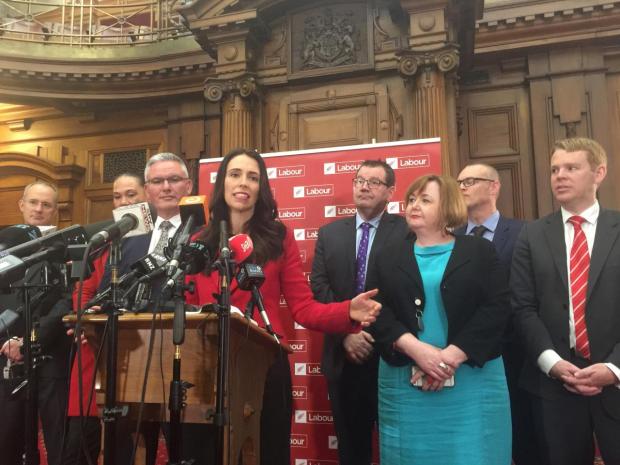
Jacinda Ardern speaks to the press alongside members of her party after Andrew Little stepped down in Wellington, New Zealand
 
Jacinda Ardern elected leader of Labour Party backed by senior party supporters (Reuters)

So the centrist Blairites finally took power with Andrew Little as the last surviving notable tie to the unions gone and a Generation Y professional politician now leading the party. Chris Trotter goes into raptures that this can be a ‘revolution’. Not the old fashioned one led by armed Reds, but by hipsters it seems. A gentler, kinder, peaceful, 21st century revolution in the image of Lennon, not Lenin.

But where is the substance to complete this style says Mike Treen. Labour needs a Corbyn who adds substance to this style. Let’s see Jacinda Ardern come up with policies that turn on the missing million workers turned off by elitist, distant, self-serving politicans. But Treen is too late. I agree with his comrade Joe Carolan that Labour is dead and that no amount of prettifying the corpse will do any thing for NZ workers. However, for those who hope labour can return from the dead, I suggest that this is not a zombie movie but a death from which there is no return. Labour has been pronounced dead by the ‘missing million’ as the party that no longer represents workers.

I suggest we look to see what disease Labour died of. When the NZLP was founded in 1916 it it was to divert the labour movement away from industrial struggles that divided the nation and threatened the future of capitalist profitability. It’s purpose was to take control of the majority of workers and split them from the Red Feds, anarchists and socialists who were committed to radical industrial action to negotiate their wages and conditions. Labour promised to win what workers needed through parliamentary reforms. It would impose the 1890s Liberal IC&A Act – that ‘arbitrated’ agreements between workers and bosses that had split the Labour movement and given rise to the Red Fed – and make Arbitration compulsory. Labour therefore was the party of the state controlled unions until compulsory arbitration was repealed by Labour in 1987 and compulsory unionism by the NACTs in 1992, which together broke the back of the unions’ resistance to neo-liberalism, taking workers back to the 1880s.

The NZLP had inflicted a mortal wound on itself. To serve its purpose as the Party that could reconcile workers to capitalism it needed to represent the unions and its membership to have any claim to be a workers party. It had to win a majority based on a working class constituency if it was to be useful to the ruling class. 1984 changed all that because Labour abandoned its founding principle of advancing the interests of workers and instead made workers pay for the capitalist crisis facing NZ by introducing Rogernomics.

Despite this historic betrayal the union bosses fought to keep Labour alive so that when the New Labour split occurred only a few small unions left Labour for NL. The NL split was premature and fizzled out as NL joined forces in an amalgam of Greens, Liberals and Mana Motuhake that became the Alliance. Labour survived by expelling its right wing faction which became ACT but under a succession of new leaders remained a Blairite, Third Way party trying to achieve a classless balance between capitalism and socialism – the notorious ‘middle’ [class]. It has not renounced its neo-liberal turn because getting the state out of business and policing fiscal responsibility is the new normal and Labour cannot serve its purpose unless it reconciles workers to the neo-liberal market and its brutal attacks on workers.

But surviving the near death experience had a cost. Labour lost its working class mojo and could no longer count on a majority from the labour movement. The NACTs continued their anti-worker attacks and drove some workers back to Labour, not because they believed in Labour as ‘their’ party but because it was the lesser evil. Labour had lost its reason to exist. The unions were gutted by the NACTs ECA in 1992 and ceased to be a force capable of sustaining the party. The Labour caucus’ focus on the ‘middle class’ reinforced the ‘neoliberal’ ideology that unions no longer served workers who had to rely on their individual efforts to get ahead.

Labour was in limbo with its traditional role overtaken by the new role of representing a classless utopia of petty bourgeois ‘middle NZ’. Under Helen Clark Labour sold itself as the natural party of the centre-left majority. To sell this it needed to compete openly with the NACTs whose history gave it much greater claim to represent the growling petty bourgeoisie. After all the NACTs originated as a farmers party and with urban petty capitalists very much in tow. Labour’s fate then was to abandon its working class constituency – the missing million – and recreate itself as the bland, Blairite, ‘classless’ party.

To do this it had to present itself as the alternative to the NACTs which has close links to the capitalist ruling class that owns business, including the media; a burgeoning new petty bourgeoisie in the cities and a new rural gentry getting rich off dairying. Every leader who stood up to claim this title was shot down by the caucus of Blairite time-servers until Andrew Little, the last vestige of Labourite ties to the union bosses, was forced to resign. Ardern’s ‘fresh’ style may attract more votes from the middle, but it is the death knell of Labour devoid of substance as the party of workers in Aotearoa/NZ.

Yet, only the death knell, because what will finally kill off Labour in the end is not its failure to advance workers interests, it is its open renunciation of its duty to attempt to do that by joining with the Greens and NZFirst to form a government. Labour parties, and social democracy in general, can always come back from the dead so long as workers live in hope. But by forming a coalition with openly capitalist parties like the Greens and NZ First, as even critics like Mike Treen advocate, sends Labour back to where it began, the Liberals of the 1890s.

The Liberal party was a cross-class party of workers, small farmers and the unemployed. Its philosophy was the reconcilation of classes under the Liberal Democratic state that stood for the self-governing nation within the British Empire. Sometimes referred to as a ‘liberal-labour’ or populist party because it contained an open contradiction between farmers and labourers that was suppressed by the submersion fusion (and diffusion) of class in the nation state; a state once called ‘proto-fascist’ by historian Willis Airey. This reconciliation could not last as the Liberals blew apart when workers rose up against the IC&A Act to form the Red Fed. Farmers split from the labourers and were enrolled as special police – Massey’s Cossacks – to smash the Red Fed, with farmers forming the Reform Party and defeated workers the Labour Party.

Labour has come full circle. It has finally renounced the existence of class politics in Aotearoa and transformed itself into the ‘classless’ populist Liberal Party that is preparing to fuse its program with the Greens and NZFirst who both represent the petty bourgeoisie in NZ. It this government eventuates, it will limit its program to that acceptable to a NZ ruling class facing a global slump in profits and climate crash dooming its future. This can only mean that the working class will again be sacrificed to the holy grail of a property owning democracy about to succumb to imperialist war and near extinction.

Workers now have no alternative but to struggle to take control of their own lives by breaking with the parliamentary farce and the bourgeois nation state, to organise their own independent mass Labour party and a new Red Fed, able to fight the class struggle in the workplace and the streets as part of a global mobilisation of workers, unemployed, poor farmers and oppressed peoples for survival socialism against a dying capitalism and rush to human extinction.


[Added September 13]


Meanwhile, many workers will vote for the ‘lesser evil’ – a Labour-Green coalition. If they become the government, we call on workers to fight to make that government deliver on its promises and to put working people before profit!
·         Reject the neo-liberal bullshit that the budget must be balanced! Down with ‘fiscal responsibility’!
·         Reject the legacy of Rogernomics! Demand that they tax the rich to fund free public health, education and housing!
·         Tax the Capital Gains of speculators!
·         For a living wage and living benefit. Make the polluters pay! Open the books! 
·         Demand NZ goes carbon neutral by 2030!
·         Re-nationalise privatised state assets and nationalise firms that close under workers’ control - without compensation!
When a Labour-Green coalition refuses to put working people before profits, and balks at taxing the rich to implement much needed reforms, workers will realise the necessity for their own political party to fight for a Workers Government able to socialise the economy and put workers needs before capitalist profits.


Saturday, March 18, 2017

Pike River Mine Disaster and the role of the Unions


The original Miners Union Hall in Runanga (just north of Greymouth on the West Coast of Aotearoa/NZ) dates from 1908, it was burnt down in 1937 and the replacement still stands as a symbol of the United Mine Workers' union.

Pike River was a failure of the unions to insist on health and safety conditions for the miners under both Labour and National Governments. The deregulation of industry was started by the 4th Labour Government under Lange. It was symptomatic that under Labour the unions fell into line with its policies and failed to put up a serious fight against the monetarist deregulation of the economy at the cost of many workers lives. Today, state-owned Solid Energy which owns the mine refuses to re-open it to recover the bodies. All the evidence that would condemn those who built and ran an unsafe mine will remain buried with the dead. We say open the mine and rebuild the United Mine Workers Union as part of a Red Federation of Labour!

Labour’s Failure

This failure was belatedly recognized by Bill Anderson, secretary of the Northern Drivers, who regretted ‘pulling’ industrial action at Marsden Point in the months before the election in 1984 on the promise that a Labour Government would meet their demands. So comfortable was the union bureaucracy with the Labour Party, that the unions were completely unprepared for the onslaught of Rogernomics. The outcome was the return to a rip, shit and bust economy of follow the money all the way to the bank and bugger the consequences. Rip, shit and bust means scavenging the resources of the semi-colonial frontier for the 'health and safety' of the rate of profit. One ventilation fan at the bottom of its shaft says it all. Had this been in the days of the Ministry of Mines rescuers would have done what they are trained to do and assessed the situation without ringing an insurance broker. So, what happened? Neo-liberal Corporatization and privatization!

Labour had no answer to neo-liberalism. Having emerged in the 1930s as a serious political force representing workers and working farmers and implementing a policy of economic nationalism, the end of the post-war boom destroyed the conditions for protectionism. This became obvious when the last Muldoon Government resorted to ‘think big’ to defend economic nationalism. The incoming Lange Government faced an international capital strike and quickly imposed the neo-liberal reforms of Finance Minister Roger Douglas. The deregulation under Rogernomics shocked Labour supporters who still had illusions in parliamentary socialism. Yet Labour’s political existence was always that of responding to crises by making workers pay for them while at the same time claiming to be defending the unions and historic gains in workers’ rights and living standards.

If we go back to the ‘golden age’ of Labour, the depression and onset of WW2, we can see clearly that Labour was protecting the profitability of semi-colonial capitalism in the only way it could by increasing the rate of exploitation of its working-class constituency. Economic nationalism hides the interest of global capitalism and its national capitalist allies behind the fig-leaf of a non-class or classless, equal opportunity society. Yet workers kept resorting to class struggle to which Labour responded as the conditions dictated.

Depression welfare became workfare and emergency regulations. Wartime brought conscription and strike breaking, which then became postwar attacks on union militants. The Nordmeyer Government (1959-62) taxed workers’ consumption. When the post-war boom ended in stagflation the Kirk Government (1972-75) faced the oil crisis with attempts to halt inflation. By the 1980s the crisis of NZ capitalism demanded the end of economic nationalism and the onset of economic rationalism. The 4th Lange Government (1984-89) imposed the shock therapy of Rogernomics, and 5th Clark Government (1999-2008) continued the neo-liberal policy settings.

From Red Fed to Dead Fed 
The history of the miners’ union on the West Coast from the days of the Red Fed to today tells us what went wrong and what we need to do. The miners were the backbone of the Red Federation after 1908 – the same year as the Blackball Strike. And it was the miners alone that kept the tradition of the Red Fed alive well into the post WW2 period. The miners alone, of all the industrial unions, were able to stay out of the Arbitration Court because they could not be replaced in the mines by unskilled scab labour. They fought directly against the bosses and their state and won more workers control over the workplace than any other union. They opposed Conscription in both wars and won an exemption for miners. The UMW (United Mine Workers) was always led by strong leaders who worked through the Red Fed days or the WW1 period and carried on the militant traditions of syndicalism, socialism and communism in the mines.

The UMW had a fractious relationship with the Labour Party until WW2 when the leadership under McLagan (Secretary of UMW and President of the FOL, and from 1942 Minister of Manpower and later Minister of Labour) collaborated with the Labour Government to impose economic stabilization in the name of the war effort. The miners fought for and won wage increases and the nationalization of mines during the war and then battled against the Holland National Government that came to power in 1949 determined to smash the militants and re-privatise the mines. The critical test came in 1951 when it was the miners who held out longest against the Wharfies’ Lockout and the ‘state of emergency’ which saw militants locked up and open-cast miners used by the National Government to isolate the militant miners and destroy their power.

Right through this history of struggle the underground miners could assert their industrial power because of their skilled work making it difficult to be replaced by strikebreakers. Open-cast mining did not require the traditional skills of underground mines. On the West Coast during ’51 it was only the Stockton opencast mine that could be worked by Navy strikebreakers. Clearly, the high point of miners’ control of the work place was the workers’ inspections of mines which meant the union did not wait on the managers or the Mines Department to shut down production for health and safety reasons.

It was the loss of this hard-won worker control over working conditions and health and safety that marked the end of the tradition of the Red Fed and the reduction of miners to no more than drivers and mechanics who could be easily replaced by scabs. In the aftermath of ’51 the UMW was no longer able to live up to the tradition of the Red Fed and eventually amalgamated with the EPMU (Engineers Union) in the CTU (Council of Trades Unions) AKA the state-arbitration Dead Fed.

It was the Dead Fed that led to the Pike River Disaster. Had the Union still been in control of work and health and safety conditions, the Pike River mine would have never been built and the disaster could have never happened. The UMW and the whole union movement after the defeat of ’51 gave away their independence when they affiliated to the Labour Party conceding to Labour Governments the authority to dictate conditions in the workplace.

Yet even under the neo-liberal repeal of the Ministry of Energy in 1998 (See Peter Ewen, Pike: Death by Parliament 'Ayes and Noes') that allowed Pike River mine to be built, the EPMU could have taken a stand and challenged the many failings in design and operation that would not have been allowed in Europe, the US or even China. (On the debate over the role of the EPMU at Pike River see http://nzagainstthecurrent.blogspot.co.nz/2014/12/how-andrew-little-failed-pike-river.html.) With the end to workers’ inspections of the workplace, the Pike River Mine was always a “disaster waiting the happen”.

Forward to the reborn Red Fed 
If we isolate the conditions that led to workers control historically we find that it is based on unity, organization, and international solidarity. The Red Fed united militant unions in which many members were recent migrants from Europe or North America. Influenced by anarchism the IWW (International Workers of the World) their political perspective was broadly syndicalist – the belief that unions were a sufficient basis for workers’ power against the capitalist state. However, syndicalism falls short of understanding the need to smash the capitalist state. The defeat of the General Strike of 1913 showed that workers had to build political organs such as workers councils and militias to counter the state force used to smash the militant unions.

The objectives of a Red Fed today would have to embrace a revolutionary socialist program to fight for a Workers’ Government that would implement a socialist plan. This would shift the syndicalist concept of workers’ control from control over the workplace to socialist control over the state and economic planning.

A UMW of the 21st century would demand the nationalisation of energy under workers control (i.e. socialization) to shut down unsustainable production unsustainable energy sources such as coal and gas (and nuclear!) and demand the redirection of production towards sustainable sources of energy such as Hydro, wind and solar.

To achieve this, it is necessary to mobilise the rank and file through strikes and occupations, breaking with the union bureaucracy and the capitalist exploiters the bureaucracy serves. Capitalism cannot survive without exploiting the labour of workers. Workers have the power to withdraw their labour and to occupy workplaces against the use of scabs and strike breakers. Workers militias would defend the occupations from state and para-military forces.

But to do this, we need a Workers Party that represents the interests of workers independently of the bosses and the union bureaucracy, and a Transitional Program for the seizure of state power and for building a socialist future.

https://situationsvacant.wordpress.com/2010/11/29/rip-shit-bust-29-pike-river-miners-find-their-wealth-in-heaven/

http://redrave.blogspot.co.nz/2011/01/v-behaviorurldefaultvmlo.html

http://redrave.blogspot.co.nz/2011/09/pike-river-mine-disaster-exposed.html

http://redrave.blogspot.co.nz/2013/12/class-struggle-107-rape-culture-dirty.html

Len Richardson. Coal, Class and Community: The United Mineworkers of NZ. AUP, 1995.
Paul Maunder. Coal and the Coast: A Reflection on the Pike River Disaster. Canterbury University Press, 2012.
Rebecca Macfie. Tragedy at Pike River Mine: How and Why 29 Men Died. Awa Press, 2013. Peter Ewen. Pike: Death by Parliament. Pit Pony Press, 2014.