Showing posts with label Asia Pacific. Show all posts

Wednesday, March 04, 2015

Smash the TPPA!


Image result for TPPA taking peoples power away


The Editor of the left journal redline says that Marx was for ‘free trade’ as if this has anything to do with workers taking a stand on the TPPA. In Marx’s day ‘free trade’ was the market prevailing over pre-capitalist society to allow capitalists to compete to produce commodities and develop capitalist society. But today the TPPA has nothing to do with free trade. Marx didn’t live to see capitalism become transformed from its competitive stage to in its highest, imperialist stage where the world was divided between imperialist monopolies and colonised countries. In the epoch of imperialism, free trade was replaced by monopoly state capitalism.

Lenin wrote his path-breaking book Imperialism- the Highest Stage of Capitalism in 1915. This epoch has advanced considerably for 100 years to the point where today NZ is torn between the two major imperialist blocs led by the US and by China. The US has been in decline since the end of the post-war boom and the onset of a structural by sis of falling profits in the 1970s. Its response to that was to embark on neo-liberalism to gain access to cheap labour and raw materials in the semi-colonial world and pursue its cold war with Russia and China until those countries collapsed and opened up to Western imperialism.

What the US and other Western powers did not foresee however, is that Russia and China while opening up new opportunities for massive profits to rescue the ailing capitalist system, maintained their independence and developed as new rival imperialist powers. China in particular was able to emerge as the main rival to the US, driving growth in the global economy on the back of its rapid expansion.

This has brought a major confrontation between the two blocs to a head in the Asia Pacific region contesting control over all the other Asia Pacific countries. This contest takes the immediate form of rival economic zones based on the US led TPPA and the China led FTAAP.

The TPPA is a continuation of neo-liberalism – the US policy dating from the 1970s to break down national barriers to US corporations to buy up cheaply what is left of scarce global resources needed to restore profits. That policy included ‘structural adjustment’ that imposed punitive deregulation on semi-colonies including removal of tariff protection. Many of those countries, including NZ were forced to eliminate tariffs to allow the penetration of foreign capital, while the US and other big imperialist powers maintained their protectionist barriers.

So is the TPPA now about the US reciprocating by suddenly reducing its own tariff barriers? Not at all, the US is now demanding that its ‘partners’ eliminate any political barriers to US corporations dictating trade and investment rules at the expense of the social needs of the populations and the destruction of the environment of these countries.

That is why the TPPA takes the form of US bullying the weaker states in its bloc to remove all sovereign barriers to US corporations buying up all sorts of property from state assets to IP and re-colonise these weaker states as sources of cheap labour and raw materials. This prevents these states from giving equal preference to China via FTAs with China, at the same time allowing the US corporates to ‘piggy back’ into China on these FTAs.

This is what is happening to NZ today. Unlike redline that says that NZ is an imperialist country, NZ has gone from a settler colony with limited self-governing independence from imperialist Britain before WW2, to a servile client state of the USA, and now in the 21st century, also a neo-colony of Chinese imperialism. The FTA with China is mainly about trade, although it also allows access to Chinese capital buying up NZ land, assets and IP. The US hopes to steal a march of China by taking direct control of the NZ economy.

Therefore, the TPPA has nothing to do with ‘comparative advantage’ (the basis of the theory of free trade) and everything to do with US state monopoly capitalism. Were Marx alive today he would recognise that imperialism arose once the limits of market competition to develop the forces of production had been reached. In its place giant monopolies backed by their states set about destroying the forces of production, producing waste, creating a global surplus of labour, and threatening the end of human civilisation and most of the living species on earth.

Anything that mobilises the federation of international freedom fighters against this destructive death star would be actively supported by Marx.

Thursday, November 01, 2012

China/US Rivalry for Asia-Pacific

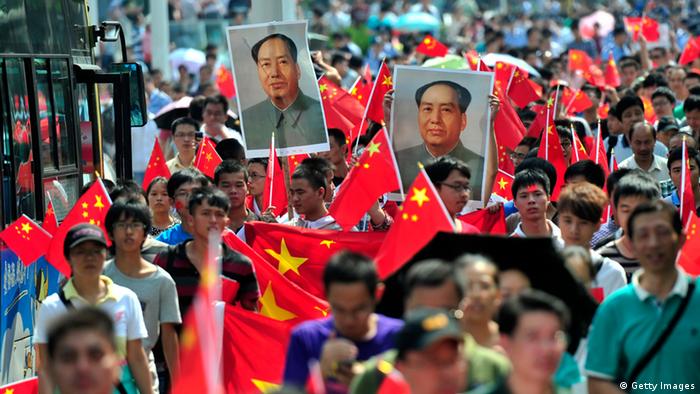
Chinese anti-Japan protest featuring Chairman Mao

US imperialism as the dominant world power is under threat. The global crisis of falling profits has hit the US and EU economy hard and the great recession must become a great depression to restore profits. As a result US rivalry with other imperialist countries is hotting up as they all compete with one another to increase their ‘spheres of influence’ and their super-profits. The US now faces China and Russia as new, expansionary imperialist powers. The main threat to US imperialism comes from China rising as we have argued for some time. China/US rivalry is the driving force behind global geopolitics today. Grasping this reality is the starting point for Marxist revolutionaries.
 

China is now the second largest global economy though still lagging well behind the USA. Yet it is overtaking the US at about 8% a year while the US economy lags between 1 or 2%. The US has responded with trade protection and a political and military ‘pivot’ into the Asia-Pacific to contain China’s growing sphere of influence. It is also continuing to try to isolate China’s ally Iran and the influence of China in Central Asia, and stepping up its activity in Africa where China has made big inroads in the last decade. This raises the stakes globally and explains the political and military moves to contain China in the Mideast, Asia and the Pacific.

China as Emerging Imperialist power


China has become a world power today because it is now imperialist. Marxists define imperialism in the way that Lenin did, as the final stage of capitalism in decline when rivalry between giant monopoly corporations backed by their powerful oppressor states compete to divide up the world into “spheres of influence” to extract ‘super-profits’ from the colonies and semi-colonies. This economic competition inevitably leads to political and military conflict. Two imperialist world wars have demonstrated the truth of this theory. The current global crisis of overproduction sets the scene for more wars including a 3rd imperialist world war.

Marxists reject crude dogmas that see the re-emergence of China as a world power as due either to its dynamic revival of pre-capitalist glory, or to a Maoist-type post-capitalist society out-developing capitalism.

China is imperialist today because it had a national revolution that smashed the ancient semi-feudal landlords of pre-capitalist China, and then threw out imperialism and the weak Chinese bourgeoisie in 1949.

The revolution was led by a Maoist bureaucracy at the head of a peasant army that nationalised bourgeois property but prevented workers and poor peasants from taking power. So the ‘post-capitalist’ society that resulted fell well short of a healthy workers’ state and failed to develop the conditions for socialism.

The post-capitalist society did not have the capacity to develop the forces of production to keep pace even with declining global imperialism. China has huge resources and population yet the dictatorship of the Maoist bureaucracy together with China’s national isolation from the world market resulted in the planned economy stagnating. It could not produce enough to meet the needs of the masses nor increase the surplus for the parasitic bureaucracy. The bureaucracy decided in the late 1970s to reintroduce the capitalist market to revive the economy. But once introduced, the law of value began to spread and take over from the plan as the main driver of the economy.

When the Maoist bureaucracy smashed working class resistance to the growing inequalities of the market at Tiananmen Square in 1989 the way was open to restore capitalism to the whole economy. At that point, China was ruled by the law of value. Prices were set by market competition and not state officials so that labour power now became a commodity. The state now served the interests of a new bourgeoisie which exploited wage labour. The top leaders of the Communist Party became a ‘Red Bourgeoisie’. The bourgeoisie began to accumulate surplus profits and China had to ‘go global’ in search of super profits from raw materials and labour. This rapid expansion as a new imperialist power brought it into conflict with the existing imperialist powers, in particular the US.

US Imperialism takes up the Challenge

While China is a looming economic threat is lags well behind the US. However its growth trajectory puts it on collision course. The US has responded economically, politically and militarily. Economically the US is stepping up its ‘trade wars’ ramping up anti-China xenophobia, blocking Chinese investment and challenging ‘unfair’ competition.

China’s threat to the US is most direct in the Asia-Pacific where it wants an economic bloc, the Regional Comprehensive Economic Partnership (RCEP), to advance its interests. The US has responded economically by joining the Trans Pacific Partnership Agreement (TPPA) which excludes and isolates China and could create a rival US- dominated Asia-Pacific sphere of influence.

A second purpose is to compete more efficiently with China by using the TPPA to open up the Asia-Pacific economies to US investment on conditions which maximise profits and impose punitive rules to enforce the extraction of super profits. Thus the US wants to enforce its domestic law in the members’ states allowing it to enforce its property rights (see Box). This political domination is backed up by a beefed up military deployment including a missile ring that encircles China (and the whole of East Asia) drawing in key US allies in the region.

China responds to US encirclement

China is building its military capacity (see cover photo of China’s first and only aircraft carrier) but in most parts of the world does not deploy it. It can compete economically and relies on trade and investment deals with national regimes on a so-called ‘win win’ basis in Asia, Latin America and Africa. It has formed economic and military blocs with Asian states to mark its shared sphere of influence over central and South Asia with other powers especially Russia and India such as the Shanghai Cooperation Organisation (SCO).

However, it sees East Asia and South Asia as its own sphere of influence, and has for years been involved in territorial disputes in the South China Sea such as that with Philippines over Huangjang Island. China has regarded the Paracel and Spratly Islands as part of its territorial waters for centuries. The current reactivation of these disputes reflects first, the competition for control of rich economic resources, and second, control over China’s main sea route to the Indian Ocean through the Strait of Malacca, and a counter to US opening military bases in Australia and the Philippines.

Also indicating the rising inter-imperialist rivalry in the China’s core zone of influence is the recent dispute in the ‘East China Sea’ with Japan over the Senkaku/Diaoyu islands . This is a small scale version of the long standoff with the US over Taiwan. Like Taiwan, China regards these Islands as part of China much as it regards its ‘internal colonies’ in Tibet, Xinjiang and Inner Mongolia as Chinese territory. The closer to China’s heartland the more these territorial disputes become inflamed by extreme xenophobia and public demonstrations against ‘foreigners’ and working class support of imperialist military adventures.

3rd World War vs Class War

New imperialist wars are inevitable sooner or later. Both the US and Japan are declining imperialist powers and belligerent in using military power to defend their spheres of influence against China. Japan’s Conservatives want to re-arm and redeploy to ‘contain’ China. China, to expand must sooner or later enter into military disputes with these powers. So far they are proxy disputes and civil wars ranging from Iran to Syria over control of oil in the Middle East and Central Asia. There are the makings of proxy wars in Africa, notably in Sudan where China and Iran are engaged in a shadowy war with Israel and the US. The most dangerous arena for military conflict, however, is in the breaking disputes over China’s claimed core sphere of influence in the Asia-Pacific.

In proxy wars between imperialist powers, and in direct military conflict, revolutionaries must be dual defeatists. This means that we oppose fighting on the side of any imperialist power to stop them grabbing of more resources, plundering and destroying humanity and nature. Where imperialism is at war with colonies or semi-colonies we defend them and fight to defeat the imperialist power, unless they are being used as proxies by another imperialist power.

So for example in the South China Sea Islands we defend Vietnam and Philippines against China. But if these nations are acting as proxies for the US, we are for the defeat of both sides while fighting simultaneously for the independence of Vietnam or the Philippines. In the Diaoyu Islands we are for self-determination from both Japan and China and oppose them being used as proxies in a war between any imperialist powers. In the latter case it is enmeshed in Okinawa’s long struggle for independence from both the US military which has bases on the island, and Japan which claims Okinawa.

Revolutionary Marxists call on workers to fight against all attempts by their ruling classes to rally workers behind their national flags into new imperialist wars. Workers have no country, we unite across borders as one international working class to fight to overthrow our ruling classes, seize state power, and bring about a new socialist global society!


Defeat US, Japanese and Chinese Imperialism!

Defend oppressed nations against imperialism!

For a Federation of Socialist Republics of the Asia-Pacific!

For a new World Party of Socialist Revolution!