 |
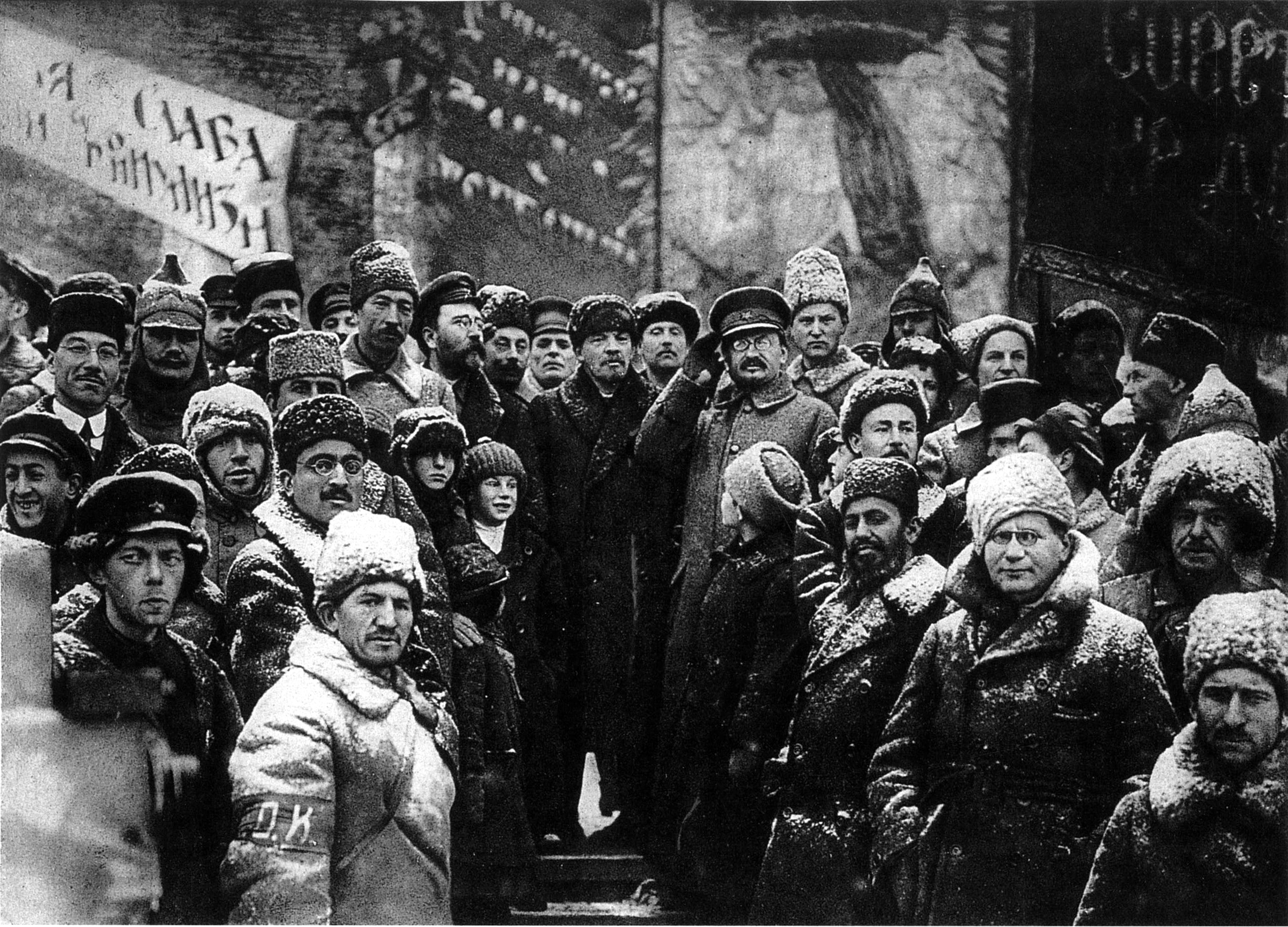
| Lenin and Trotsky at Second Anniversary of the October Revolution |
Developing Lenin and Trotsky on post-soviet Russia and China
There are big debates going on about whether Russia and China are
imperialist powers
today. This
arises when it becomes obvious that the major local and regional wars around
the globe, such as in Ukraine, are in reality proxy wars between the
established imperialist powers led by the US, and the upstarts, Russia and
China. With the rapid rise of
inter-imperialist
rivalry between the US and China led blocs this question has become urgent
since it involves a policy of defeat for both sides if they are imperialist or
the defence of Russia and/or China if they are not. Unlike much of the left
that thinks that the old debates of the workers states are no longer important
today, we argue here that the fundamental differences that arose over the
workers states nearly a century ago carry over into the 21
st century
revisionist politics of new batches of Mensheviks who substitute the petty
bourgeois for the revolutionary agency of the proletariat.
The usual approach of Leninist-Trotskyists is to apply Lenin’s criteria from
Imperialism, the highest stage of capitalism, which essentially
reduces to the overproduction of capital in the great powers which requires
capital export to colonies and semi-colonies to raise the rate of profit at
home. The argument goes back to Marx’s
Capital to establish the
foundations of the theory, and forward to see if the theory applies to Russia
and China today. The problem is therefore framed in terms of whether
Russia
and
China
today are imperialist on Lenin’s criteria
.
A second important question
that flows from this approach, however, is not just “if” this is the case, but
“how”. This is because to be consistent with Lenin’s theory, more needs
explaining than the theory underpinning capital export and whether Russia and
China qualify in these terms. Lenin as well as explaining the rise of imperialism
also argued that the world had been divided among the imperialist powers. Some
have taken this mean that there is no room for new imperialist powers to
emerge, not least former workers’ states!
In summary, Lenin’s theory draws on Marx
Capital to posit
imperialism as a necessary stage of finance capital that arises out of its
inherent crisis tendencies. Driven by crises of over-production of capital at
home to export capital to get access to cheap raw materials and labor, the
competing imperialist powers carve up the world market among them. From that
point on the world market can be re-divided among these powers only by means of
trade, political and military wars until such time as wars produce revolutions
capable of defeating imperialism and making the transition from capitalism to
socialism.
Therefore it follows that there is no provision in the theory for the
emergence of new imperialist powers escaping colonial or semi-colonial
servitude. They lack the pre-condition for such a transition – that is, they
lack genuine political and economic independence from imperialism. They are
oppressed states and as such will remain oppressed by one or other imperialist
power. So not only must Lenin’s theory be developed to explain the emergence of
Russia and China as imperialist, we must prove “how” this is possible. In the
process we can demolish all the rival theories that arrive at false conclusions
based on a non-Marxist, non-dialectical method, that is, a bourgeois eclectic,
empiricist method.
We must first show that Lenin’s theory, because it is grounded in
Marxist method, is powerful enough to explain why Russia and China can emerge
as imperialist nations late in the imperialist epoch. That is, far from being
‘exceptions’ to the rule, they prove the rule; that, in the epoch of
imperialism, only nation states that have made successful national revolutions
and become independent of imperialism, are capable of making the transition to
imperialism. The measure of ‘independence’ is not the ‘political independence’ of
neo-colonialism, but economic independence won by the expropriation of
imperialist property, and the property of comprador national bourgeoisie that
act as agents of imperialism.
The Imperialist Epoch
We can illustrate this briefly by reviewing the history of those imperialist
states that existed at the time Lenin wrote
Imperialism: the highest stage
of capitalism. Imperialist states by his definition are
oppressor states that extract super-profits from oppressed states. Here we will
show that those that became imperialist, like Spain, Italy, Britain, Japan,
Russia and the USA, inherited pre-capitalist territories and expanded through
wars of independence or conquest. All these countries were imperialist by 1914.
They divided the world market among them and since then no colony or
semi-colony that won their ‘political independence’ has succeeded in breaking
free from imperialism,
unless that revolution went further than the
bourgeois democratic revolution and expropriated the bourgeoisie. Russia
is the classic case of a workers revolution where the bourgeoisie were
expropriated. Less clear are the post-ww2 national revolutions in China,
Vietnam and Cuba, that ended up expropriating the bourgeoisie only because the
bourgeoisie refused to make peace with a predominantly peasant-based
government.
Those colonies and semi-colonies that underwent national revolutions that
fell short of expropriating capitalist and imperialist property have remained
oppressed countries failing to break free from imperialism. Since some of these
are considered by many to be imperialist (or sub-imperialist), it is important
to demonstrate why that cannot be the case. This question has arisen mainly in
relation to the
BRICS
–that is, the grouping of Brazil, Russia, India, China and South Africa. These
states are grouped together because they appear to be similar on the surface.
They are large developing or emerging countries that exercise some regional
economic influence and export some capital. For this reason not only do Russia
and China appear to have both semi-colonial and imperialist features, so too do
India, Brazil and even South Africa. Yet by Lenin’s criteria only Russia and
China make the grade because they alone have a history of national liberation
struggles that expropriated the bourgeoisie. India, Brazil and South Africa
never completed their national revolutions and so never achieved the level of
independence from the existing imperialist powers to make possible their own
transition to imperialism. That is, the accumulation of capital in those
countries was largely expropriated by the imperialist countries leaving them
incapable of developing their productive forces to the point of causing crises
of overproduction leading to capital export.
Russia and China are different
In stark contrast, Russia and China
did complete their national
revolutions to break from imperialism to a point sufficient to develop the
forces of production beyond that possible in a capitalist semi-colony. The only
possible explanation for the economic growth of Russia and China outside the
global capitalist economy is that they were post-capitalist planned economies
that accumulated a social surplus produce. What makes Russia and China
different from the rest of the BRICS is their independence as post-capitalist
economies, outside the sphere of interest of any existing capitalist power, allowing
these degenerated workers states to develop independently of the law of value.
Yet at the same time their almost complete isolation from the global capitalist
market forced them to backslide into economic stagnation as the parasitic
bureaucracy consumed the surplus as its privileged income at the expense of the
further development of the forces of production. While this isolation and
stagnation ultimately led the restoration of capitalism, their independence
from imperialism allowed them to escape semi-colonial oppression when they
re-entered the global capitalist system and to make the transition to
imperialism.
This analysis allows us to develop Lenin’s theory to the new situation of
restored former workers states. We do this by integrating Lenin’s theory with
Trotsky’s theory of the degenerated workers states. These are
not the
same as the classic ‘limits to growth’ faced by capitalist semi-colonies
promoted by development theorists like Walt Rostow. As Trotsky
had
predicted, if the working class was unable to mount a political revolution
to resist the growing distributional inequalities resulting from the stagnation
of the plan, the bureaucracy could to overturn workers property and restore the
law of value to stimulate economic growth and convert itself into a new
capitalist class. The gradual step by step bureaucratic reintroduction of the
Law of Value (LOV) became a total transformation in the class character of the
state between ‘89-‘92 in Russia and China, when the bureaucracy decided to
restore capital and, given the laws of motion of capital, created the
pre-conditions for the necessary emergence of imperialism.
We will see how a range of empiricist non-Marxist theories fail to explain
this concrete reality in Russia and China today. We exclude from this analysis
the Stalinist Communist Parties and their associated currents. They defended
the Soviet Union (SU) uncritically and many still see the SU and China as ‘socialist’
(in Stalin’s language) despite the inroads of global capitalism. We limit the
analysis here to those self-described Trotskyists in the tradition of the 4
th
International. We target these groups to demonstrate that
Lenin’s theory of
imperialism and Trotsky’s theory of the workers state are both necessary in the
case of Russia and China today to prove that alternate empiricist theories
based on impressions, or appearances, of the concrete reality, fail to provide
a guide to revolutionary practice. The programmatic consequence of
such a bourgeois anti-Marxist method is a bourgeois program directed against
the revolutionary program of the proletariat.
As we argue here, this empiricist method leads to the theory/practice of a
refusal to defend workers states or to fight for the political revolution. In
both cases this liquidation of the Trotskyist program contributed to the defeat
of the workers states. Some recognise this as an historical defeat, others as a
victory over Stalinism, but neither owns up to their rotten role in liquidating
the Trotskyist program of world revolution in defence of the workers states. In
the recent debates over the role of imperialism in a number of conflicts across
the globe, the big majority of reformist and ‘centrist’ currents reject Marxist
dialectics for an empiricist and eclectic method of Menshevism. This rejects
the Bolshevik party as the proletarian vanguard and turns the socialist
revolution into an evolutionary process a la Kautsky or Stalin in which the
petty bourgeois substitutes itself for the revolutionary agency of the
proletariat. As Trotsky argued in
In Defence of Marxism
(IDOM), empiricism is the hallmark method of the petty bourgeois intellectuals
who select facts in isolation to promote their interests as a
class or
caste that acts as the labour agents of capital.
Empiricism versus Dialectics
Empiricism is the method of the bourgeoisie because it corresponds to
capitalism at the level of exchange where the exploitative relations of
production appear in a fetishised form as relations of exchange. When the petty
bourgeois empiricists ‘select facts’ they are those facts that accord with this
fetishised view of capitalism, in which they play a mediating role in the
market between employers and workers. Petty bourgeois intellectuals along with
the labor bureaucracy therefore act as the agents of the bourgeoisie
subordinating the working class to its rule. The class struggle is a constant
battle between revolutionary Marxists who represent the general and historical
interests of the proletariat, and the petty bourgeois reformists, who attempt
at every turn to subordinate the proletariat to the bourgeoisie. The Russian
Revolution succeeded because the revolutionary Bolshevik party prevailed over
the reformists and Mensheviks and led the workers and poor peasants to victory.
The degeneration of the Russian revolution and the failure of the German
revolution resulted from the failure of workers to form Bolshevik parties and
break from the petty bourgeois currents in the labour movement outside the SU
and the rise of the Stalinist bureaucracy inside the SU.
The Russian revolution is the pivotal event in the history of the
proletariat. It was the single event that proved the Bolsheviks superior to the
Mensheviks. Acting as the agents of the bourgeoisie, the petty bourgeoisie in
general rejected the revolution as premature. For example, the Mensheviks and
Kautskyites did not think the pre-conditions for socialist revolution were
present in Tsarist Russia. First there had to be a bourgeois revolution. Hence
the Bolshevik revolution was regarded as a coup rather than a genuine
revolution because it skipped over the bourgeois revolution. The Bolsheviks broke
from the Mensheviks to overthrow the bourgeoisie and make a socialist
revolution and the Mensheviks wanted their revenge. They regarded themselves as
vindicated by history and rewound events in their heads to start again. Either
the bureaucracy became the agents of the bourgeoisie in preparing the ground
for socialism, or they became a new bourgeoisie to create a new or more
advanced version of capitalism.
These Mensheviks fell into two camps, pro-Stalinist and anti-Stalinist
depending on their attitude towards the historic role of the Stalinist
bureaucracy. Both camps objectify the proletariat in order to eliminate its
subjective role in the revolutionary process substituting the petty bourgeoisie
as the subjective agency of history.
Thus o
ne identifies with the
Stalinist bureaucracy as progressive in this process and so credits the
bureaucracy with the subjective revolutionary agency of the proletariat. The
other reverses the signs and attributes to the Stalinist bureaucracy the
subjective agency of a bourgeoisie or a new ruling class. The both mask
their conservative role in collaborating with the bourgeoisie by blaming the
working class as unprepared for the historic tasks. Both represent a
degeneration of Trotsky’s dialectics that puts the revolutionary agency of the
proletariat, and in particular the proletarian revolutionary party, at the
heart of its program and characterises the Stalinist bureaucracy as a
counter-revolutionary ‘caste’ inside the working class which is dependent on
workers property for its privileges.
(1) The Pro-Stalinists
By crediting the Stalinist bureaucracy with an independent progressive role
in the transition to socialism, the pro-Stalinists liquidate the revolutionary
party and program. Usually they are identified as Pabloites after the leader of
the FI in the immediate post-war period. The
Pabloites
paid lip-service to the defence of the SU but in reality betrayed the
revolution by liquidating the revolutionary party capable of leading the
revolution. They responded to the restoration of capitalism in the SU and EU,
as well as China in the 1990s, by recognising it as a counter-revolution but
without taking any responsibility for it in their liquidating of Trotskyism
into neo-Stalinism!
A recent example of this is
Barry
Sheppard’s apologetics for Pabloism. Sheppard admits that the official
United Secretariat of the Fourth International (USFI) went soft on Stalinism
and began to see the political revolution as an objective process. But he
doesn’t think that it had any responsibility for the counter-revolution in the
SU. He claims that the USFI always defended the SU despite Stalinism and did
not capitulate like the ‘third camp’. Of course this is formally true; the SU
was not capitalist, nor imperialist. But this does not absolve the Pabloites
from any blame for the collapse of the SU. If you liquidate the party by
underestimating the counter-revolutionary role of the bureaucratic caste, you
are relying on objective forces outside the revolutionary party to defend
workers property. In some ways this submission to evolutionary socialism is
worse than the ‘third camp” since it defaults the task of political revolution
to the Stalinist bureaucracy. Sheppard exposes his unreconstructed Pabloism by
justifying the Socialist Workers Party (SWP-US) liquidation into the Cuban
bureaucracy on the basis of its mass support and break from ‘Stalinism’. Since
Cuba was a healthy workers state (however limited by its size and isolation) it
did not need a political revolution. Not surprisingly, by such criteria Cuba
remains a workers’ state today.
Most Pabloists see restoration as a transformation of Degenerate Workers
States (DWS) into new capitalist semi-colonies. So facing the current global
crisis and intensification of inter-imperialist rivalry they defend Russia and
China from imperialism. We wrote a detailed critique of this when we were in
the
FLTI.
The latest attempt to dredge up theoretical excuses against Russia as
imperialist is that of Sam Williams at the
Critique
of Crisis Theory Blog. The author seems to be in the Pabloite tradition. He
is orthodox on Tendency for the Rate of Profit to Fall (TRPF) etc but shows he
has no grasp of Marx’s method. His concept of capitalist crisis is flawed by
his failure to understand that Lenin developed Marx’s concept of
finance
capital by graspingits fusion of banking and productive capital at the
concrete level of state monopoly capital. No surprise then to find that
Williams substitutes for Lenin’s concept of imperialism an eclectic empiricist
fact book. For him finance capital is banking capital. So Russia cannot be
imperialist because it has no major private banks. Already 100 years ago Lenin
had defined Russia as a special hybrid case of imperialism in fusing its
capitalist state banks with the Tsarist Empire as an example of state monopoly
capital. Never mind, William’s empiricist litmus test is banking capital above
per capita $100,000. So NZ is imperialist! Yet Russia and China is below the
cut-off point so they cannot be imperialist. William’s second main criterion of
imperialism is a military machine. Russia lacks a military machine? Such a
method is a caricature of Marxism and Leninism.
Other
pro-Stalinists,
refusing to recognise the reality of capitalist restoration, deny that a
counter-revolution has taken place, still looking for some progressive faction
in the bureaucracy that will rescue the workers states from capitalist
restoration. For some, Russia has undergone restoration while China has not.
What accounts for the restoration of one and not the other is the empiricist
‘selection of facts’ according to some historic schema. In Russia the Yeltsin
counter-revolutionary coup led to the outlawing of the Communist Party of the
Soviet Union (CPSU), whereas in China the Communist Party (CPC) remains in
power. This ‘fact’ is sufficient, backed by selected Trotsky quotes, to account
for restoration in the SU but not in China. But by equating restoration with
the defeat of the Communist Party, these pro-Stalinists confess to their
bankruptcy in crediting the Communist Party with the ability to stop
restoration and develop the forces of production as a historically progressive
petty bourgeois caste.
(2) The Anti-Stalinists
Anti-Stalinists are of two sorts. First there are those Trotskyists who see
the Stalinist bureaucracy as totally counter-revolutionary. The bureaucracy is
a caste dependent for its privileges on workers property and it does this by
usurping workers power and administering the plan on bourgeois norms. In this
respect the Stalinist bureaucracy is seen as the class equivalent of the
bourgeoisie. For anti-Stalinists there can be no political bloc with the
Stalinists even to defend workers’ property.
The second group of anti-Stalinists are those who saw the Stalinists not
merely substitute for the bourgeoisie but actually convert into a bourgeoisie
in the 1920s or 1930s restoring capitalism and imperialism.
Both comprise the ‘third camp’ which Trotsky subjected to a cutting class
analysis:
“...this new anti-Marxist grouping which appears under the label of the
‘Third Camp’. What is this animal? There is the camp of capitalism; there is
the camp of the proletariat. But is there perhaps a ‘third camp’ –a petty
bourgeois sanctuary? In the nature of things, it is nothing else.”
We will give most space to our critique of the ‘third camp’ since it was the
major break from Lenin and Trotsky on the Workers State, and the concept of a
new class state in the SU led to the first major revision in Lenin’s theory of
imperialism. Moreover, Trotsky was quick to see the implications of the method
underlying this concept of the USSR as ‘imperialist’.
‘Third camp’ vs Trotsky
For the ‘third camp’ in general, the object was to re-define the SU as
not-a-workers-state since the Stalinists and not the proletariat ruled the
state. Whatever ‘new society’ they arrived at it involved a major revision of
Marx’s
Capital so we have to retrace our steps somewhat to uncover the
origins of the ‘third camp’ and why it survives today. In short the ‘third
camp’ arose out of the Socialist Workers Party (SWP-US) in the late 1930’s
under pressure of liberal public opinion opposed to Stalinist
‘totalitarianism’. Against Trotsky who argued that workers must defend the
Soviet Union unconditionally, despite the counter-revolutionary bureaucracy,
the ‘third camp’ equated the Soviet Union with its Stalinist regime. When that
regime joined forces with fascism and invaded Finland, such was the liberal
outrage that the ‘third camp’ had to look for a new theory of the workers state
to justify refusal to defend it. What followed was an attempt to rewrite Marx
theory of capitalism, so that capitalism could exist without a market, nor any
of the laws of motion that capitalism is notorious for, like booms and slumps,
crises and wars.
The ‘third camp’ in the SWP-US began their retreat from unconditional
defence of the USSR by identifying the workers’ state with its bureaucratic
regime. First they falsified the unconditional defence slogan they recently
shared. Instead of defence of workers property relations
despite the
bureaucracy, it became defence of the bureaucracy. Then as the bourgeoisie
saw the bureaucracy’s foreign policy as no different to that of Hitler, the
petty bourgeois opposition agreed and Stalin’s foreign policy became
‘imperialist’.
“Disagreeing among themselves on the class nature of the
Soviet state, the leaders of the opposition agree on this, that the foreign
policy of the Kremlin must be labelled ‘imperialist’ and that the USSR cannot
be supported ‘unconditionally’. (IDOM, 99). “
Our innovators cover the
holes in their position with violent phrases. They label the policy of the USSR
‘imperialist’. Vast enrichment of the sciences! Beginning from now on both the
foreign policy of finance-capital and the policy of exterminating
finance-capital will be called imperialism. This will help significantly in the
class education of the workers! (p. 75)
It is necessary to add that
the stretching of the concept of ‘imperialism’ lacks even the attraction of
novelty. At present not only the ‘democrats’ but also the bourgeoisie of the
democratic countries describe Soviet policy as imperialist. The aim of the
bourgeoisie is transparent –to erase the social contradictions between
capitalist and Soviet expansion, to hide the problem of property, and in this
way to help genuine imperialism.” (p. 76.)
Here is Trotsky destroying the credibility of petty bourgeois intellectuals
and their empiricist apologetics for refusing to
unconditionally
defend the workers’ states:
“Throughout the vacillations and convulsions of the opposition,
contradictory though they may be, two general features run like a guiding
thread from the pinnacles of theory down to the most trifling political
episodes. The first general feature is the absence of a unified conception. The
opposition split sociology from dialectic materialism. They split politics from
sociology. In the sphere of politics they split our tasks in Poland from our
experience in Spain –0ur tasks in Finland from our position on Poland. History
becomes transformed into a series of exceptional incidents; politics becomes
transformed into a series of improvisations. We have here, in the full sense of
the term, the disintegration of Marxism, the disintegration of theoretical
thought, the disintegration of politics into its constituent elements.
Empiricism and its foster-brother, impressionism, dominate from top to
bottom...Throughout the vacillations and convulsions of the opposition, there
is a second general feature intimately bound with the first, namely, a tendency
to refrain from active participation, a tendency to self-elimination, to
abstentionism, naturally under cover of ultra-radical phrases. You are in favour
of overthrowing Hitler and Stalin in Poland; Stalin and Mannerheim in Finland.
And until then you reject both sides equally, in other words, you withdraw from
the struggle, including the civil war.” (IDOM, 114-115)
Trotsky labels the opposition’s position on the USSR “conjunctural
defeatism:
“Let us now check up on how Shachtman, aided by a theoretical vacuum,
operates with the ‘realities of living events’ in an especially vital question.
He writes: “We have never supported the Kremlin’s international policy...but
what is war? War is a continuation of politics by other means. Then why should
we support a war which is the continuation of the international which we did
not and do not support? The completeness of this argument cannot be denied; in
the shape of a naked syllogism we are presented here with a rounded-out theory
of defeatism...Since we never supported the Kremlin’s international policy,
therefore we ought never to support the USSR...Since we are against Stalin we
must therefore be against the USSR too. Stalin has long held this opinion.
Shachtman has arrived at it only recently. From this rejection of the Kremlin’s
politics flows a complete and indivisible defeatism. Then why no say so?”
The reason Shachtman and the opposition do not recognise this as defeatism
is their empiricist method of splitting the function of war from the organ of
class rule, the state:
“Shachtman hold it possible that a function, namely, war, can be studied
‘concretely’ independently of the organ to which it pertains, i.e., the state.
Isn’t this monstrous? This fundamental error is supplemented by another equally
glaring. After splitting function away from organ, Shachtman in studying the
function itself, contrary to all his promises, proceeds not from the abstract
to the concrete but on the contrary dissolves the concrete in the abstract.
Imperialist war is one of the functions of finance capital, i.e., the
bourgeoisie at a certain stage of development resting upon capitalism of a
specific structure, namely monopoly capital. This definition is sufficiently
concrete for our basic political conclusions. But by extending the term
imperialist war to cover the Soviet state too, Shachtman cuts the ground away
from under his own feet. In order to reach even a superficial justification for
applying one and the same designation to the expansion of finance capital and
the expansion of the workers’ state, Shachtman is compelled to detach himself
from the social structure of both states altogether by proclaiming it to be –an
abstraction. Thus playing hide and seek with Marxism, Shachtman labels the
concrete as abstract and palms off the abstract as concrete! This outrageous
toying with theory is not accidental. Every petty-bourgeois in the US without
exception is ready to call every seizure of territory ‘imperialist’, especially
today with the US does not happen to be occupied with acquiring territories.”
IDOM, 162-3)
Trotsky sums up the petty bourgeois opposition as a whole just after the
split in the SWP (US) in April 1940 in his article,
‘Petty-Bourgeois
Moralists and the Proletarian Party’:
“The petty-bourgeois minority of the SWP split from the proletarian
majority on the basis of a struggle against revolutionary Marxism. Burnham
proclaimed dialectical materialism to be incompatible with his moth-eaten
‘science’. Shachtman proclaimed revolutionary Marxism to be of no moment from
the standpoint of ‘practical tasks’. Abern hastened to hook up his little booth
with the anti-Marxism bloc...Only the other day Shachtman referred to himself
in the press as a ‘Trotskyist’. If this be Trotskyism then I at least am no
Trotskyist. With the present ideas of Shachtman, not to mention Burnham, I have
nothing in common...As for their ‘organisational methods’ and political
‘morality’ I have nothing but contempt. Had the conscious agents of the class
enemy operated through Shachtman, they could not have advised him to do
anything different from what he himself has perpetrated. He united with
anti-Marxists to wage a struggle against Marxism. He helped fuse together a
petty-bourgeois faction against the workers. He refrained from utilising
internal party democracy and from making an honest effort to convince the
proletarian majority. He engineered a split under the conditions of a world
war. To crown it all, he threw over the split the veil of a petty and dirty
scandal, which seems especially designed to provide our enemies with
ammunition. Such are these ‘democrats’, such are their 'morals’’!
Bureaucratic Collectivism
Trotsky’s damning verdict on the petty-bourgeois “third camp” exposed the
theoretical fraud of determining the character of the workers state from the
‘concrete’ foreign policy of its Stalinist regime. This means defining social
relations or production in terms of its political relations, or economics by
power relations. This reduces Marxism to common liberalism. Agreement on the
Soviet Union as ‘imperialist’ left the problem of what form of class society is
engaged in such ‘imperialist’ expansion. Under the heat of Trotsky’s ridicule,
a new theory of the class character of the Soviet Union was needed to account
for Stalin’s ‘imperialism’. Max Shachtman, ever the eclectic according to
Trotsky, abandoned his abstract ‘workers state’ (i.e. isolated from class
relations) for a version of the theory of ‘bureaucratic collectivism’ and rise
of the bureaucracy as a ‘new class’.
Trotsky critiqued the theory of ‘bureaucratic collectivism’ in
‘The USSR
and War’. For Bruno R:
“...the new bureaucracy is a class, its relation
to the toilers is collective exploitation, the proletarians are transformed
into the slaves of totalitarian exploiters...Bruno has caught on to the fact
that tendency of collectivisation assumes as a result of the political
prostration of the working class, the form of
bureaucratic collectivism. The phenomenon
itself is incontestable. But what are its limits, and what is its historical
weight? What we accept as a deformity of a transitional period, the result of
the unequal development of multiple factors in the social process, is taken by
Bruno R for an independent social formation in which the bureaucracy is the
ruling class.” [Our emphasis]
Bruno R equates the regimes of Stalinism with fascism and the ‘New Deal’. He
abstracts this form of collectivist regime from two specific social formations,
capitalism and a new social formation. But he produces no analysis in support
of a new bureaucratic collectivist social formation in which a new class of
bureaucrats exploits workers as slaves. Shachtman attempts to adapt Bruno
R’s concept. He says that in 1939 Stalin became “Hitler’s agent” in an
“aggressive military alliance.” This means that Stalinism is an “
imperialism"
peculiar to the Stalinist bureaucracy in its present stage of degeneration”.
The basis of this imperialism is
‘bureaucratic
collectivism’:
“Now to summarize our position:
What then exists in Russia? We call it a bureaucratic collectivist state –
anti-proletarian and anti-socialist, but also anti-capitalist. The ruling class
is a bureaucracy. The possibility of such a bureaucracy was foreseen by Marx.
I’ve already published without challenge that the leader next to Trotsky of the
Russian opposition said in 1931 that in Russia there is a unique ruling class.
Bukharin said that in degeneration a peculiar ruling class could emerge.
Trotsky allowed for its possibility and concluded therefore that if it occurred
Marxism would have proved to be a utopia. I don’t agree with his conclusions
but nevertheless he allowed for the theoretical possibility. Our theory arose
from our analysis of the developments in Russia. It is impossible for the
working class to maintain power indefinitely in one country and it is impossible
to create socialism in one country. We thought that the capitalists would be
restored but the Russian bourgeoisie proved to be too weak to retake power.
Capitalism can come to Russia primarily from the outside. But world capitalism
didn’t and couldn’t do it because it was too weak and too torn by its own
internal contradictions. In the midst of this mutual impotence, to maintain the
revolution or to re-establish bourgeoisie rule, the unique ruling class
brilliantly foreseen by Bukharin came to pass by smashing both the working
class and the remnants of the bourgeoisie in Russia. The bureaucracy came to
power and expanded production – not socialist production or capitalist
production, as the international capitalists know it. The working class does not
exist in its capitalist form or in its workers’ state form. Even less does the
old bourgeoisie exist.”
Shachtman develops Bruno R to characterise Stalinism as imperialism to
justify rejection of unconditional defence of the SU. This is the
eclectic/empiricist method in full view. On the one hand he quotes Lenin to say
that imperialism always existed. “Every war in which two belligerent camps are
fighting to oppress foreign countries or peoples and for the division of booty
must be called imperialist”. On the other hand, Stalinism is a ‘peculiar’ form
specific to a degenerated ‘bureaucratic collectivism’. The SU does not live up
to Shachtman’s definition of capitalism or socialism as neither a property
owning bourgeoisie exists, nor does the proletariat control state power, so he
must invent a new society. He never developed this theory beyond an
outline
sketch of a new society to fill in the blank page in his blueprint.
Meanwhile, the ‘third camp’ had already largely abandoned ‘bureaucratic
collectivism’ for the theory/practice of ‘state capitalism’. Note that we are
using ‘third camp’ here in Trotsky’s class sense as the ‘sanctuary’ of the
petty bourgeoisie.
State Capitalism vs Trotsky
(1) Dunayevskaya vs Trotsky
Dunayevskaya was
Trotsky’s
secretary in Mexico but resigned in 1939 when Stalin signed a pact with
Hitler. She was a prominent member of the opposition in the SWP (US) that
rejected unconditional support of the SU. After the split in SWP the opposition
formed the Workers Party. Dunayevskaya was the first to develop the state
capitalist theory within the 4
th International against Shachtman’s
‘bureaucratic collectivism’ theory. Despite his blueprint approach to reality,
Shachtman was correct to reject the state capitalist position as
misrepresenting the LOV under capitalism. The LOV cannot operate under
capitalism unless commodities are produced for sale in the market. Value is
thus only realised or valorised by means of exchange. Dunayevskaya abstracts
from the market and quotes Marx to say that the LOV does not require a market
to be produced and valorised. She argues Marx theoretically anticipated the
concentration and centralisation of capital to the point of a single state
capitalist. This is a general tendency within capitalism globally so the SU is
not an isolated case. But while the tendency has not yet under fascism or the
New Deal reached the point of a fully developed state capitalism, in the case
of the SU there are
no
theoretical grounds against such a development where a single ‘collective’
capitalist in the form of the state can both produce and exchange value in
terms of the LOV.
Unfortunately for Dunayevskaya,
Marx used the term state as ‘collective
capitalist’ as an abstraction. The state is derived from production relations
where capitalists compete at the level of the firm, at the level of monopoly,
and at the level of the nation state to destroy their rivals! In the
workers state the LOV as managed by state planning and exchanging of value
according to administrative prices is no longer the
form of the LOV
that defines capitalism, any more than it is the LOV under feudalism or an
imagined ‘bureaucratic collectivism’. It is the ‘collective labourer’ in the
form of the dictatorship of the proletariat. Marx’s theoretical projections are
at a level of abstraction that only bear fruit when the capitalist laws of
motion are concretised by experience and observation as the ‘many
determinations’ that manifest at the level of everyday society.
Lenin and Trotsky applied Marx’s method through the theory and practice of
an organised revolutionary international party to both ‘interpret’ and ‘change’
the course of events of the ‘uneven and combined development’ of global
capitalism in all of its everyday reality. They took the TRPF that Marx
theorised in the mid 19
th century to show how this produced periodic
crises of overproduction that gave rise to the epoch of imperialism and
monopoly state capitalism which determined the historically specific struggle
between classes and nations. A long time before Marx’s theoretical ‘collective
capitalist’ could become a reality then, capitalist crises, wars and
revolutions would bring about the revolution and the transition to socialism.
Far from the SU becoming the first case of the realisation of the
‘collective capitalist’, it was the result of capitalist crisis exploding imperialism
at its ‘weakest link’ where workers rose up to expropriate the bourgeoisie and
build a workers’ state. Compared with Dunayevskaya’s attempt to cut and paste
Marx’s abstraction of ‘collective capital’ to the concrete, complex, reality of
a specific, isolated and backward workers’ state, Lenin and Trotsky applied
Marx’s dialectics to the practical problem of making and defending the
revolution from the ongoing counter-revolution. The qualitative point at which
the revolution would turn into a counter-revolution would be reached when the
LOV was re-established in its capitalist
form. That is, whatever the
level of centralisation or ‘statification’ of the economy, when the LOV is no
longer expressed by administered prices, but determined by the market.
(2) Cliff vs Trotsky
The next move was made by
Tony Cliff.
After the war Trotskyists tried to explain the expansion of Stalinism into
Eastern Europe, and Cliff succumbed to anti-Stalinist liberal public opinion
that saw this expansion as that of a ‘communist empire’. To overcome the
logical fantasy of a ‘new class society’ that mysteriously appears between
capitalism and socialism Cliff takes the easy way out and invents a new theory
of state capitalism dating back to 1929. Cliff said that capitalism was
restored at precisely the time that Stalin smashed the limited market of the
New Economic Policy
(NEP)
and collectivised agriculture. Capitalism arose with Stalin’s ruthless
suppression of the law of value. In this respect Cliff was closer to Marx than
Dunayevskaya. It is obvious that the LOV under capitalism requires exchange
value and therefore a market. Since it was
not operating inside the
SU, Cliff tried to rescue
his version
of state capitalism by claiming that the LOV was introduced into the SU
through its foreign trade. It was enough for the SU to compete on the world
market to be dominated by the LOV! This is Cliff’s claim to fame. Yet
obviously, state monopoly of foreign trade negated the LOV and its effects
inside the SU. So there is no way that the sale of military goods on the
international market was a transmission belt to mean that the capitalist LOV
operated in the SU. Cliff’s ‘innovation’ was to junk Marx.
As
Paul
Morris points out, far from the SU foreign trade (largely in military
goods) transmitting exchange value into the SU internal economy, its trade and
foreign relations were designed to reproduce ‘use-values’ inside the SU. That
is, even though the SU had to ‘compete’ on the global market it did this on the
basis of bureaucratic price setting at the expense of the workers’ wages:
“... Cliff concedes that Russia’s [SU] military competition with the
West forced it to produce useful weapons and not accumulate large sums of
value. In the end, therefore, the whole argument hinges on the following
assertion: ‘Because international competition takes mainly a military form the
law of value expresses itself in its opposite, viz. a striving for use values’.
Cliff gives the example of a capitalist society in war subordinating the
production of butter to the production of guns, introducing technical
innovations which in peacetime are prevented by the profit making needs of
cartels. Is this an example o the law of value expressing itself through its
opposite? Only if we consider why the capitalist state goes to war, namely to
expand its sphere of extraction of surplus value, to expand its sphere of
capital accumulation.”ibid
In other words, only if the SU is competing globally to expand its sphere of
capital accumulation, rather than expand its production of use-values
domestically, could it be seen as capitalist and imperialist. Capitalist imperialism
negates the LOV in the production of military use-values for destruction as a
means of defending, reproducing and expanding the accumulation of exchange
values. But the SU does not suppress the LOV in its military competition since
it is defending a system of producing use-values. “It is producing use-values
to defend the production of use-values”.
ibid
This is important because it completely knocks out any attempt to claim that
the SU was ‘imperialist’ in reproducing the LOV and super-exploiting its
‘colonies’ like capitalist imperialism. If the LOV had actually operated in the
SU it would have led to the super-exploitation of its labor power to, and its
colonial servitude by, imperialism. But the SU was neither a capitalist
imperialism nor were its ‘satellites’ capitalist semi-colonies. The form of
‘exploitation’ that took place inside the SU and within its satellites was
based on administrative price fixing.
Thus all the other questions that arise about the nature of the SU as state
capitalist: are its workers exploited capitalistically? Is the
bureaucracy a new ruling class? Is state capitalism the highest stage of
capitalism? Does the SU exhibit the capitalist laws of motion, in particular
crises of overproduction, etc., and how to explain the collapse of Stalinism
etc., become nonsensical in the absence of the LOV. Labour power is not a
commodity; the bureaucracy does not collectively own the means of production;
state capitalism does not replace state monopoly capitalism as the highest
stage; crisis in the SU is not the overproduction of commodities but stagnation
in the production of use-values; and the collapse of Stalinism exposes the myth
that the LOV existed in the SU and that it reproduced it as a ‘soviet
imperialism’.
ibid
Today the Cliffites continue to
claim
continuity with Marx and Lenin to explain the existence of Russian
imperialism and the its role in conflicts such as the breakup of the Ukraine.
They say the cold war was an inter-imperialist struggle between two imperialist
super-powers. ‘Soviet imperialism’ was defeated in 1990s by US imperialism only
to see imperialism return as a revived Great Russian imperialism mounting a
challenge to US hegemony? This is a dizzy switchback ride for the Cliffites and
any workers who unfortunately fall for them.
(3) Daum vs Trotsky
Neither the wartime ‘third camp’ nor the post-war Cliffites could provide a
convincing alternative to Trotsky’s theory/practice of the Degenerated Workers
State (DWS). Not until the collapse of the SU in 1991 did another ‘innovation’
appear on the stage. This was Walter Daum’s
‘Life and Death of Stalinism’.Much
of what follows is drawn from the
critical review of
Daum’s book by the LRCI in 1994. Daum recognised that earlier attempts to
'improve' on Trotsky while he was alive ran into the problem of Trotsky’s
powerful Marxist method. Trotsky had ridiculed both ‘bureaucratic collectivist’
and ‘state capitalism’ theories. Neither Shachtman nor Dunayevskaya had been
able to prevail against Trotsky’s theory of the ‘workers state’ and his
polemics against the ‘petty bourgeois opposition’. Cliff revived ‘state
capitalism’ after the war but in doing so was seen to be breaking from Trotsky
in the process. Daum revived the theory of state capitalism at a time when
Trotskyism was facing the historic defeat of the SU. He claimed that state
capitalism had existed since the ‘counter-revolution’ in 1939, and what is
more, the theory of state capitalism, corrected elaborated, was in true
continuity of Marx’s method and the tradition of Lenin and Trotsky.
His theory was not new. It was a development of that of Dunayevskaya. First,
Daum had to argue that the LOV existed under the workers state. He did this by
re-defining the workers state in transition to socialism as a
stage of
capitalism. This rests on the fact that the workers state is the
‘dictatorship of the proletariat’. Since the proletariat still exists (but as
the ruling class) then so did wage-labor and wage exploitation. What
constitutes an advance over earlier stages of capitalism, however, is that the
workers who are now in power decide how their surplus-value is distributed on
the basis from each according to the work, and to each according to the labor;
i.e. bourgeois norms of distribution.
However, when that power is gradually
hijacked by the Stalinist bureaucracy after 1924 it leads to bourgeois norms of
distribution being transformed into capitalist property relations in the form
of state capitalism. In Daum’s view the qualitative turning point in
restoration of capitalism was Stalin’s elimination of all proletarian
opposition to the bureaucratic dictatorship in 1939.
However Daum’s claim to improve on Trotsky falls at the first hurdle by
misrepresenting Marx’s concept of the
capital-labor
relation at the level of production. The proletariat certainly survived in
the SU as the ruling class. After all the ‘dictatorship of the proletariat’ is
another name for a workers’ state. But this is not a proletariat defined by the
labor-capital relation. The labor-capital relation was obliterated except for
exceptional forms where capitalist firms were allowed to survive or the NEP
which encouraged peasants to produce food to sell on the market. But such
exceptions proved the rule that the labor-capital relation was subordinated to
administrative prices under the proletarian dictatorship.
Second, Daum rewrites
Marx at the level of exchange. The LOV can only operate by means of market
exchange. Value is not realised as value unless it is exchanged on the market.
Hence even where exceptional forms of capitalist production survived,
subordinated to the plan in the SU, the LOV did not set the prices in the whole
economy. When Lenin talked of a ‘bourgeois state’ without the bourgeoisie, he
was faithfully developing Marxism. The workers were in power but under the
conditions of an isolated, backward economy, the workers state was forced to
use of bourgeois methods of production and distribution norms, subordinated to
and directed at creating the pre-conditions for socialist production.
Conclusion
We can conclude that post-war Trotskyism contributed to the defeat of the
legacy of the Bolshevik revolution by abandoning the proletariat as the
revolutionary class, and liquidating the Bolshevik-Leninist-Trotskyist party.
In its place the main currents of post-war Trotskyism degenerated into a
petty-bourgeois Menshevism, worshipping the objective development of the
revolution under the subjective leadership of Stalinism and the labor
bureaucracy; the conservative, indeed reactionary, layers of the working class
that acted as the agents of the bourgeoisie in the labor movement. One camp of
pro-Stalinists, the Pabloists, worshipped Stalinism as a progressive force in
the labor movement. Another camp of anti-Stalinists, the ‘third camp’, turned
the SU into a capitalist imperialism between 1929 and 1939; their intent was to
paint the SU as imperialist so that it did not need to be defended.
Fortunately, the vast majority of the world’s workers did not equate the SU
under Stalinism with fascism and willingly defended the SU against fascism. As
we have seen such was the role of Stalinism in defeating fascism that it was
widely seen as ‘progressive’ even by a large section of the Fourth
International.
The original ‘third camp’ inside the Workers Party (US) had no great
influence during the war as it merely mirrored one current of petty bourgeois opinion,
and its adherents soon abandoned Trotskyism. Dunayevskaya and Cliff revived the
‘third camp’ however, as forms of state capitalism and ‘soviet imperialism’,
abandoning the defence of the SU and appealing to workers to take no side
during the Cold War. Daum arrived only at the funeral of the SU, perhaps to
assuage the guilt of those who did not defend the SU over the previous 50
years, and today justifying this betrayal as a qualification for leading the
class struggle against Russian (but not yet Chinese) imperialism! The Daumites
are unique in the 'third camp' since they can claim a spurious unbroken
continuity with Marx since for them Russian imperialism today is a continuation
of Tsarist and Soviet imperialism! Hypocritically, they refuse to take any
responsibility for the betrayal of the DWSs and their world historic defeat at
the hands of capitalist imperialism, and yet claim credit for the world
historic defeat of Stalinism.
Other anti-Stalinists, who ‘defended’ the SU despite the Stalinists, like
the International Committee under Gerry Healy, substituted for the hated
Stalinists, ‘progressive’ nationalist petty bourgeois leaders like
Paz
Estenssoro in Bolivia and Gaddafi in Libya who betrayed the colonial
revolutions with their popular fronts with imperialism. In other words they
were fake Trotskyists who substituted for Stalinists to bloc with the national
bourgeois and imperialism in popular fronts for ‘national roads to socialism’.
While they did not abandon the SU, they propped up the Western imperialists
against the SU, rather than defend it by Leninist-Trotskyist means – making the
world revolution! They were not alone. The pro-Stalinist Pabloists also abandoned
the proletariat and the Leninist Party for petty bourgeois social movements,
propping up imperialism while handing over by default the leadership of the
political revolution to the Stalinists for centuries.
We stick with Trotsky. We defended the SU, China, Vietnam and Cuba until
their defeat at the hands of the counter-revolutions of the imperialist powers,
aided and abetted by the petty bourgeois renegades of Trotskyism. These
renegades have no credibility as Marxists, Leninists or Trotskyists, having
abandoned the unconditional defence of the SU they attempt to take credit for
explaining imperialism in Russia and China today, junking Marxism, Leninism and
Trotskyism. The theory of state capitalism cannot sustain the notion of
‘Stalinist imperialism’ or ‘Maoist imperialism’. There is no continuity between
'soviet imperialism' and Russian and Chinese imperialism today. It is their
history as degenerated Workers States that explains why both Russia and China
have re-emerged as imperialist powers today.
That is why we insist that the question of Russian and Chinese imperialism
is at the heart of the transitional program today. We arrive at our analysis
using Trotsky’s dialectics to demonstrate that the qualitative transformation
of Russia and China from DWSs into new imperialist states accounts for the
fundamental reality today. It is a betrayal of one’s revolutionary duty to turn
ones back on the current terminal crisis of capitalism in which two imperialist
blocs led by the US and China battle each other to re-divide the world in the
struggle for survival. All concrete political and social questions posed today
are in the last analysis determined by this inter-imperialist rivalry. To fail
to understand this is to fail to build a new world party of socialism on
Trotsky’s transitional method, and to doom the international proletariat, and
with it humanity, to destruction, and almost inevitably, extinction.
Selected References
Dunayevskaya and Shachtman on the Russian Question
http://thecommune.co.uk/ideas/state-capitalism-or-bureaucratic-collectivism-the-debate-on-the-russian-question-in-the-workers-party/
Tony Cliff
http://www.marxists.org/archive/cliff/works/1955/statecap/
Paul Morris, The Crisis of Stalinism and state capitalist theory
http://www.fifthinternational.org/content/review-walter-daum-%E2%80%93-life-and-death-stalinism
Imperialism & the anti-capitalist Left: Ukraine in Context
http://left-flank.org/2014/05/21/imperialism-anti-capitalist-left/#sthash.Qjp8HWOv.mIcMMXxi.dpbs
Walter Daum ‘Life and Death of Stalinism’
http://www.scribd.com/doc/185446840/The-Life-and-Death-of-Stalinism-A-Resurrection-of-Marxist-Theory-Walter-Daum
Review of Life and Death of Stalinism by Walter Daum,
http://www.permanentrevolution.net/entry/1475
Barry Sheppard Three Theories of the USSR
http://links.org.au/node/3901
Sam Williams ‘Is Russia Imperialist’
http://critiqueofcrisistheory.wordpress.com/is-russia-imperialist/
Roger Annis, ‘Discussion: The ‘Russia is Imperialist’ thesis is wrong.’
http://links.org.au/node/3916
Trotsky, Petty Bourgeois Moralists and the Proletarian Party.
https://www.marxists.org/archive/trotsky/idom/dm/30-pbmoral.htm
Trotsky, In Defence of Marxism.
http://www.marxists.org/archive/trotsky/idom/dm/


 Posts
Posts

