Showing posts with label Chavez. Show all posts

Monday, March 25, 2019

Venezuela faces civil war


Chris Trotter, well-known in NZ as a ‘left’ commentator, rubbishes those calling for revolution to solve the crisis in Venezuela. He describes the power of the armed forces of modern states and then asks revolutionaries “how big is your army?” compared to that of Maduro.  Clearly, he wants workers to put their trust in Maduro to defend Venezuela against any imperialist intervention rather than arm themselves to resist imperialism, win over the ranks of the army, and replace Maduro’s‘Bolivarian’ bourgeois regime with a workers and poor farmers’ government. 
Trotter has always had a distaste for the revolutionary masses, from the time when he wrote off the Red Fed and backed the social democratic road to socialism in Aotearoa in his book No Right Turn. The role of social democracy (those self-proclaimed labourite leaders in the unions and in government) is to disarm the masses and capitulate to the capitalist state. To speak only about how 'socialist' Maduro has a big loyal army ignores the urgency of splitting the ranks from the officer command to supply arms to the workers loyal to Maduro to form militias capable of defeating a determined US-sponsored coup. 
Chile 1973 is evidence of what happens when reformists rely on a self-professed 'socialist' leader who actively opposes arming the masses.  Germany 1919 is an example of armed mutineers capable of taking power being disarmed by a deal between the reformist 2nd International Social Democracy and the German ruling class. The positive example is Russia 1917 when the armed workers, soldiers and peasants’ soviets took power and defended and defeated an imperialist invasion in a four-year civil war. 
The history lesson is, never rely on social democratic politicians or popular fronts if you want to make a revolution. The masses have the ability to arm and defeat the forces of both social democracy and fascism. A current example is the Anti-Fa mobilization in the US recounted in this issue. Social democracy will always slag off the revolutionary left as 'unrealistic', ‘ultraleft’ and ‘sectarian’, as a way of blaming workers for not being ready for revolution.  A cheap and nasty disarming and diverting of workers onto the parliamentary road and into the arms of fascism. 
The most significant test case of armed workers organising today is what is happening in the USA. The dominant but declining world power with a Bonapartist leader (who claims to stand for the nation ‘above classes’ but is covertly serving reactionary classes) capable of moving right to an open fascist regime using petty bourgeois armed gangs to openly attack working class organisations. That is the cue for the outbreak of an armed US civil war, actually a 'class war', between armed workers and armed capitalists that is the inevitable result of the decline and decay of US imperialism. 
Of course, such regimes attempt to suppress the armed masses at home by embarking on more imperialist adventures and invasions of neo-colonies like Venezuela in the name of the ‘war on terror’. US military adventures will come up against its major rivals, Russia and China, causing more genocides and bigger wars.
The outcome, socialism or barbarism, will depend on organized armed worker self defence against a right Bonapartist or Fascist regime, and refusal to fight foreign wars against oppressed countries or imperialist rivals. Just as the German and Russian workers and soldiers did 100 years ago.

Tuesday, February 05, 2019

USA Hands Off Venezuela!

Chavistas rally to fight the threatened US led coup to grab Venezuela's oil wealth
Maduro and United Socialist Party of Venezuela (PSUV) are not capable of resolving the crisis of capitalism and defeating right populist and imperialist coups d’etats in the long run. Rightist reaction makes headway exactly and only where the crisis of working class leadership is not resolved in the workers’ favor. Maduro’s regime is a “left-Populist” model of bourgeois power, of the dictatorship of Capital, that seeks to maneuver between the imperialist blocs and ultimately fails, leaving the masses where they were before, subjugated to the dictates of global capital and as objects to be exploited in inter-imperialist geopolitics.
We have often said, and it has proven to be true, that the PSUV, the Chavez “United Socialist Party of Venezuela,” has always been a popular front, all by itself, in its class membership composition and its program. When state power is held by such a party, the result is no different than the more classical popular front version of a coalition of reformist workers parties with one or more parties of the bourgeoisie. When such regimes fail it is the masses who pay the price. That is, of course, unless the social vanguard is  prepared to solve the crisis of proletarian leadership. This is the ideological struggle between Menshevism and Bolshevism in the modern context. The “socialists” take power and administer capitalism. Or the workers seize power!
We can already see how the struggle within the U.S. ruling class between Trumpsters and the neo-con layers of  historical rightism has resulted in the appointment of Elliot Abrams as Special Envoy for Venezuela. This is the same Abrams, who under threat of felony prosecution took a plea deal and was  convicted of withholding information from Congress in the Iran/Contra affair. He was an apologist for the Mozote massacre of over 500 in El Salvador and facilitator of any number of other such “fabulous achievements” for which he was charged but never tried. He is the capitalists’ equivalent of a mob enforcer, i.e., a persuader of enforcers. And he is now in charge of crushing the Venezuelan revolution.
Chavismo, an ideology based on a failed putchist’s rise to power as a “left-populist” was always incapable itself of freeing the country from the shackles of imperialism and establishing socialism.  Relying on administration of the capitalist state it, never desired to or tried to build a revolutionary workers party capable of making the socialist revolution. Rather, it recreated the often tried and often failed ‘bloc of classes’ model in the name of an “anti-imperialist” 21st  century Socialism. This “socialism” sought Win Win deals with like-minded “socialists” in China, where the bloc of four classes ideology has led to the resurgence of the capitalist mode of production with the “communist” party in power. Because of their faith in the “progressive” sectors of the bourgeoisie and in Chinese and Cuban socialism, the Chavistas prevented the popular assemblies from growing into revolutionary workers councils which armed the masses to establish direct democratic workers control of the economy and make the socialist revolution.   Instead the Chavistas used their party to bloc with the “progressive” bourgeoisie–the “bolio-bourgeoisie” and this bloc tied the workers trapped in the Chavista party to their own capitalist state and blocked their road to power.
The Venezuelan National Assembly is not an institution that serves the working masses of Venezuela, but the capitalist government of Maduro AND property rights that defy the official land reform, which  in any event actually guarantees the ownership rights of the latifundistas who can prove title dating to 1848, i.e., the biggest landowners! In total contrast we say the democratic organizations of the working class are the trade unions, the factory and workplace committees, worker and union self-defense guards, worker assemblies, workers councils and a revolutionary workers party and revolutionary workers’ International. We say expropriate the latifundistas and land to those who till it! For a Planned economy to employ and feed everyone!
Today in Latin America after decades of experiments in bourgeois “democracy,” sloganeering for another constituent assembly builds illusions in the failed forms of cross-class democracy.  Our fight is for the formation of workers councils and a government of workers councils that takes all political power into the hands of the workers’ self-organized bodies. A constituent assembly, “revolutionary” or otherwise, is only a detour and an obstacle to the path to workers power. A cross-class assembly will only serve the reaction. We call for workers councils and an All-Venezuela Council of Workers’ deputies. These should be immediately recallable by the local bodies.
The history of Popular Fronts has in all cases and varieties been an interregnum permitting rightism to prepare its revenge upon the masses. Likewise, where all petty-bourgeois tendencies in the workers’ movement embrace a nationalist and minimalist program, worker revolutionists propel an internationalist perspective, an international party, an explicit transitional program and the permanent revolution, where all the democratic tasks are carried through to consummation and exceeded and outgrown by concretizing the socialism of “from each according to their ability, to each according to their needs!
To defeat the designs of imperialism, whether USA sanctions and  intervention, Chinese debt servitude or Russian projects and influence, the task before the working class is not to defend the Maduro government against the right power grab but to defend Venezuela against all expropriators of the national wealth and the imperialist and proxy militaries assembled in the wings. Maduro will not and cannot defend you! Russian mercenaries are assembled to defend Maduro while Elliot Abrams and war hawks in Washington dust off contingency plans. The URGENT task for revolutionary workers is to break from Maduro and build a revolutionary workers party that fights for the power of workers councils and workers militias.  A party which breaks the ranks of the armed forces from defense of the capitalist order and arms the workers and peasants to oppose imperialist intervention, proxy army invaders and rightist coup leaders. Socialism cannot be built in one country. A workers government in Venezuela would need to extend the socialist revolution to Latin America and all of South America and beyond.
The revolutionary cancellation of the debt to all imperialists will put a  workers government in direct conflict with Chinese imperialism. China is owed $23 billion, a debt which takes half of Venezuelan oil revenue proceeds to sustain.  For a rentier state with a one crop economy this debt to China is strangling the nation in the name of 21st century socialism. Chavez cut deals to provide underpriced oil to China in return for loans, which were lauded by the left as the foreign aid of  a ”workers State” (International Communist League-ICL and other Robertsonites) or as anti-imperialist solidarity by the World Social Forum (WSF), Party for Socialism and Liberation (PSL), Workers World Party (WWP), etc. Only revolutionary cancellation of debts to imperialists will permit long-term solving of the food crisis when linked to an internationalist perspective of socialist federation of Latin America, a planned workers economy that unites the cities and the countryside.
US HANDS OFF VENEZUELA! NO IMPERIALIST INTERVENTION!
PROSECUTE ELLIOT ABRAMS FOR WAR CRIMES! DOWN WITH TRUMP!
FOR MASS ACTIONS AND STRIKES AGAINST US MILITARY ADVENTURES!
ABOLISH SOUTH COM, BRING ALL US TROOPS HOME NOW!
RUSSIAN MERCENARIES OUT NOW!
ONLY WORKERS POWER CAN GUARANTEE  DEMOCRATIC RIGHTS TO FREE SPEECH, ASSEMBLY AND PRESS! FREE ALL CLASS WAR POLITICAL PRISONERS!
NEITHER MADURO NOR GUIADO BUT A WORKERS’ & CAMPESINOS’ GOVERNMENT BASED ON WORKERS COUNCILS AND WORKERS MILITIAS!
FOR WORKERS DEFENSE OF VENEZUELA FROM IMPERIALISM!
FOR WORKERS ACTION AND SELF-DEFENSE COMMITTEES TO DEFEAT RIGHT-WING AND IMPERIALIST REACTION!
VENEZUELAN MILITARY RANK-AND-FILE SOLDIERS: ARREST YOUR OFFICERS AND ARM THE MASSES! LAND TO THOSE WHO WORK IT!
CANCEL THE FOREIGN DEBT AND NATIONALIZE THE COMMANDING HEIGHTS OF THE ECONOMY UNDER WORKERS CONTROL WITH NO COMPENSATION! FOR A RATIONAL, SOCIALIST PLANNED ECONOMY!
FOR A VENEZUELAN REVOLUTIONARY WORKERS PARTY AND A NEW REVOLUTIONARY WORKERS INTERNATIONAL BASED ON THE METHOD OF THE 1938 TRANSITIONAL PROGRAM!
FOR A SOCIALIST FEDERATION OF LATIN AMERICA!
First Published by CWG(USA) http://www.cwgusa.org/?p=2264

Friday, September 08, 2017

Where is the FLTI on Russia/China in Venezuela?


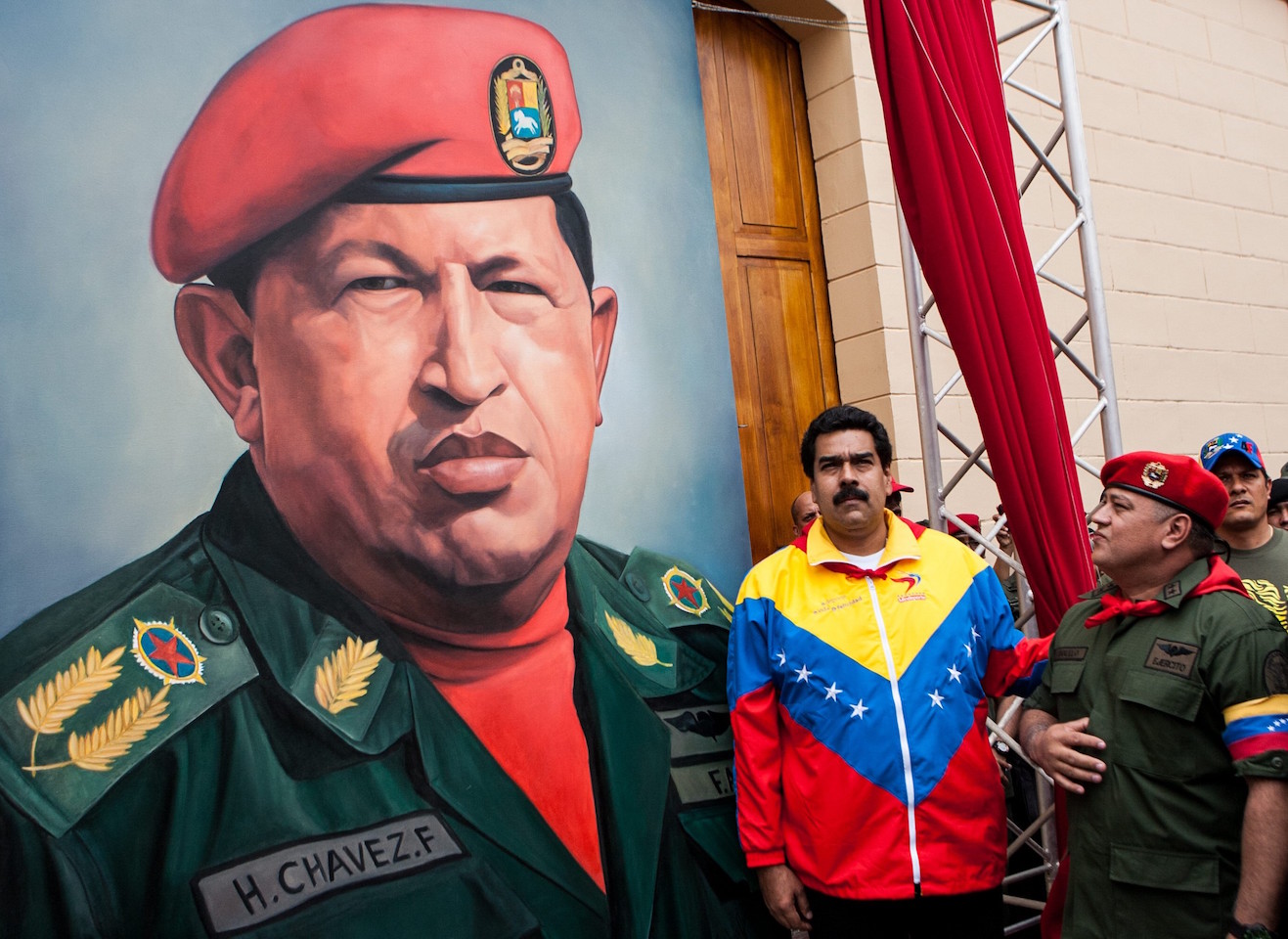
https://images.jacobinmag.com/2015/12/17010548/maduro_diosdado_chavez_efe.jpg
 

When a revolution stops halfway instead of going all the way to victory, it will be defeated by the counter-revolution. Since Chavez took power in the name of the Bolivarian Revolution and proclaimed “21st Century Socialism” we saw this clearly as an attempt by the ‘Bolivarian’ fraction of the national bourgeoisie to build a sort of half-way house Cuban/Chinese 'socialism-in-one-country'. The fate of such a half-baked revolution would be that the weak national bourgeoisie would have to act as compradors to not only US imperialism, but the rising Russian and Chinese imperialism, to suppress the workers’ revolution.

We wrote in 2009 that the regime was nationalising US oil interests, but at the same time becoming dependent on Chinese and Russian loans to keep the state oil company, PDVSA, solvent. The regime's anti-imperialist posture against the US was boosted by its Castroite and Chinese ‘market socialist’ credentials under the guise of a “5th International”! When we pointed this out to the FLTI we were condemned as US social chauvinists.

As predicted, today we see the Bolivarian regime under pressure from imperialism, and from its own working class suffering from years of deprivation and repression by the regime. The FLTI see this crisis as one of the US staging a coup d’état to restore the opposition bourgeoisie to power and control of the PDVSA. We see it as much more than that.

The US under Trump is acting to limit the growing influence of its big rivals, Russia and China in Venezuela. Already its sanctions have forced the regime further into the arms of Russia and China. They have responded by upping their ownership and control of Venezuelan oil resources.

This means that as Russia and China increase their stakes in Venezuela, US sanctions will hit their investments hard. The have every reason to support the regime and its repression of the workers who turn against it.

Most important, the failure of the FLTI to understand the rise of Russia and China as imperialist powers, disarms workers who still have faith in the Bolivarian regime and its Russian and Chinese allies. If the army splits and a coup is attempted, then it is all on for a war between the regime backed by the US bloc and the opposition backed by the Russia/China bloc.

The FLTI is calling correctly for workers to break from the Bolivarian regime and build an independent workers government. And in the event of a coup and civil war it will correctly defend the regime militarily from US imperialism. But what will it say about the role of Russia and China when they take the side of the regime to defend their investments, and workers illusions in the Bolivarian revolution disarm them in the face of these new imperialist powers? To claim that Russia and China are dupes of the US won’t wash. Time to face the reality that Russia and China are new imperialist powers.

Wednesday, March 04, 2015

Syriza: Revolutionary lessons from Russia to Greece!


Embedded image permalink
Antarsya (anti-capitalists) protest the 'accord' between Syriza and the EU. But where are their workers councils and militias for the socialist insurrection?


Mike Treen, National Director of Unite!, the NZ trade union, argues that Syriza’s success in Greece may vindicate those who claim that bourgeois parliament can open the road to socialist revolution in the 21st century. He attempts to justify this political conviction by illustrating how history proves him right. Of course we reserve the same right. We follow him through his historical examples from the Russian October to the Greek March and prove him wrong!

Mike Treen states: “The SYRIZA victory and the electoral victories of left-wing governments in Latin America over the past 15 years have placed on the political agenda the issue of whether socialists can use elections in capitalist society as springboards to a deeper revolutionary socialist transformation of society in the interests of the majority of working people.”

The Russian Revolution

We agree that this is an important question. But the examples Mike Treen uses don’t prove his point. The political tendency he once belonged to, the Socialist Workers Party (SWP-US), in the 1980s revised their view of the Bolshevik revolution claiming that while Lenin called for ‘soviets to power’ he was actually for a “democratic dictatorship” in which workers and poor peasants shared power with rich capitalist peasants! This shared power was supposedly necessary because Russia still had to complete the bourgeois tasks of national independence and overthrow the feudal landlords. The bourgeois revolution had to be completed before the socialist revolution was possible.

Lenin famously rejected the workers sharing power with rich peasants. In his April Theses he stated: 


“The specific feature of the present situation in Russia is that the country is passing from the first stage of the revolution—which, owing to the insufficient class-consciousness and organisation of the proletariat, placed power in the hands of the bourgeoisie—to its second stage, which must place power in the hands of the proletariat and the poorest sections of the peasants.”

Yet, the SWP now claimed that Lenin, despite the April Theses, never abandoned power sharing with rich peasants in April 1917 and that the Bolshevik program remained the Democratic Dictatorship of the Proletariat and the Peasantry. The implication must be that the Bolsheviks made a mistake and were premature in sending the Cossacks (rich peasant soldiers) to disband the Constituent Assembly (parliament) for which elections had already been held, and replacing this bourgeois parliament with a ‘Workers’ and Poor Peasants Government' based on soviets of workers, poor peasants and soldiers and sailors.

Mike Treen may no longer subscribe to the SWP (US) theory today, however in his blog post he infers that in practice, the Bolsheviks realised their mistake and encouraged the rich peasants to enrich themselves in a desperate attempt to bolster the economy (the New Economic Program or NEP). Stalin’s dictatorship, in reversing these market reforms and collectivising everything, led ultimately to the decline and fall of the Soviet Union.

What the SWP was actually trying to do in its revised version of the Bolshevik Revolution was to return to the pre-April Theses position that workers would share power with the capitalist peasants in a “democratic dictatorship”; that is, a bourgeois parliament that would destroy the remnants of feudalism and develop capitalism sufficiently to allow the majority of workers and working peasants to make a socialist revolution.

This was an open attack on Trotsky’s theory of Permanent Revolution, which argued that such ‘democratic tasks’ could not be completed in a power-sharing alliance with any capitalist class whose interests firmly aligned it to imperialism. In the epoch of imperialism all democratic tasks could only be completed under the dictatorship of the proletariat.

Lenin in the April Theses endorsed this theory. It meant that henceforth, only the workers and poor peasants in power could complete the outstanding tasks of the bourgeois revolution such as national independence and the end to landlordism. It excluded all power sharing, later known as popular fronts, with the bourgeoisie, including the rich peasants.

But the SWP needed to revise the history of the Bolshevik revolution and the theory of Permanent Revolution so as to legitimate the power-sharing popular front parliamentary road as the correct revolutionary strategy for socialists today.

In reality, the Russian Revolution did not succumb to a wrong strategy on the part of the Bolsheviks. Russia faced either a workers revolution where workers led the poor peasants to power, or a Tsarist counter-revolution supported by the rich peasants. The rich peasants could only become part of the revolution if the counter-revolution was defeated and their petty capitalist interests were subordinated to the workers state.

This was proved when the Provisional Government under Kerensky allied itself to the Tsarist General Kornilov in an attempt to smash the soviets and was defeated when his troops were won over to the soviets. The October Revolution took power and incorporated the rich peasants into the socialist plan but never shared power with them.

As to the degeneration (bureaucratisation) of the revolution, this was due not to the mistaken revolutionary program of the Bolsheviks, but rather to the capitalist counter-revolution that surrounded, invaded and isolated it, and defeated the revolution in Germany. One of the results of this setback was the reliance upon the rich peasantry in the New Economic Policy (NEP).

The German revolution

In Germany, the soviets were, as Treen says, defeated by social democracy committed to bourgeois parliamentary elections. This was inevitable because the Spartacists (the German Bolsheviks) were too weak to win a majority in the workers councils (soviets) and make a proletarian revolution. Therefore the new bourgeois republic had to go through a stage of sharing power with the bourgeoisie in preparing the working class for socialist revolution. 


However, in fact, the conditions for proletarian revolution did exist as the soldiers and sailors mutinied and formed armed soviets all over Germany. What was lacking was the revolutionary leadership to guide the armed workers towards revolution.

The Spartacists led by Luxemburg and Liebknecht had only recently broken from the United Social Democratic Party (USPD) of Kautsky (which advocated a parliamentary transition) and the old Social Democratic Party (SPD - the Second International Party that voted to go to war in August 4, 1914), and did not have the influence of the Bolsheviks to win majorities in the soviets and lead an insurrection. The USPD and SPD were able to persuade the majority of workers to vote them into power in the new capitalist republic. Ebert, the SPD leader became the Chancellor.

Yet, instead of ushering in a progressive transition to socialism, these capitalist elections became the front for a counter-revolution in which the SPD, USPD led Government allied to the bourgeoisie, the aristocracy (Junkers) and the fascists smashed the armed soviets, and assassinated its leaders, including Luxemburg and Liebknecht, ushering in a long period of fascist reaction in Europe that culminated in the rise of Hitler to power. 


As mentioned above, the defeat of the German revolution isolated the Soviet Union. So it was German social democracy in league with fascism that led directly to the bureaucratic degeneration of the Russian Revolution under Stalin.

Revolution in Yugoslavia, China, Vietnam, Cuba...

The revolutions that followed in China, Cuba, Vietnam etc all followed more or less the Russian model of workers and poor peasants governments replacing capitalist governments. While the leaders of these revolutions were Stalinists or petty bourgeois nationalists who attempted to share power with the bourgeoisie (including the rich peasants), as in the “bloc of four classes” of Stalin’s famous popular front in China in the 1920s, they were always faced with armed counter-revolution, and survived only because the mass pressure from below of workers and poor peasants forced them to go all the way to socialist insurrection.

Events proved that the bourgeoisie will never share power in parliaments with the working class when that class is armed and fighting a civil war. We saw it in Germany in 1923, in China in 1927, in Italy and Germany when the fascists staged parliamentary coups. In Spain during the civil war the Republican parliaments trapped the workers in the popular fronts in Madrid and Barcelona where they were disarmed and slaughtered by the fascist army.

History shows that bourgeois parliaments are death traps disarming workers in the face of fascism, and so must be overthrown and replaced with Workers and Peasants Governments.

The defeat of the fascist regimes in Europe (mainly by the sacrifices of the Soviet Union) created the conditions for the overthrow of the bourgeoisie. In Eastern Europe the Red Army kicked out the capitalists. In Yugoslavia Tito’s partisans took power. 


In China the long March led to a peasant uprising in 1949 which became a Government of poor peasants allied to the workers. In Vietnam a war of independence against the French liberated the North but was met by the armed intervention of US imperialism in the South. Cuba threw out the US mafia bourgeoisie in 1959 and despite attempts to remain on good terms with the US was attacked militarily and forced into the arms of the Soviet Union.

In each of these cases, these revolutions fell short of the Russian Revolution because the armed workers and soldiers were not in command. Such was the total blockade by imperialism, their isolation and dependence on the Stalinist Soviet Union that these revolutions were born as bureaucratised ‘deformed workers’ states.

So it was not any failure to follow the parliamentary road in these countries that led to the eventual collapse of their revolutions and the restoration of capitalism. It was armed counter-revolution, encirclement, cold war and imperialist propaganda that resulted in their bureaucratisation and ultimately to the restoration of capitalism.

In fact, the strategy of the imperialists to destroy the workers states was one of ‘democratic counter-revolution’. The capitalists sucked in most of the ‘left’ including all those who long held illusions in the parliamentary road, to propagandise the ‘parliamentary road’ back to capitalism. The ‘evils’ of ‘communism’ were portrayed as godless collectivism counter-posed the righteous capitalist democracy and free market. The bureaucratic elites in the workers states played along with ‘reforms’ ushering in ‘democracy’ and market freedoms.

In most cases the restoration of capitalism was via the ‘democratic’ road of replacing ‘One Party States’ with bourgeois democracies. However, these ‘democracies’ arose as the result of bloody invasions as in Vietnam, or of murderous ethnic cleansing as in Yugoslavia. Only where imperialist intervention failed to create a ‘democratic’ faction within the Stalinist bureaucracy to take control of the party, did restoration take the form of ‘market socialism’ as in China and Cuba.

All this proves, contrary to the ideology of the parliamentary road opening the road to socialism, that it has proved to be either a barrier to socialist revolution, or, a counter-revolutionary means of opening the door to the restoration of capitalism under the guise of ‘bourgeois democracy’.

The Bolivarian Revolution

The Bolivarian Revolution that Treen speaks of has so far failed to build soviets based on workers and poor peasants capable of taking power from the popular front capitalist governments of the Chavistas in Venezuela and the MAS (Movement for Socialism) in Bolivia. 


This is because there is no vanguard party in Venezuela or Bolivia capable of breaking workers out of their popular front parties, as Trotsky called them, the PSUV and the MAS. These are the more commonly called ‘populist’ parties which combine workers and petty bourgeoisie ‘sharing power’ with the so-called progressive national bourgeoisie, in one political party.

When Trotsky was exiled to Mexico in 1936 he was in the box seat to observe the nationalisation of the Anglo-American oil companies in 1938 by the regime of General Cardenas. He said that while workers should support these nationalisations they did not amount to the socialisation of capitalist property. The state in essence remained the state of the capitalist class and would have to be overthrown and state property turned into workers property. 


Failing that, it was easy for the capitalists, especially a coup backed by the US, to ‘privatise’ state property back into the hands of privately owned companies. Therefore, the task for revolutionaries was to break from the populist parties and their regimes, seize power, and install Workers and Peasants’ governments with the armed workers, peasants and soldiers in command.

These lessons were written into the Transitional Program that Trotsky drafted in 1938, two years before his assassination by an agent of Stalin. The first major test of this program in Latin America was in 1952 when the miners in Bolivia staged an armed insurrection against the Bolivian ruling class. 


Instead of taking power and installing a Workers’ and Peasants’ government, the miners abandoned their program (Theses of Pulacayo) and shared power with ‘progressive’ capitalist leader Paz Estenssoro in the “petty bourgeois” MNR government. This allowed the ruling class to rally and arm its supporters, and defeat the revolution.

A revolution that finishes in a “half-way house” power sharing government with the bourgeoisie is already half dead. Many such betrayals of workers in Latin America including that of Peron in Argentina, and Allende in Chile, right up to the populist party/regimes in Venezuela and Bolivia today, follow the same pattern of revolutions strangled by workers ‘sharing power’ with the bourgeoisie in popular fronts.

Therefore it is defeatist to wait for the populist leaders like Allende, Maduro or Morales to call for ‘communes’ when they actively suppress independent workers and peasants armed mobilisations. Not until armed soviets are built from below and workers split from the popular front parties will the bourgeoisie be thrown out of power and replaced by workers and peasants governments that advance the “revolutionary transformation.”

Syriza and the Greek Revolution

Syriza and Podemos have arisen to replace the betrayals of PASOK and the Socialist Party but are modelled on the Latin American popular front of class collaboration between workers and the bourgeoisie. Syriza has formed a popular front with ANEL a right wing nationalist party and is talking about nominating a former minister in the bourgeois New Democracy party as its Presidential candidate. As with all popular fronts, its purpose is to contain the demands of the masses within what is acceptable to the bourgeoisie. In this case the Germany imperialist bourgeoisie.

Thus the Syriza leadership has turned its back on the rank and file demand to repudiate the debt and end austerity and is negotiating with the banks for more favourable terms. All of the left in Syriza with the exception of the Communist Tendency accepted the bloc with the right wing ANEL, and none have protested the appointment of its leader as Minister of Defence. So much for parliamentary democracy opening the road to revolution!

Syriza’s parliamentary strategy immediately came to grief. The EU as part of the world capitalist economy is in trouble. German imperialism if facing decline as its economy stagnates and is in no position to grant Greece even minor favours. Letting Greece off even part of its debt repayment would send a message all the bankrupt fellow PIIGS. So Syriza has already betrayed its supporters in doing a deal that recycles Greek debt and delays the implementation of its anti-austerity program.

The reaction of the left wing of Syriza however, does not question the parliamentary road only that Syriza must get off the highway and take the byway in renouncing the debt and leaving the Euro.

Apart from the Communist Tendency It does not even call for a break from ANEL or for mass popular organisation to defend it against a right wing coup! Thus the left version of the popular front is still a death trap. The Minister of Defence can stage a coup from inside cabinet!

The revolutionary left in Syriza must draw the historical lessons. Workers participation in bourgeois parliaments cannot be progressive in the epoch of imperialism. This is true of workers parties forming governments which are powerless in the face of the institutions of the state including the armed forces, the bureaucracy and its paramilitaries. 


It is even worse when workers are trapped in popular front parties like the PSUV and the MAS, or workers parties enter parliamentary blocs with open bourgeois parties like ANEL. They are no more than fascist fodder. As we saw above, Bolivia, 1952, tells the truth about the popular front!

The next step towards the Greek revolution is for workers to split Syriza from its bourgeois partners in Greece, and from its imperialist masters in the EU, to unite to build a mass workers party and to form independent workers’ councils and militias to defend the class from the state and its fascist paramilitaries. Only then can it open the road to a victorious socialist revolution the formation of a Greek socialist republic within a wider Federations of Socialist Republics of Europe.

Forward to the Revolution!

Bourgeois elections can only advance the revolutionary transformation by default. That is, by dashing the hopes of the masses that support them and in the process exposing bourgeois parliaments, as in Germany 1920 and 2015, as no more than a ‘democratic’ front for the counter-revolution.

That is why it is a matter of urgency to build revolutionary parties with a program for armed soviets of workers and the oppressed in every country to resist the inevitable reactionary fascist movements that will be unleashed by the bourgeoisie to smash the revolutionary mobilisation of the masses.