CS 132 Autumn 2020 by Dave Bedggood on Scribd
Showing posts with label aotearoa. Show all posts
Showing posts with label aotearoa. Show all posts
Tuesday, March 24, 2020


Monday, March 25, 2019
Health Workers betrayed by "labour" Party

Another year of
wage stagnation and dangerous conditions of continued deliberate underfunding
of state provided health services. Residents Doctors Association and Midwifes
continue to fight while the district health board bosses (DHB) deliberately
drag out negotiations (longer than a year of negotiations).
Members
of the Resident Doctors' Association have held four 48-hour strikes so far this
year. They are fighting against DHB bosses who want to dictate rosters and
extreme shifts. The RDA wants to be able to reject unsafe rosters: Rosters like
10 days on and up to 4 nights in a row. Who would want to be assessed by a
doctor in their past day 6 let alone the last hours of that sort of roster?
This government delivers tired
doctors to the working people of NZ who need medical services. That is state
deliberately funding second class health services to ordinary working class.
While the ‘rich enough’ can dip into both public health services and when
concerned or dissatisfied access the private specialists. Labour willingly
stands by and runs down the public health service which as a by-product is
fostering private health providers.
Nurses (NZNO) took repeated
strike action and the rank and file repeatedly rejected offers of cost of
living increases. However, their leadership sold them only barely repackaged
deal, and promises of progress on gender pay equity that could be a decent pay
rise. The PSA (Health) also gave in for an equivalent pay deal, below cost of
living increases at < 3% per year. Health workforce has been sold pathetic
deals by union bureaucracies that are too close to the Labour Party and so
demobilise the workforce to stop pressure on a Labour Government.
The labour bureaucracy of the Council
of Trade Unions (CTU) was exposed when it failed to support the RDA. Teachers
(NZEI & PPTA) and state sector public service association (PSA) voted
against basic solidarity. The PSA was even caught out helping the formation of
a scab doctor union “SToNZs”, who negotiated a side deal which gave away safe
rostering. PSA and NZNO also refuse any deviation from the leaders/bureaucrats
who are anti-MERAS. Yes, they compete for members in the health sector, but to
also refuse solidarity with workers in struggle such as the Midwives union, is
against the wider class interests. That pays into the government and employers’
hands, continuing to underfund health while health sector unions lack
solidarity and can be picked off one at a time.
The Labour led government idly
sits by and keeps the DHB Budget under screws sticking to a “fiscal cap” –
Labour’s self-imposed budget parameters for its efficient running of the
capitalist regime. This means all the DHBs have to ration health services and
screw down wage bills. There are not enough resources and waitlists are
referred back to their GPs to avoid being a real waitlist. Patients in pain or
seriously mentally unwell, are more likely to assault health workers. But
protection of our health workforce would come with effective treatment and good
prevention.
The Labour Party has in effect,
abandoned working people and sticks to the capitalists’ limits, now obviously
within their own budget responsibility rules, in other words putting profits
before working people. It treats the DHBs as private corporations. The government
is effectively encouraging DHBs in their anti-worker rostering. We hear DHBs
are not employing experienced nurses who are on top RN pay grades if they can
get nurses on lower pay grades and save some money. That means less experience
on the floor – fewer specialised nurses. Forever training up relatively new
nurses is not the rational way to provide good health services.
Health workers also need to treat
DHBs as private corporations and demand a living wage by taking strike action
building support in the unions and wider working class until they get their
demands. Labour will either respond to the pressure by conceding apparent
reforms (increasing funding for DHBs) or it will come out as an openly
capitalist party doing the bidding of finance capital and sending the army in
to replace health workers. (As it did do in the last nurses strikes). And continue
subsidising private health providers (many public dollars go to private health
operators and profits.
Either way, it is a united
organised working class that is needed to defeat the parties who defend this
capitalist regime and to socialise health under workers’ control.
For Fighting Democratic unions
under rank and file control!
Socialise Health under Workers
Control!
For a Workers Government based
on Workers Councils!
Friday, December 14, 2018
Tuesday, February 13, 2018
Busting the Cannabis Madness Myth

The Green's Bill to extend access to Medical Cannabis came up for a vote to send it to Select Committee on 31st January. It was voted down 73 to 47. A majority for the Bill would have sent it to Select Committee - a relatively democratic forum to challenge the myths surrounding cannabis without the debate being dominated by the hysteria of the corporate media and the lobbyists for Big Pharma. It would have forced the health bureaucracy to defend their 'scientific evidence' about the 'harm' of cannabis against serious criticism. Its defeat proves that there is entrenched opposition in parliament to liberalising Medical Cannabis, especially the right to grow and supply outside of the control of Big Pharma.
Clearly the 'refer madness' myth hyped for decades remains the main barrier to reform. Our target has to be the pseudo scientific and bureaucratic devotion to the myths underlying prohibition that has stymied all genuine cannabis reform in NZ. The biggest lie is that cannabis causes psychosis.
Progress with cannabis law reform is cripplingly slow. Why? A century of stigmatisation and prohibition has embedded a reactionary ‘harm’ mythology from the days of ‘reefer madness’ to today’s ‘cannabis psychosis’ in the popular culture, health science and medical practice. The mythology claims that cannabis is addictive, leads to ‘harder’ drugs, makes you anti-social, dumbs you down, makes you fail in education, perform poorly at work, and in the end, it makes you mad. These are myths that conveniently blame individuals as ‘dope fiends’ rather than the victims of the alienating capitalist society into which they are born.
We won’t make any headway towards the liberalisation of cannabis and other drugs until we debunk these ‘harm’ myths, and understand the nature of capitalism and its effects, inequality, poverty, social breakdown etc, as the real cause of drug use, and that drug abuse is a consequence of a policy of prohibition. But let's skip the historical lecture and go straight to the misuse of science to bolster a hysterical prohibition culture.
NZ Misuse of Drugs Act and the myth of ‘harm’
The NZ Misuse of Drugs Act makes cannabis use a crime (unless waived by Ministerial approval) rather than a health need, on the grounds that it causes harm to health. Even if Cannabis were ‘decriminalised’ the assumption of ‘harm’ requires a ‘least harm’ approach to law reform by the Ministry of Health (MOH) which considers that cannabis ‘contributes’ to 32 deaths per year in NZ.
The NZ Drug Foundation (NZDF) rejects the MOH method of arriving at 32 deaths. It adopts a more moderate approach; that harm does not arise from “toxic overdoses”, but the “long-term effects” of use.
Cannabis does cause harm, but the harm comes from heavy long-term use and is mostly linked to mental health – lasting physical harm is unlikely, while poisoning or death is unheard of.So, the NZDF proposes ‘decriminalisation’ of cannabis use by 2020 combined with heavy state regulation and licensing to minimise ‘harm’. It seems that the Drug Foundation is trying to steer the public debate for law reform down the path of least resistance. Yet that resistance seems to be coming mainly from the Government and Health bureaucracy rather than in the general population.
This conflict between ‘harm’ and ‘health’ is evident in the Drug Foundation itself. On the one hand, the NZDF Executive Director Ross Bell argues that the District of Columbia (US) legalisation of use, but not trade, might be best for NZ:
Mr Bell looks to the District of Columbia which changed its approach towards marijuana as recently as last year. It legalised its use, but not the trade in it, so under a new law, people can grow it, use it and give it away, but they can't sell it. This is most closely in line with how Kiwis use it, Mr Bell said, suggesting it could be a starting point for discussion here. “If you think of the way Kiwis use cannabis, often they're not getting it from the tinny house. It might be the first thing we allow is for people to grow and give.”However, the Drug Foundation’s official new reform proposal repeats the ‘cannabis causes harm’ mantra.
We know that the majority of people use cannabis without serious harm.However, a small proportion experience negative impacts such as anxiety, depression, memory loss and mood swings. Those who use cannabis long term may face health risks such as respiratory disease (if smoked) and mental illnesses such as schizophrenia, at least for those who may be predisposed.Cannabis impairs driving, especially when combined with alcohol. It also carries the risk of dependency in around one in 10 users. Heavy use by young people has been linked to poorer outcomes in education and employment as well as a reduction in IQ points, though the research on this is mixed.Our verdict? Cannabis can be harmful, so our law should focus on minimising harm, especially to young people. The best way to minimise harm is to tightly regulate use.”The evidence for and against ‘harm’
The evidence contests the ‘harm’ myth. It shows that the “negative effects” attributed to cannabis such as anxiety and depression, mood swings and even memory loss are are widely experienced in society by many who don’t use cannabis, and when they occur among the few users who 'overdose', this like any drug overdose, is largely the result of prohibition which works against safe and controlled conditions for drug use.
Dependency is another word for addiction and this claim is widely disputed, notably by Carl Hart, not only for cannabis, but for other ‘hard’ drugs as well (to his own surprise). He finds that when offered choices between drugs and money his experimental subjects will often reject drugs and take the money proving that drug addiction is learned behaviour in situations where you don’t get to choose money.
And the familiar story that cannabis ‘abuse’ by youth harms their schooling, college prospects and can lead to suicide, and so on, is probably the effect of prohibition. When kids who are expelled from school, denied financial support and criminalised explains much of the risk of suicide.
But the biggest driver of the 'minimal harm' orthodoxy in the NZDF model reform relies on the Canterbury Study led by David Fergusson. Take the link between smoking cannabis and the risk of lung cancer. A US study using a large sample, done by Tashkin, showed that the 'normal, moderate’ level of cannabis smoking had no measurable link to lung cancer. Not only that, cannabis smoking was better than non-smoking for some people! This study, however, was contradicted by the NZ study which did find a ‘correlation’ between heavy smoking and lung damage.
Tashkin says,
The largest epidemiologic (case-control) study of the association between marijuana use and lung cancer failed to demonstrate that marijuana increases the risk of developing lung (or, for that matter, upper airway) cancer.” He notes that a much smaller, recent study from New Zealand did claim to find a link, but only in very heavy users. He says, “The authors’ interpretation of their data can be faulted because of the small numbers of their subjects exhibiting such heavy use, which rendered their estimates of risk imprecise." [My emphasis]The Scientific American, however, is more precise:
… looking at residents of Los Angeles County, the scientists found that even those who smoked more than 20,000 joints in their life did not have an increased risk of lung cancer. [my emphasis]Tashkin is saying that the Canterbury study cannot claim to have found that heavy smoking of cannabis causes lung damage. His Los Angeles sample of heavy users found no significant correlation. The NZ sample of heavy smokers was too small to exclude all other factors that may explain the correlation between cannabis and lung damage. Therefore, the positive correlation in the NZ study between cannabis use and lung damage may be a consequence of lung damage caused by some other unmeasured cause.
While very heavy smoking of cannabis causing lung damage may be ‘common sense’, Tashkin's large study was able to control for confounding factors and did not find any correlation, or causal link. If there are doubts about the Canterbury project’s results on lung damage, perhaps the NZDF concern about a studies 'suggesting' a causal link between cannabis use and ‘psychosis’ in adolescents should be also be re-examined.
Cannabis and Psychosis: Search for a causal link…
One of the reviews of studies (7, one of which was the Christchurch study) into this link by Le Bec PY et. al. (2009) found that “cannabis may be an independent risk factor” for psychosis:
Together, the seven studies were all prospective cohorts and represented 50,275 human subjects. There were three European studies (from Sweden, Holland and Germany), one from New Zealand and one from Australia. Only one study of the seven did not show a significant association between cannabis consumption and increase of the risk of developing a psychosis. However, this study had some bias, such as low level of cannabis use and the lack of evaluation of cannabis use after inclusion. For the six other studies, data show the existence of a significant association between cannabis use and psychotic disorders (with an increased risk between 1.2 and 2.8 in Zammit et al.'s study), particularly among vulnerable individuals (that is with a pre-psychotic state at the time of inclusion). Therefore, all the studies that assessed a dose-effect relationship showed this link between cannabis use and the emergence of psychosis or psychotic symptoms. The fact that all causal criteria were present in the studies suggests that cannabis use may be an independent risk factor for the development of psychosis. Results seem to be more consistent for vulnerable individuals with the hypothesis that cannabis use may precipitate psychosis, notably among vulnerable subjects. In particular, early onset of cannabis use during adolescence should be an environmental stressor that interacts with a genetic predisposition to induce a psychotic disorder. https://www.ncbi.nlm.nih.gov/pubmed/19748375 [my emphasis]Note that the closest that this review comes to finding that cannabis may be a cause of psychosis, is that, “…cannabis use may be an independent risk factor for the development of psychosis.” The strength of that suggestion comes down to what are referred to as “all causal criteria” being controlled as potential confounders, that is, alternative causes. So, what is the strength of this claim in the Christchurch study? In their 2004 paper Fergusson et. al. addressed the problem of testing ‘causal linkages’ to eliminate other explanations. I will summarise their paper.
Fergusson et. al. (2004) describe how their statistical method allowed them to control for ‘confounders” (i.e. other possible causes) both, “fixed” influences, such as age, gender etc that did not change over the time-frame of the data, and “time-dynamic” influences, such as education, employment etc., that did change over the time-frame and could ‘confound’ the association between cannabis use and psychosis. By testing the association among all confounders, against cannabis use, and against psychiatric symptoms, the study concludes that there is still a residual association between cannabis use and psychosis, ‘independent’ (with its own causal effect) of the influence of all confounders, that justifies treating cannabis as a contributory cause.
The second important conclusion was that the study was able to compare the subjects scores on all the relevant variables over a time frame between 18, 21 and 25 years of age, and data collected at those three points showed that the “direction of cause” was from cannabis to psychosis, rather than the reverse.
How does one include all possible alternative causes in a longitudinal cohort study with a relatively small sample size, so that cannabis stands out as the ‘independent’ cause? Note that for the sake of the argument about 'cause' I am not challenging the validity and reliability of the data such as 'psychiatric symptoms' at this point. Nor am I competent to assess the statistical methods used to perform these ‘tests’ in the Christchurch study. However, an assessment of such statistical methods was included in the review of the field by Ksir and Hart in 2016. They reviewed the evidence in support of two competing theories (hypotheses) between cannabis and psychosis; the “contributing cause” view held by the Christchurch study, and the “shared vulnerability” view held by the review authors.
Cannabis and Psychosis: Critical Overview of the Relationship.
According to Ksir and Hart (2016)
Interest in the relationship between cannabis use and psychosis has increased dramatically in recent years, in part because of concerns related to the growing availability of cannabis and potential risks to health and human functioning. There now exists a plethora of scientific articles addressing this issue, but few provide a clear verdict about the causal nature of the cannabis-psychosis association. Here, we review recent research reports on cannabis and psychosis, giving particular attention to how each report provides evidence relating to two hypotheses: (1) cannabis as a contributing cause and (2) shared vulnerability. Two primary kinds of data are brought to bear on this issue: studies done with schizophrenic patients and studies of first-episode psychosis. Evidence reviewed here suggests that cannabis does not in itself cause a psychosis disorder. Rather, the evidence leads us to conclude that both early use and heavy use of cannabis are more likely in individuals with a vulnerability to psychosis. The role of early and heavy cannabis use as a prodromal [symptomatic of an attack or disease] sign merits further examination, along with a variety of other problem behaviors (e.g., early or heavy use of cigarettes or alcohol and poor school performance). Future research studies that focus exclusively on the cannabis-psychosis association will therefore be of little value in our quest to better understand psychosis and how and why it occurs. [my emphasis]In other words, the authors conclude that cannabis cannot be shown to be a cause of psychosis, and the best interpretation of the limited evidence is that it suggests that cannabis may be part of a “shared vulnerability” where those ‘vulnerable’ to psychosis may use cannabis along with other substances as a means of self-medication.
The policy conclusions that flow from this conclusion are to reject cannabis as a cause of psychosis on the basis of a weak claim of “contributory causation”, and to address the common social and genetic factors that cause this ‘shared vulnerability’ associated with cannabis use. This shifts the focus away from the prevailing model of “harm” towards a model of “preventative health”.
That this is a highly politicized area is attested to by the debate between Ksir and Hart and the authors of one of the studies they reviewed, over why a correlation cannot as a rule be a cause, and whether the the appropriate policy response is the legalization of cannabis and other drugs or continued prohibition.
The significance of these policy options is clear if the most obvious cause of ‘harm’ is prohibition itself rather than the ‘harm’ attributed to cannabis. For example, the US study referred to above claiming that cannabis use led to school dropouts, failure to attend college, and more suicide attempts, could easily be explained as the effects of prohibition. The author advocates that prohibition should be replaced by prevention.
Conclusion: Prohibition causes the harm attributed to cannabis
The reform debate therefore comes down to one of two approaches. First the ‘harm’ model. Modest and incremental change via decriminalisation leaves the growth, sale and consumption, regulated and licensed, redirecting drug policy from prohibition towards state control and regulation. This is the moderate road which makes the assumption of ‘harm’ an excuse to protect individuals from harming themselves. The question of what constitutes ‘harm’ is reviewed, and the myths that cannabis is a 'gateway drug', that overdoses are 'toxic' and can even cause death, are rejected. Nevertheless, cannabis is still held to cause ‘harm’ among youth, long-term heavy users and those genetically or socially at risk of mental illness. For that reason law reform must be gradual, based on ‘best science’ and guided by the medical model of ‘least harm’.
The second approach is that cannabis is a harmless natural plant, used as a preventative and palliative medicine over millennia. Cannabis and our endocannabinoid system have co-adapted over our history of evolution. It is not only ‘harmless’ it is ‘harm-killing’ with many (including as yet undiscovered) health benefits. These include pain relief replacing opioids, stopping spasms in MS, and seizures in epileptics and pain in advanced cancer etc. And coming over the horizon is the prevention and elimination of diseases including cancer, Alzheimer’s, schizophrenia, etc. In assessing these health benefits, we should combine all sources of evidence: anecdotal, medical, laboratory research, epidemiological, as well as the ‘gold standard’ clinical trials, to understand fully the important role of cannabis in our lives.
We conclude that the ‘harm’ associated with cannabis is mainly caused by the policy of prohibition that reflects the objectives of powerful groups and class interests in society, and is reproduced in research assumptions and media sensationalism. It is not an attribute of cannabis itself but of politically loaded economic and social policies. We can see this clearly in the benefits that have accrued in many nations such as Portugal and Paraguay, and in those US states where decriminalisation or legalisation has occurred. Medical Cannabis has now been approved by WHO. But we still have to overcome the fear of THC as the cause of ‘reefer madness’ and prove that in a safe, legal environment, CDB cannot be separated from THC and the other components of cannabis without losing the full health benefits of the herb.
We can make a start as capitalism goes into its terminal decline and fall, but only fully reap the benefits of cannabis as part of the socialisation of production for need and not profit in a socialist society that has returned to nature in time to avoid human extinction.
Wednesday, August 23, 2017
Trump Plays with Fire in Korea
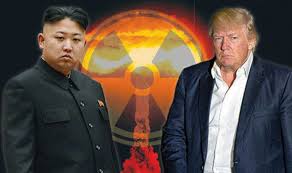
Trump is reviving Bush junior’s bellicose approach to the DPRK which carries great risks for the whole world.
By revving up the ‘axis of evil’ scenario Trump risks global destruction for the sake of what: tourism? In his bizarre phone conversation with the Governor of Guam he boasts that the publicity will boost Guam’s hotel occupancy to 110%, and that anyway Trump backs Guam 1000%. A fat lot of comfort that will give to the citizens of Guam many of whom see themselves as ‘pawns’ in the US global game of chess.
China, according an Editorial in the the semi-official Global Times, sees the war of words between Trump and Kim Jong-un as a “Reckless Game”. It states what is likely to be the official China line.
"The US and North Korea have both ramped up their threatening rhetoric. The Pentagon has prepared plans for B-1B strategic bombers to make preemptive strikes on North Korea’s missile sites. US Secretary of Defense James Mattis issued an ultimatum to North Korea on Wednesday to “cease any consideration of actions that would lead to the end of its regime and destruction of its people. Meanwhile, North Korea issued plans to fire four intermediate-range missiles to land 30-40 kilometers from Guam and claimed it would finalize the plan by mid-August."
If these threats are acted on that would seriously escalate the war of words in a shooting match. China would likely not intervene at this level but promises to do so if there is any attempt to invade the DPRK by the US and the ROK.
"China should also make clear that if North Korea launches missiles that threaten US soil first and the US retaliates, China will stay neutral. If the US and South Korea carry out strikes and try to overthrow the North Korean regime and change the political pattern of the Korean Peninsula, China will prevent them from doing so."
The prospect of a hot war between China and the US over Korea is dangerous for everyone in the region including New Zealand. It would risk escalation into nuclear war and that war becoming the dreaded WW3. China is currently trying to persuade both Trump and Kim Jong-un to back off. But it could not sit back while the DPRK is directly attacked or invaded. So why is Trump trumping the most belligerent of US Presidents George Bush in the level of threats made against the DPRK?
Is Trump such a maverick that he can’t tell the difference between what is good for business and what is good for humanity? Even ‘casino Capitalism’ requires punters. Clearly there is room for moderating the Bush bellicosity in the direction of Clinton’s negotiated deals on nuclear proliferation. Clinton knew that the DPRK regime was an anachronism, a failed state, and not some threat to US interests. Obama continued this policy recognising that the DPRK was a small fish in its own tank compared with an expansive China. So is this crisis down to Trump’s personality, the back-to-the-Great-USA fundamentalism of his militant support base pushing Trump into war, or is there something deeper driving this?
The global forces that are behind this crisis are those of a renewed rivalry between the declining US imperialist bloc, and the rising China/Russia imperialist bloc. The US has dominated the Pacific since the end of WW2. It defeated Japan and established its allies and bases in the region including the armistice on the 38th parallel in Korea separating the ROK and DPRK. But the US failed to stop the Chinese revolution and having worked hard since Nixon went to China in 1974 to restore capitalism and destroy “communism” eventually got its wish but was unable to reap the prize – a servile client state to inject some life into the US economy.
Instead of succumbing as new colonies of Western imperialism with the end of the cold war, both China and Russia as former ‘workers’ states’, used their state controlled economies to deny the West their prize of conquest. Both opened up to the West but more or less on their own terms. Western investment was quarantined within these state capitalist regimes to benefit the ‘red’ capitalists. Today, both are emerging as rivals to the declining US imperialism. And as is always the case with declining capitalist powers they cannot compete economically so they do so militarily. But today, the US is no longer the ‘hegemonic’ global power facing China’s economic dominance and Russia’s military technology.
So Trump’s foreign policy in Asia, while adventurous, is an inevitable expression of this rise and fall of great powers. Korea is one of a number of flash points around the world between the two imperialist blocs where the US faces the rising influence of China/Russia including Ukraine, Syria, the South China Sea. All these flash points are evidence that the rivalry between the old and new imperialist powers explains what is going on in the world.
More importantly, all these imperialist powers are facing a global, terminal crisis as the global system stagnates. While they are competing in Europe, the Middle East and Asia with economic and political sanctions, and fighting proxy wars, facing termination, these wars must escalate into regional and ultimately global extermination. So what we are seeing in Korea today is the prospect of a cold war on words that spreads to hot wars between nuclear powers.
It is not in the interests of any power to go to world war as it would destroy not only the enemy but any economic base for survival of the human species. The problem is that such wars can start by accident, or by crazy “Dr Strangelove” actors who push the wrong button. So what can we do to try to stop such a catastrophe?
For a start we should tell our NACT regime not to follow the Australian example of unconditional support for Trump. NZ is a semi-colony of the US AND China. Politically our ruling class it is client of the US, economically it is a client of China. Both are imperialist powers which exploit the NZ economy at the expense of NZ workers. We must be against the intervention of both (all) powers on the Korean Peninsular and refuse to support any request to side with one or other. Not because NZ has an international reputation for peacekeeping which is a lie as our intervention on Afghanistan proves. Our neutrality should be against any war in which a small power becomes a pawn in the fight between two global powers because as a semi-colony ourselves we defend the right of other semi-colonies to be independent of imperialist domination.
So our neutrality does not extend to Korea itself. We are for its self-determination which in simple language means independence from all imperialist powers. During the Korean war the left in NZ was split between the Stalinist, Maoist and Trotskyist left that defended the DPRK as having a legitimate claim to oust the US from the ROK and create a united socialist Korea. The rest of the anti-war movement had illusions in the UN armistice as creating ‘peace’ in denial of the ongoing ‘class war’ that shapes our destinies.
Today we have to take the same stand against China’s threat to intervene to defend the DPRK. This turns Korea into the site of another proxy war between imperialists over who controls Korea. Korean working people must determine their own future in a united Korea. They must be supported by the billions of working people around the world who lives are at stake can change this by organising into a global anti-imperialist movement.
This is why we urgently need a left in NZ that is anti-imperialist through and through rather than pacifist with illusions in the UN. That is the only way to unite workers in both Koreas, China, the US and the rest of the Pacific, against the imperialist regimes and their client regimes that a pushing for war and risking global catastrophe. In playing with fire in Korea Trump is playing with all of our lives. To survive we need Survival Socialism.
Thursday, June 15, 2017
Saturday, March 18, 2017
Pike River Mine Disaster and the role of the Unions
 |
| The original Miners Union Hall in Runanga (just north of Greymouth on the West Coast of Aotearoa/NZ) dates from 1908, it was burnt down in 1937 and the replacement still stands as a symbol of the United Mine Workers' union. |
Labour’s Failure
This failure was belatedly recognized by Bill Anderson, secretary of the Northern Drivers, who regretted ‘pulling’ industrial action at Marsden Point in the months before the election in 1984 on the promise that a Labour Government would meet their demands. So comfortable was the union bureaucracy with the Labour Party, that the unions were completely unprepared for the onslaught of Rogernomics. The outcome was the return to a rip, shit and bust economy of follow the money all the way to the bank and bugger the consequences. Rip, shit and bust means scavenging the resources of the semi-colonial frontier for the 'health and safety' of the rate of profit. One ventilation fan at the bottom of its shaft says it all. Had this been in the days of the Ministry of Mines rescuers would have done what they are trained to do and assessed the situation without ringing an insurance broker. So, what happened? Neo-liberal Corporatization and privatization!
Labour had no answer to neo-liberalism. Having emerged in the 1930s as a serious political force representing workers and working farmers and implementing a policy of economic nationalism, the end of the post-war boom destroyed the conditions for protectionism. This became obvious when the last Muldoon Government resorted to ‘think big’ to defend economic nationalism. The incoming Lange Government faced an international capital strike and quickly imposed the neo-liberal reforms of Finance Minister Roger Douglas. The deregulation under Rogernomics shocked Labour supporters who still had illusions in parliamentary socialism. Yet Labour’s political existence was always that of responding to crises by making workers pay for them while at the same time claiming to be defending the unions and historic gains in workers’ rights and living standards.
If we go back to the ‘golden age’ of Labour, the depression and onset of WW2, we can see clearly that Labour was protecting the profitability of semi-colonial capitalism in the only way it could by increasing the rate of exploitation of its working-class constituency. Economic nationalism hides the interest of global capitalism and its national capitalist allies behind the fig-leaf of a non-class or classless, equal opportunity society. Yet workers kept resorting to class struggle to which Labour responded as the conditions dictated.
Depression welfare became workfare and emergency regulations. Wartime brought conscription and strike breaking, which then became postwar attacks on union militants. The Nordmeyer Government (1959-62) taxed workers’ consumption. When the post-war boom ended in stagflation the Kirk Government (1972-75) faced the oil crisis with attempts to halt inflation. By the 1980s the crisis of NZ capitalism demanded the end of economic nationalism and the onset of economic rationalism. The 4th Lange Government (1984-89) imposed the shock therapy of Rogernomics, and 5th Clark Government (1999-2008) continued the neo-liberal policy settings.
From Red Fed to Dead Fed
The history of the miners’ union on the West Coast from the days of the Red Fed to today tells us what went wrong and what we need to do. The miners were the backbone of the Red Federation after 1908 – the same year as the Blackball Strike. And it was the miners alone that kept the tradition of the Red Fed alive well into the post WW2 period. The miners alone, of all the industrial unions, were able to stay out of the Arbitration Court because they could not be replaced in the mines by unskilled scab labour. They fought directly against the bosses and their state and won more workers control over the workplace than any other union. They opposed Conscription in both wars and won an exemption for miners. The UMW (United Mine Workers) was always led by strong leaders who worked through the Red Fed days or the WW1 period and carried on the militant traditions of syndicalism, socialism and communism in the mines.
The UMW had a fractious relationship with the Labour Party until WW2 when the leadership under McLagan (Secretary of UMW and President of the FOL, and from 1942 Minister of Manpower and later Minister of Labour) collaborated with the Labour Government to impose economic stabilization in the name of the war effort. The miners fought for and won wage increases and the nationalization of mines during the war and then battled against the Holland National Government that came to power in 1949 determined to smash the militants and re-privatise the mines. The critical test came in 1951 when it was the miners who held out longest against the Wharfies’ Lockout and the ‘state of emergency’ which saw militants locked up and open-cast miners used by the National Government to isolate the militant miners and destroy their power.
Right through this history of struggle the underground miners could assert their industrial power because of their skilled work making it difficult to be replaced by strikebreakers. Open-cast mining did not require the traditional skills of underground mines. On the West Coast during ’51 it was only the Stockton opencast mine that could be worked by Navy strikebreakers. Clearly, the high point of miners’ control of the work place was the workers’ inspections of mines which meant the union did not wait on the managers or the Mines Department to shut down production for health and safety reasons.
It was the loss of this hard-won worker control over working conditions and health and safety that marked the end of the tradition of the Red Fed and the reduction of miners to no more than drivers and mechanics who could be easily replaced by scabs. In the aftermath of ’51 the UMW was no longer able to live up to the tradition of the Red Fed and eventually amalgamated with the EPMU (Engineers Union) in the CTU (Council of Trades Unions) AKA the state-arbitration Dead Fed.
It was the Dead Fed that led to the Pike River Disaster. Had the Union still been in control of work and health and safety conditions, the Pike River mine would have never been built and the disaster could have never happened. The UMW and the whole union movement after the defeat of ’51 gave away their independence when they affiliated to the Labour Party conceding to Labour Governments the authority to dictate conditions in the workplace.
Yet even under the neo-liberal repeal of the Ministry of Energy in 1998 (See Peter Ewen, Pike: Death by Parliament 'Ayes and Noes') that allowed Pike River mine to be built, the EPMU could have taken a stand and challenged the many failings in design and operation that would not have been allowed in Europe, the US or even China. (On the debate over the role of the EPMU at Pike River see http://nzagainstthecurrent.blogspot.co.nz/2014/12/how-andrew-little-failed-pike-river.html.) With the end to workers’ inspections of the workplace, the Pike River Mine was always a “disaster waiting the happen”.
Forward to the reborn Red Fed
The UMW had a fractious relationship with the Labour Party until WW2 when the leadership under McLagan (Secretary of UMW and President of the FOL, and from 1942 Minister of Manpower and later Minister of Labour) collaborated with the Labour Government to impose economic stabilization in the name of the war effort. The miners fought for and won wage increases and the nationalization of mines during the war and then battled against the Holland National Government that came to power in 1949 determined to smash the militants and re-privatise the mines. The critical test came in 1951 when it was the miners who held out longest against the Wharfies’ Lockout and the ‘state of emergency’ which saw militants locked up and open-cast miners used by the National Government to isolate the militant miners and destroy their power.
Right through this history of struggle the underground miners could assert their industrial power because of their skilled work making it difficult to be replaced by strikebreakers. Open-cast mining did not require the traditional skills of underground mines. On the West Coast during ’51 it was only the Stockton opencast mine that could be worked by Navy strikebreakers. Clearly, the high point of miners’ control of the work place was the workers’ inspections of mines which meant the union did not wait on the managers or the Mines Department to shut down production for health and safety reasons.
It was the loss of this hard-won worker control over working conditions and health and safety that marked the end of the tradition of the Red Fed and the reduction of miners to no more than drivers and mechanics who could be easily replaced by scabs. In the aftermath of ’51 the UMW was no longer able to live up to the tradition of the Red Fed and eventually amalgamated with the EPMU (Engineers Union) in the CTU (Council of Trades Unions) AKA the state-arbitration Dead Fed.
It was the Dead Fed that led to the Pike River Disaster. Had the Union still been in control of work and health and safety conditions, the Pike River mine would have never been built and the disaster could have never happened. The UMW and the whole union movement after the defeat of ’51 gave away their independence when they affiliated to the Labour Party conceding to Labour Governments the authority to dictate conditions in the workplace.
Yet even under the neo-liberal repeal of the Ministry of Energy in 1998 (See Peter Ewen, Pike: Death by Parliament 'Ayes and Noes') that allowed Pike River mine to be built, the EPMU could have taken a stand and challenged the many failings in design and operation that would not have been allowed in Europe, the US or even China. (On the debate over the role of the EPMU at Pike River see http://nzagainstthecurrent.blogspot.co.nz/2014/12/how-andrew-little-failed-pike-river.html.) With the end to workers’ inspections of the workplace, the Pike River Mine was always a “disaster waiting the happen”.
Forward to the reborn Red Fed
If we isolate the conditions that led to workers control historically we find that it is based on unity, organization, and international solidarity. The Red Fed united militant unions in which many members were recent migrants from Europe or North America. Influenced by anarchism the IWW (International Workers of the World) their political perspective was broadly syndicalist – the belief that unions were a sufficient basis for workers’ power against the capitalist state. However, syndicalism falls short of understanding the need to smash the capitalist state. The defeat of the General Strike of 1913 showed that workers had to build political organs such as workers councils and militias to counter the state force used to smash the militant unions.
The objectives of a Red Fed today would have to embrace a revolutionary socialist program to fight for a Workers’ Government that would implement a socialist plan. This would shift the syndicalist concept of workers’ control from control over the workplace to socialist control over the state and economic planning.
A UMW of the 21st century would demand the nationalisation of energy under workers control (i.e. socialization) to shut down unsustainable production unsustainable energy sources such as coal and gas (and nuclear!) and demand the redirection of production towards sustainable sources of energy such as Hydro, wind and solar.
To achieve this, it is necessary to mobilise the rank and file through strikes and occupations, breaking with the union bureaucracy and the capitalist exploiters the bureaucracy serves. Capitalism cannot survive without exploiting the labour of workers. Workers have the power to withdraw their labour and to occupy workplaces against the use of scabs and strike breakers. Workers militias would defend the occupations from state and para-military forces.
But to do this, we need a Workers Party that represents the interests of workers independently of the bosses and the union bureaucracy, and a Transitional Program for the seizure of state power and for building a socialist future.
https://situationsvacant.wordpress.com/2010/11/29/rip-shit-bust-29-pike-river-miners-find-their-wealth-in-heaven/
http://redrave.blogspot.co.nz/2011/01/v-behaviorurldefaultvmlo.html
http://redrave.blogspot.co.nz/2011/09/pike-river-mine-disaster-exposed.html
http://redrave.blogspot.co.nz/2013/12/class-struggle-107-rape-culture-dirty.html
Len Richardson. Coal, Class and Community: The United Mineworkers of NZ. AUP, 1995.
Paul Maunder. Coal and the Coast: A Reflection on the Pike River Disaster. Canterbury University Press, 2012.
Rebecca Macfie. Tragedy at Pike River Mine: How and Why 29 Men Died. Awa Press, 2013. Peter Ewen. Pike: Death by Parliament. Pit Pony Press, 2014.
The objectives of a Red Fed today would have to embrace a revolutionary socialist program to fight for a Workers’ Government that would implement a socialist plan. This would shift the syndicalist concept of workers’ control from control over the workplace to socialist control over the state and economic planning.
A UMW of the 21st century would demand the nationalisation of energy under workers control (i.e. socialization) to shut down unsustainable production unsustainable energy sources such as coal and gas (and nuclear!) and demand the redirection of production towards sustainable sources of energy such as Hydro, wind and solar.
To achieve this, it is necessary to mobilise the rank and file through strikes and occupations, breaking with the union bureaucracy and the capitalist exploiters the bureaucracy serves. Capitalism cannot survive without exploiting the labour of workers. Workers have the power to withdraw their labour and to occupy workplaces against the use of scabs and strike breakers. Workers militias would defend the occupations from state and para-military forces.
But to do this, we need a Workers Party that represents the interests of workers independently of the bosses and the union bureaucracy, and a Transitional Program for the seizure of state power and for building a socialist future.
https://situationsvacant.wordpress.com/2010/11/29/rip-shit-bust-29-pike-river-miners-find-their-wealth-in-heaven/
http://redrave.blogspot.co.nz/2011/01/v-behaviorurldefaultvmlo.html
http://redrave.blogspot.co.nz/2011/09/pike-river-mine-disaster-exposed.html
http://redrave.blogspot.co.nz/2013/12/class-struggle-107-rape-culture-dirty.html
Len Richardson. Coal, Class and Community: The United Mineworkers of NZ. AUP, 1995.
Paul Maunder. Coal and the Coast: A Reflection on the Pike River Disaster. Canterbury University Press, 2012.
Rebecca Macfie. Tragedy at Pike River Mine: How and Why 29 Men Died. Awa Press, 2013. Peter Ewen. Pike: Death by Parliament. Pit Pony Press, 2014.
Subscribe to:
Posts (Atom)

 Posts
Posts

