 |
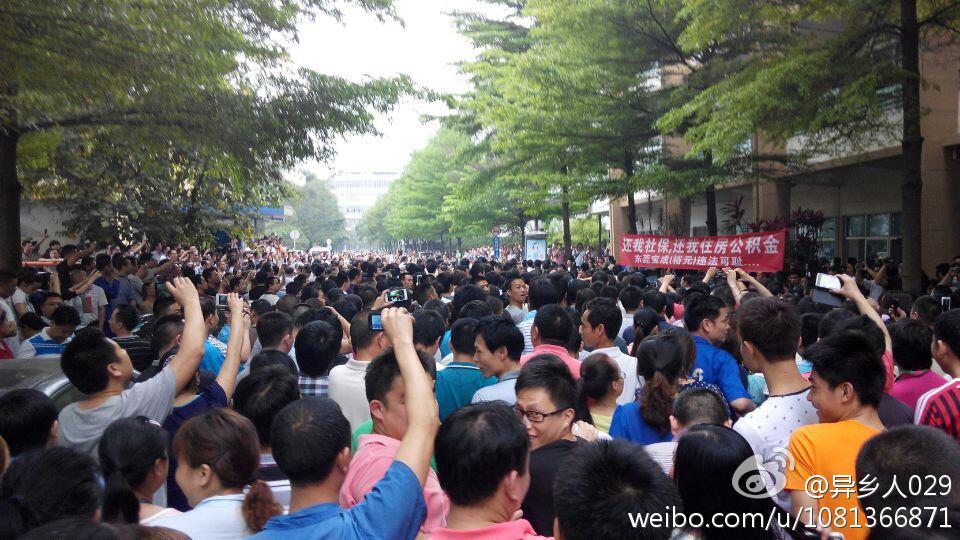
| Yue Yuen Shoe Strike (Nike Adidas) over unpaid pensions 2014 |
China’s slowdown proves that it not immune to these laws. It is not a panacea for global capitalism’s decline. China is now facing its own capitalist crisis of overproduction which it cannot resolve without attacking the 1 billion Chinese workers. And despite its past defeats those workers cannot survive without fighting for a genuine socialist revolution. That is why China, more than any other the country, is where capitalism’s past and future manifests itself as a fundamental clash between the proletariat and the capitalist ruling class.
We can dispense with those pseudo theories that explain China’s rise as something to do with ‘market socialism’. This is a futile attempt to both recognise the truth that the capitalist market exists in China, yet somehow claim it serves the goals of ‘socialism. The reality is that the restoration of the capitalist market could not coexist with ‘socialism’ in its bastardised bureaucratic form of state ownership of property in China. It had to destroy those aspects of Chinese society that owe anything to ‘socialism’. First, it had to defeat the working class as the class that grew up under bureaucratic ‘socialism’. Far from advancing under ‘market socialism’ the workers met with an historic defeat.
The restoration of capitalism was a huge defeat for the millions of workers. Hao Qi says:
“During the country’s transition to capitalism, as the bonus-centered incentive system could not sustain itself, enterprises needed the existence of a reserve army to discipline workers and a segregated labor market to divide and conquer the working class. A continuous influx of migrant workers and the 30 million laid-off workers from the state-owned sector jointly expanded the reserve army of labor within a few years in the 1990s. The reserve army significantly depressed the power of the working class as a whole, and the segregation of the labor market also weakened the solidarity of the working class. This is why we have witnessed the major decline of labor’s share since the early 1990s.”
However according to the same writer the Global Financial Crisis of 2008 reversed that decline:
“There is a new turning point for the Chinese working class. After the outbreak of the global capitalist crisis, labor’s share in China began to recover. Along with this fact, one can also observe that the nominal wage level has grown faster than nominal GDP since 2008, and in 2012 China’s working-age population decreased for the first time in the reform era, which implies that the reserve army of labor will shrink in the near future. More importantly, there is a developing workers’ struggle for a decent living wage that is sufficient to afford the cost of living in the urban areas. The new generation of migrant workers who were mostly born in the 1980s and ‘90s insists on living in the urban areas. This has led to struggles for higher wages. Workers’ struggle for a larger share of the national income will eventually end the high-profit era for capitalists and thus open up a new era for the Chinese economy.” ibid
In sum, this ‘optimistic’ view of the labor movement in China is that it has recovered from its early defeats of the 1990s and has emerged ‘empowered’ and capable of increasing the share of labor. It argues that rising numbers of strikes and successes in improving wages and conditions will lead to higher consumption and overcome China’s economic problems. How realistic is this view?
Critics have argued that the ‘empowerment’ thesis is ‘false optimism’ and not backed by the reality. Strikes have in fact declined since the massive labor militancy in the early days of capitalist restoration in the 1990s. They question the claim that the reserve army of migrant workers flooding to the cities is slowing significantly and reducing downward pressure on wages. The rural reserve army is still 300 million strong. More important is the crisis which forces capital to increase the rate of exploitation of wage labor. There is a trend towards precarization of work, with shorter hours, atomization of the workforce, worsening conditions, employer corruption of unions etc. Even the purported ‘victory’ of rising wages reflects central government policy of boosting consumption rather than union power.
Whatever the evidence that the record number of strikes is linked to growing class conscious labor movement can we draw the conclusion that Chinese workers are any better or worse prepared than in other capitalist countries to fight back against the effects of a major economic crash on their lives? That would be to ignore the historical differences between the West and the East.
Just as the recent rapid rise of China as a major imperialist power is unprecedented (the last major power to emerge as imperialist was the USA before the First World War!) relative to the rest of the capitalist world, so we have to look at the developing class struggle in China in the same light.
Class struggle in China is conditioned by its history as an pre-capitalist empire for millennia, a capitalist colony for over a century (from the Opium war of 1840), then by a national revolution that broke from global capitalism from 1949 to the 1990s, followed by the restoration of capitalism and the rise of a new Chinese imperialism. This unique history has important implications for our understanding of China and global capitalism today.
What makes China different?
To explain the impact of the past on China today and on the prospects for a socialist future, we have to explore what makes China’s road to capitalism different from the West. Since China today is clearly capitalist the class struggle between the working class, poor peasants and the capitalist ruling class is like that of all capitalist states. However, there are important differences in the development of capitalism in China.
The First Chinese Revolution in 1911 led by the new bourgeois class overthrew the Qing dynasty. But because Chinese development was retarded by imperialism, no powerful national bourgeoisie had emerged capable of leading the democratic revolution in China. It was an already historically redundant class caught between the massive peasantry and the rising industrial proletariat on the one side, and the occupying imperialist powers on the other side.
The weak national bourgeoisie feared the peasants and workers more than the imperialist exploiters and sided with the latter. This fear was well founded as it was the workers and poor peasants who defeated Japan and the Kuomintang army in 1949, proving once again after Russia in 1917 that ‘backward’ countries in the epoch of imperialism can only become independent of imperialism through socialist revolution.
This unique history is the big difference between China and the West. In the West capitalist development in the 19th and 20th centuries occurred over centuries on the basis of the plunder of the colonial world including the plunder of the ancient Chinese empire. Modern imperialism allowed these nations to accumulate huge wealth and bribe large sections of the working class with colonial super-profits to serve the interests of the bourgeoisie as politicians in the reformist parties and bureaucrats in the labor unions.
Trotsky pointed out that this accounted for the success of the revolution in Russia and its failure in Europe. The strength of reformism in Europe tied workers to the parliamentary system whereas in Russia, a backward capitalist country under a Tsarist dictatorship, bourgeois democracy was yet to be born. The socialist revolution overtook the bourgeois democratic revolution and incorporated its tasks as part of the ‘permanent revolution’.
However, for the Bolsheviks, a successful workers revolution in a backward country could not lead to socialism in one country. Russia’s isolation and economic backwardness created the conditions for the emergence of a bureaucracy under Stalin after 1924. The Stalinist bureaucracy reverted to a Menshevik “two-stage” theory that 'backward' (colonial or semi-colonial) countries had to follow the example of the Western countries and go through a bourgeois democratic stage to prepare the conditions for socialism. In the absence of a Russian bourgeoisie Stalin reverted to the old Bolshevik formula of the “democratic dictatorship of the workers and the peasants” in which the workers and all the peasantry would complete the bourgeois revolution in the absence of a revolutionary bourgeoisie.
According to his unreconstructed Menshevik cynicism that the proletarian revolution was premature in Russia, Stalin turned this theory into the “bloc of four classes” i.e. a national front of the proletariat, peasantry, petty bourgeois intelligentsia, and national bourgeoisie, to bring about the ‘bourgeois democratic’ revolution. This would allow the Soviet Union to form alliances with 'democratic' capitalist countries to buy the time necessary to build ‘socialism in one country’.
Against this Menshevik theory, the Bolshevik concept of Permanent Revolution was defended by the Left Opposition between 1923 and 1928 in an effort to win the leadership of the CCP to lead the poor peasants against the national bourgeoisies, including the rich peasants (kulaks), and the imperialist bourgeoisies. So the ‘permanent revolution’ must start off as a bourgeois democratic revolution against imperialism but immediately pass over to the socialist revolution against the bourgeoisie.
Theory/program of ‘permanent revolution’
Karl Marx originated this theory after the failure of the bourgeois revolutions in Europe in 1848. Henceforth the bourgeoisie was incapable of completing its own revolution to extend bourgeois rights to the masses (as we saw when Napoleon revoked the freedom of the slaves in Haiti) and that historic task was now that of the proletariat as part of the world socialist revolution.
Marx foresaw that the colonial world would not need to follow mechanically copy the stages of growth of capitalism in the West. Once the West extended is rule over the whole world (coming to its full force as imperialism in the late 19th century) the colonies could complete their national democratic struggle for independence only by means of socialist revolution.
In 1850 Marx talking about ‘backward’ China wrote:
“Chinese socialism may, of course, bear the same relation to European socialism as Chinese to Hegelian philosophy. But it is still amusing to note that the oldest and most unshakeable empire on earth has, within eight years, been brought to the brink of a social revolution by the cotton bales of the English bourgeoisie; in any event, such a revolution cannot help but have the most important consequences for the civilized world. When our European reactionaries, in the course of their imminent flight through Asia, finally arrive at the Great Wall of China, at the gates which lead to the home of primal reaction and primal conservatism, who knows if they will not find written thereon the legend: “République chinoise Liberté, Egalité, Fraternité” Review: January-February, 1850
Just as in Europe where the reactionary bourgeoisie was suppressing ‘Liberty, Equality, Fraternity’ for fear of the working class, in China the Taiping uprising in 1850 against the British invaders proved to Marx that that the working class had the potential lead the peasants to overthrow not only imperialism but also its own weak pro-imperialist bourgeoisie and complete the bourgeois revolution as the socialist revolution. Thus Marx anticipated the prospect of ‘socialist revolution’ (even if ‘bourgeois’ at the start) led by workers and peasants completing the bourgeois revolution as ‘permanent revolution’ in backward capitalist countries.
Such an eventuality was first proven correct in Soviet Russia. The Bolsheviks moved quickly to complete the bourgeois revolution avoiding the death trap of the bourgeois Provisional Government between February and October 1917. They took over the program of the party of poor peasants, the Social Revolutionaries, for ‘land to the tiller’, to win them to the revolution. They expropriated foreign capitalists, repudiated the foreign debt, and formed the Red Army to defeat the military invasions of the imperialists. Even when widespread starvation caused by the Civil War forced the Bolsheviks to allow the rich peasant Kulaks and capitalists to profit from agriculture and trade, these enterprises were under the control of the workers state.
However, just as in Russia where permanent revolution was aborted by global capitalism and the Stalinist bureaucracy after 1924, in ‘backward’ China the CCP, as part of the Comintern dominated by Stalin, also adopted the Menshevik program of the Bloc of Four Classes and the two-stage revolution. The first ‘democratic’ stage of the revolution required a bloc of workers, peasants, intellectuals and ‘progressive’ bourgeoisie. This bloc would require the CCP to subordinate itself to Chiang Kai Shek’s nationalist army and expose it to repression.
Trotsky and the Left Opposition from 1923 onwards opposed Stalin’s Menshevik theory as part of his betrayal of Bolshevism and his program for “socialism in one country” and fought against this policy in the CCP. They condemned Stalin’s treacherous role in the smashing of the Second Chinese revolution in 1927 when the bourgeois general Chiang Kai Chek unleashed his army to massacre the CCP leaders and the militant rank and file in Shanghai and Canton.
After the betrayal of the Second Chinese Revolution the CCP was led by Mensheviks like Mao who retreated from the cities to a peasant war of national liberation against Japan and the nationalist Kuomintang. Following its military victory in 1949 the CCP tried to negotiate with the ‘progressive’ bourgeoisie only to find it had fled into the imperialists’ camp. The CCP had to amend Stalin’s bloc of Four Classes to a bloc of Three Classes led not by the workers but by the petty bourgeois CCP leadership. The result was the formation of a bureaucratic centralised state apparatus run by the CCP to complete the ‘bourgeois democratic’ revolution but taking state power in the name of workers and peasants.
Capitalist property was expropriated and the market replaced by the plan administered by a bureaucratically deformed workers’ state. The CCP intelligentsia promoted itself as the state manager of ‘socialist’ property but in reality the workers and peasants had no say in how the state was run or the planning process itself. There was no workers democracy that could replace the bureaucracy and move China towards a genuine socialism. China as a bureaucratically deformed ‘workers’ state was stuck in limbo between its capitalist past and its socialist future. Its fate would be decided either by a political revolution in which workers overthrew the bureaucracy and took power directly to implement genuine socialism, or the defeat of the workers by the parasitic bureaucracy to restore capitalism under the ideology of “market socialism”.
Was the Chinese revolution ‘socialist’?
Was this the socialist revolution Marx spoke of? No, because the workers did not lead the poor peasants to the seizure of power. The struggle for national independence was led by a bureaucratic Stalinist party forced by the desertion of the bourgeoisie to base itself on the workers and poor peasants as a parasitic caste feeding off their labor.
After the revolution the bureaucracy had to industrialise to develop the forces of production to meets the needs of both the rural and industrial workforce as well as provide a surplus for the parasitic caste. The poor peasants who had formed the ranks of the national army were rapidly subordinated by the growth of industry and the rise of the urban working class.
The peasantry had no future as an independent class. The peasantry’s aspirations are limited to the horizon of petty capitalism or to private capitalist land ownership. The state blocked these aspirations by collectivising the land. So the fate of the peasantry was to become a rural labor force and a reserve army of labor to serve the needs of industry.
This change in rural society follows from the need to develop agricultural productivity to cheapen the wage goods of industrial workers and to create a surplus army of landless peasants who could migrate to the cities as a reserve of cheap labor. Thus wages in industry were driven down by migrant labor whose low wages were supplemented by subsistence goods in the countryside.
While this bureaucratically deformed workers state appears to bourgeois intellectuals as no more than a new ‘socialist’ elite administering the old centralised state of the ‘middle empire’, it was in reality now under the overall determining influence of the global capitalist economy. Rebuffed by the bourgeoisie, the bureaucracy had to forcibly collectivise the agricultural labor of the old peasant family farmers to meet the needs of the industrial working class and generate a surplus.
But the bureaucracy could not claim the surplus as private property without stoking a political revolution of peasants and workers challenging its rule. It was necessary to resort to corruption and abuse of the norms of ‘socialism’ to maintain its privileges.
The bureaucratic plan led to the Chinese economy stagnating and a declining surplus. Because this threatened the material basis of the bureaucracies privileges by 1978 the party embarked on the first market reforms to increase output. The CCP had increasing difficulty justifying its reforms in terms of ‘socialist’ norms of freedom and equality to the masses which had the power to resist them. It stretched the concept of ‘socialism’ inventing “market socialism” to sell the restoration of ‘capitalism’ to the masses.
However, increasing opposition to ‘market socialism’ as market reforms to restore capitalism threatened the rule of the bureaucracy. The defeat of the 1989 uprising of Tienanmen Square that arose as a protest against growing corruption and enrichment of the party leadership at the expense of freedom and equality, was an historic defeat for the working class and marked the tipping point in the restoration process. The CCP Congress in 1992 for the first time recognised that the economy was now based on the market (law of value) rather than state planning.
Thus the inherent class contradiction of Chinese ‘socialism’ (between the bureaucracy as agent of global capitalism, and the peasants and workers) was resolved with the historic defeat of workers by the bureaucracy determined to convert itself into a capitalist class. The concessions to workers under the bureaucratic state – labor protection in the nationalised SOEs, peasant property, labor rights etc - were removed or subordinated to demands of capitalist profit. All the old ‘socialist’ protections of workers and peasants rights became increasingly eliminated.
Unable to escape the global crisis of capitalism which is now enveloping China, the Chinese working class is facing millions of redundancies as inefficient firms are closed down. They have to fight for the most basic demands, for the ‘iron rice bowl’ for jobs and a living wage etc for their survival. These struggles are leading to more strikes and occupations which will pose the necessity of taking control of industry. At the same time the struggle of rural collectives in the villages exposed to corruption and exploitation for decades remains the basis for the survival of the 300 million rural reserve army of labor.
Industrial workers and rural workers can only resolve China’s capitalist crisis in their own class interests by seizing power, overthrowing the Chinese bourgeoisie and replacing the capitalist state with a Workers and Farmers' State able to implement a socialist plan. The only ‘new era’ in the age of global capitalist decline and terminal crisis in which workers can win a living income will be the new socialist era. So how do we get there? And what would it look like?
A Transitional Program for China
Immediate demands
1. Return to the Rice Bowl! Jobs for all and a living wage! Free, universal health, education and social welfare!
2. Defend the collective land rights of villages! For a state rural bank to fund cooperatives!
3. Build fighting, democratic unions! Form strike committees! For workers occupation of industry, and workers and farmers’ councils!
4. For a mass independent workers and working farmers political party to put up candidates against the CCP!
5. For a world party of socialist revolution based on the revolutionary program of the communist internationals including the 1938 Transitional Program!
Democratic demands
1. Reject all historic oppression today! Full equality to all without discrimination by race, ethnicity, gender, age, sexual orientation, disability etc!
2. China is not returning to its “middle kingdom”, it is a modern, capitalist empire! No to Chinese great power chauvinism!
3. Against Chinese imperialism! In any war with other imperialist powers we are for workers turning their guns on their own ruling class!
4. Reject colonial oppression! For the right of self-determination for oppressed peoples and nations!
5. No to false Stalinist and Maoist national/popular fronts with the national bourgeoisies against imperialism!
Socialist Demands
1. Reject capitalist restoration under the guise of ‘market socialism’. Down with the CCP and its new Red Capitalist class! Down with the billionaires!
2. For the political general strike and workers insurrection! For a popular army, workers’ and peasants’ militias!
3. For a Workers’ and Farmers' Government based on soviets everywhere! For the immediate expropriation of the private property of Chinese and foreign capitalists!
4. For a workers plan based on soviets to plan production for need! From each according to the ability, to each according to their need!
5. For a Federation of Socialist Republics of the Asia-Pacific!


 Posts
Posts

